 Français
 English

| ELK.No | ES7856 |
| Product name | PEA-15 rabbit pAb |
| Reactivity | Human;Mouse;Rat;Monkey |
| Applications | WB;IHC;IF;ELISA |
| Other name | PEA15; Astrocytic phosphoprotein PEA-15; 15 kDa phosphoprotein enriched in astrocytes; Phosphoprotein enriched in diabetes; PED |
| Size | 100μL |
| Unit price ($) | 248 |
| Human gene ID | 8682 |
| Human Swiss-Prot | Q15121 |
| Source | Rabbit |
| Isotype | IgG |
| Target | PEA-15 |
| Fields | |
| Gene name | PEA15 |
| Protein name | Astrocytic phosphoprotein PEA-15 |
| Human gene link | View Human Gene |
| Human Swiss link | View Human Swiss-Prot |
| Mouse gene ID | 18611 |
| Mouse gene link | View Mouse Gene |
| Mouse Swiss-Prot | Q62048 |
| Mouse Swiss link | View Mouse Swiss-Prot |
| Rat gene ID | 364052 |
| Rat gene link | View Rat Gene |
| Rat Swiss-Prot | Q5U318 |
| Rat Swiss link | View Rat Swiss-Prot |
| Immunogen | The antiserum was produced against synthesized peptide derived from human PEA-15. AA range:81-130 |
| Specificity | PEA-15 Polyclonal Antibody detects endogenous levels of PEA-15 protein. |
| Formulation | Liquid in PBS containing 50% glycerol, 0.5% BSA and 0.02% sodium azide. |
| Clonality | Polyclonal |
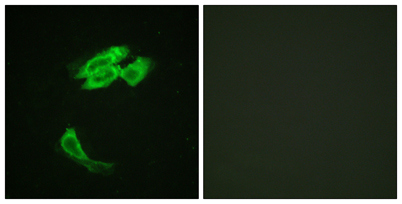
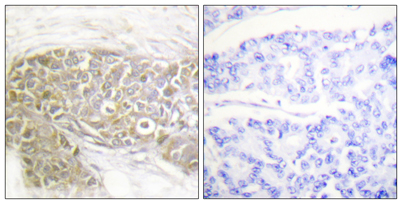
| Dilution | Western Blot: 1/500 - 1/2000. Immunohistochemistry: 1/100 - 1/300. Immunofluorescence: 1/200 - 1/1000. ELISA: 1/40000. Not yet tested in other applications. |
| Purification | The antibody was affinity-purified from rabbit antiserum by affinity-chromatography using epitope-specific immunogen. |
| Concentration | 1 mg/ml |
| Storage stability | -20°C/1 year |
| Molecular Weight (Da) | |
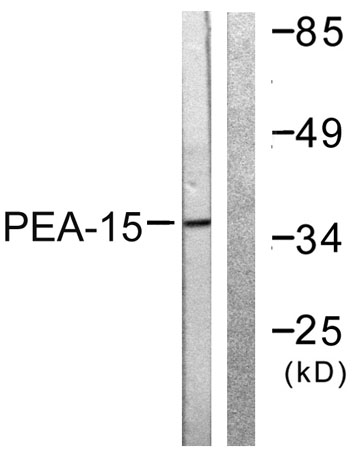
| Observed band (KD) | 36kD |
| Background | phosphoprotein enriched in astrocytes 15(PEA15) Homo sapiens This gene encodes a death effector domain-containing protein that functions as a negative regulator of apoptosis. The encoded protein is an endogenous substrate for protein kinase C. This protein is also overexpressed in type 2 diabetes mellitus, where it may contribute to insulin resistance in glucose uptake. Alternative splicing results in multiple transcript variants. [provided by RefSeq, Jul 2014], |
| Function | function:Blocks Ras-mediated inhibition of integrin activation and modulates the ERK MAP kinase cascade. Inhibits RPS6KA3 activities by retaining it in the cytoplasm (By similarity). Inhibits both TNFRSF6- and TNFRSF1A-mediated CASP8 activity and apoptosis. Regulates glucose transport by controlling both the content of SLC2A1 glucose transporters on the plasma membrane and the insulin-dependent trafficking of SLC2A4 from the cell interior to the surface.,PTM:Phosphorylated by protein kinase C and calcium-calmodulin-dependent protein kinase. These phosphorylation events are modulated by neurotransmitters or hormones.,similarity:Contains 1 DED (death effector) domain.,subcellular location:Associated with microtubules.,subunit:Binds RPS6KA3, MAPK3 and MAPK1. Transient interaction with PLD1 and PLD2 (By similarity). Interacts with CASP8 and FADD.,tissue specificity:Ubiquitously expressed. Mo |
| Subcellular location | Cytoplasm. Associated with microtubules. |
| Expression | Ubiquitously expressed. Most abundant in tissues such as heart, brain, muscle and adipose tissue which utilize glucose as an energy source. Lower expression in glucose-producing tissues. Higher levels of expression are found in tissues from individuals with type 2 diabetes than in controls. |

Use collapsible tabs for more detailed information that will help customers make a purchasing decision.
Ex: Shipping and return policies, size guides, and other common questions.