 Français
 English
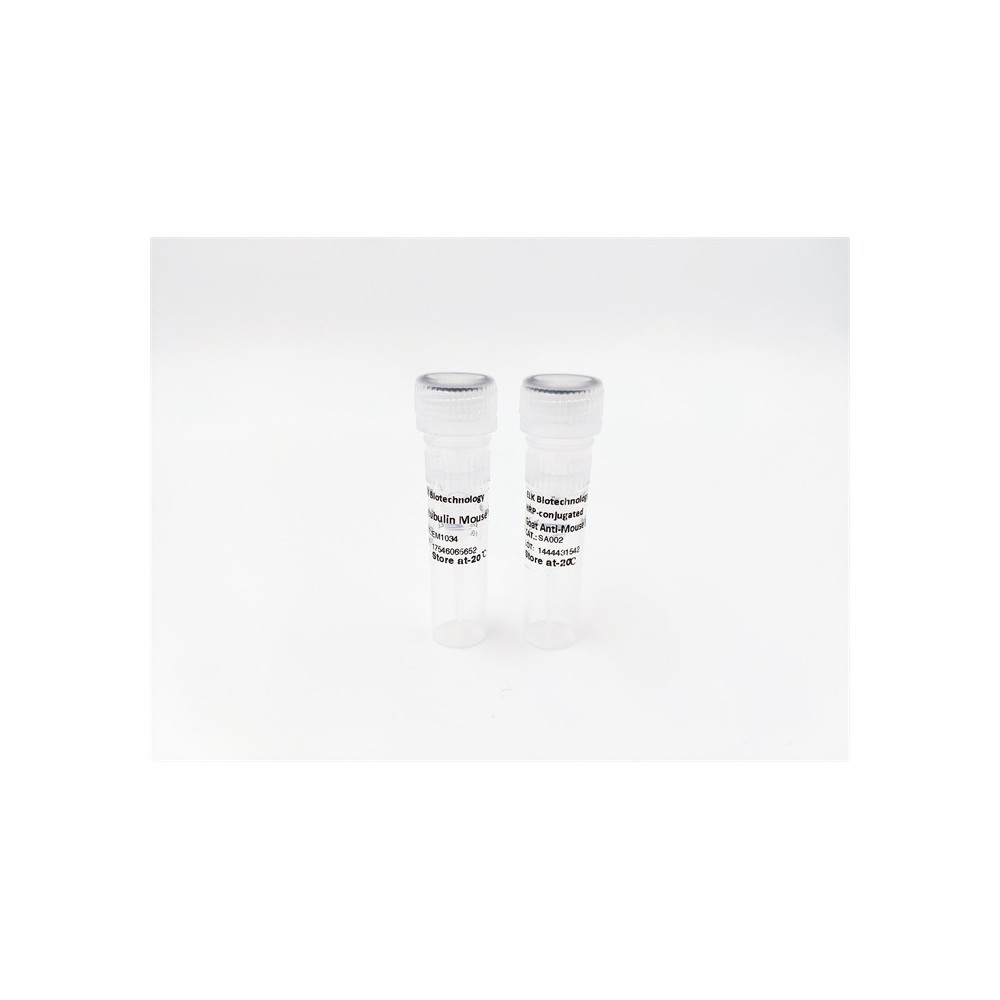

| ELK.No | ES7890 |
| Product name | TSC-22 rabbit pAb |
| Reactivity | Human;Mouse;Rat |
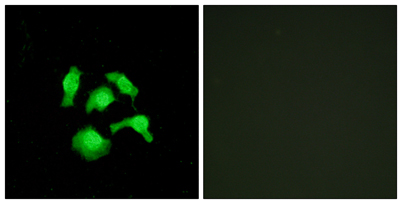
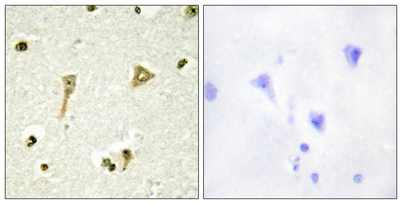
| Applications | WB;IHC;IF;ELISA |
| Other name | TSC22D1; KIAA1994; TGFB1I4; TSC22; hucep-2; TSC22 domain family protein 1; Cerebral protein 2; Regulatory protein TSC-22; TGFB-stimulated clone 22 homolog; Transforming growth factor beta-1-induced transcript 4 protein |
| Size | 50μL |
| Unit price ($) | 148 |
| Human gene ID | 8848 |
| Human Swiss-Prot | Q15714 |
| Source | Rabbit |
| Isotype | IgG |
| Target | TSC-22 |
| Fields | |
| Gene name | TSC22D1 |
| Protein name | TSC22 domain family protein 1 |
| Human gene link | View Human Gene |
| Human Swiss link | View Human Swiss-Prot |
| Mouse gene ID | 21807 |
| Mouse gene link | View Mouse Gene |
| Mouse Swiss-Prot | P62500 |
| Mouse Swiss link | View Mouse Swiss-Prot |
| Rat gene ID | 498545 |
| Rat gene link | View Rat Gene |
| Rat Swiss-Prot | P62501 |
| Rat Swiss link | View Rat Swiss-Prot |
| Immunogen | The antiserum was produced against synthesized peptide derived from human TSC22D1. AA range:71-120 |
| Specificity | TSC-22 Polyclonal Antibody detects endogenous levels of TSC-22 protein. |
| Formulation | Liquid in PBS containing 50% glycerol, 0.5% BSA and 0.02% sodium azide. |
| Clonality | Polyclonal |
| Dilution | Western Blot: 1/500 - 1/2000. Immunohistochemistry: 1/100 - 1/300. Immunofluorescence: 1/200 - 1/1000. ELISA: 1/20000. Not yet tested in other applications. |
| Purification | The antibody was affinity-purified from rabbit antiserum by affinity-chromatography using epitope-specific immunogen. |
| Concentration | 1 mg/ml |
| Storage stability | -20°C/1 year |
| Molecular Weight (Da) | |
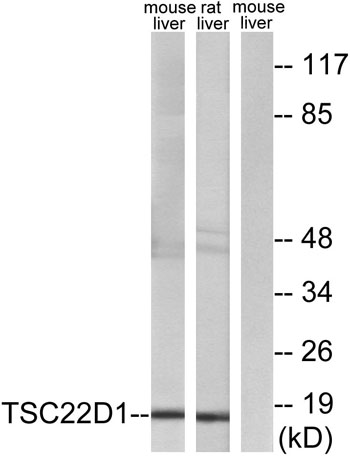
| Observed band (KD) | 16kD |
| Background | This gene encodes a member of the TSC22 domain family of leucine zipper transcription factors. The encoded protein is stimulated by transforming growth factor beta, and regulates the transcription of multiple genes including C-type natriuretic peptide. The encoded protein may play a critical role in tumor suppression through the induction of cancer cell apoptosis, and a single nucleotide polymorphism in the promoter of this gene has been associated with diabetic nephropathy. Alternatively spliced transcript variants encoding multiple isoforms have been observed for this gene. [provided by RefSeq, Aug 2011], |
| Function | function:Transcriptional repressor. Acts on the C-type natriuretic peptide (CNP) promoter.,induction:In aortic endothelial cells, induced by cytokines, including TGFB.,similarity:Belongs to the TSC-22/Dip/Bun family.,subunit:Homodimer or heterodimer. Can form an heterodimer with TSC22D4.,tissue specificity:Widely expressed in fetal and adult tissues., |
| Subcellular location | Cytoplasm . Nucleus . |
| Expression | Widely expressed in fetal and adult tissues. |

Use collapsible tabs for more detailed information that will help customers make a purchasing decision.
Ex: Shipping and return policies, size guides, and other common questions.