 Français
 English

| ELK.No | ES7928 |
| Product name | Duo rabbit pAb |
| Reactivity | Human;Mouse;Rat |
| Applications | WB;ELISA |
| Other name | KALRN; DUET; DUO; HAPIP; TRAD; Kalirin; Huntingtin-associated protein-interacting protein; Protein Duo; Serine/threonine-protein kinase with Dbl- and pleckstrin homology domain |
| Size | 50μL |
| Unit price ($) | 148 |
| Human gene ID | 8997 |
| Human Swiss-Prot | O60229 |
| Source | Rabbit |
| Isotype | IgG |
| Target | Duo |
| Fields | |
| Gene name | KALRN |
| Protein name | Kalirin |
| Human gene link | View Human Gene |
| Human Swiss link | View Human Swiss-Prot |
| Mouse gene ID | 545156 |
| Mouse gene link | View Mouse Gene |
| Mouse Swiss-Prot | A2CG49 |
| Mouse Swiss link | View Mouse Swiss-Prot |
| Rat gene ID | 84009 |
| Rat gene link | View Rat Gene |
| Rat Swiss-Prot | P97924 |
| Rat Swiss link | View Rat Swiss-Prot |
| Immunogen | Synthesized peptide derived from Duo . at AA range: 810-890 |
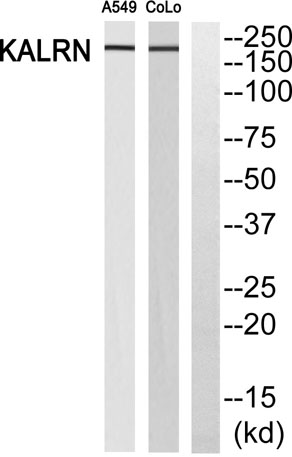
| Specificity | Duo Polyclonal Antibody detects endogenous levels of Duo protein. |
| Formulation | Liquid in PBS containing 50% glycerol, 0.5% BSA and 0.02% sodium azide. |
| Clonality | Polyclonal |
| Dilution | Western Blot: 1/500 - 1/2000. ELISA: 1/20000. Not yet tested in other applications. |
| Purification | The antibody was affinity-purified from rabbit antiserum by affinity-chromatography using epitope-specific immunogen. |
| Concentration | 1 mg/ml |
| Storage stability | -20°C/1 year |
| Molecular Weight (Da) | 340kD |
| Observed band (KD) | |
| Background | Huntington's disease (HD), a neurodegenerative disorder characterized by loss of striatal neurons, is caused by an expansion of a polyglutamine tract in the HD protein huntingtin. This gene encodes a protein that interacts with the huntingtin-associated protein 1, which is a huntingtin binding protein that may function in vesicle trafficking. [provided by RefSeq, Apr 2016], |
| Function | catalytic activity:ATP + a protein = ADP + a phosphoprotein.,cofactor:Magnesium.,disease:Genetic variation in KALRN is associated with susceptibility to coronary heart disease type 5 (CHDS5) [MIM:608901]. CHD is the leading cause of death and disability worldwide. CHD is multifactorial disease with a strong genetic component. Classic epidemiologic studies have revealed many risk factors for CHD, including age, sex, hypertension, dyslipidemia, diabetes mellitus, smoking, and physical inactivity.,domain:The two GEF domains catalyze nucleotide exchange for RAC1 and RhoA which are bound by DH1 and DH2 respectively. The two GEF domains appear to play differing roles in neuronal development and axonal outgrowth. SH3 1 binds to the first GEF domain inhibiting GEF activity only when in the presence of a PXXP peptide, suggesting that the SH3 domain/peptide interaction mediates binding to GEF1. CR |
| Subcellular location | Cytoplasm . Cytoplasm, cytoskeleton . Associated with the cytoskeleton. |
| Expression | Isoform 2 is brain specific. Highly expressed in cerebral cortex, putamen, amygdala, hippocampus and caudate nucleus. Weakly expressed in brain stem and cerebellum. Isoform 4 is expressed in skeletal muscle. |

Use collapsible tabs for more detailed information that will help customers make a purchasing decision.
Ex: Shipping and return policies, size guides, and other common questions.