 Français
 English

| ELK.No | ES7959 |
| Product name | CD32-C rabbit pAb |
| Reactivity | Human;Rat;Mouse; |
| Applications | WB;ELISA |
| Other name | FCGR2C; CD32; FCG2; IGFR2; Low affinity immunoglobulin gamma Fc region receptor II-c; IgG Fc receptor II-c; CDw32; Fc-gamma RII-c; Fc-gamma-RIIc; FcRII-c; CD antigen CD32 |
| Size | 50μL |
| Unit price ($) | 148 |
| Human gene ID | 9103 |
| Human Swiss-Prot | P31995 |
| Source | Rabbit |
| Isotype | IgG |
| Target | CD32 |
| Fields | >>Phagosome;>>Osteoclast differentiation;>>Leishmaniasis;>>Staphylococcus aureus infection;>>Tuberculosis |
| Gene name | FCGR2C |
| Protein name | Low affinity immunoglobulin gamma Fc region receptor II-c |
| Human gene link | View Human Gene |
| Human Swiss link | View Human Swiss-Prot |
| Mouse gene ID | |
| Mouse gene link | |
| Mouse Swiss-Prot | |
| Mouse Swiss link | |
| Rat gene ID | |
| Rat gene link | |
| Rat Swiss-Prot | |
| Rat Swiss link | |
| Immunogen | The antiserum was produced against synthesized peptide derived from human FCGR2C. AA range:251-300 |
| Specificity | CD32-C Polyclonal Antibody detects endogenous levels of CD32-C protein. |
| Formulation | Liquid in PBS containing 50% glycerol, 0.5% BSA and 0.02% sodium azide. |
| Clonality | Polyclonal |
| Dilution | Western Blot: 1/500 - 1/2000. ELISA: 1/40000. Not yet tested in other applications. |
| Purification | The antibody was affinity-purified from rabbit antiserum by affinity-chromatography using epitope-specific immunogen. |
| Concentration | 1 mg/ml |
| Storage stability | -20°C/1 year |
| Molecular Weight (Da) | |
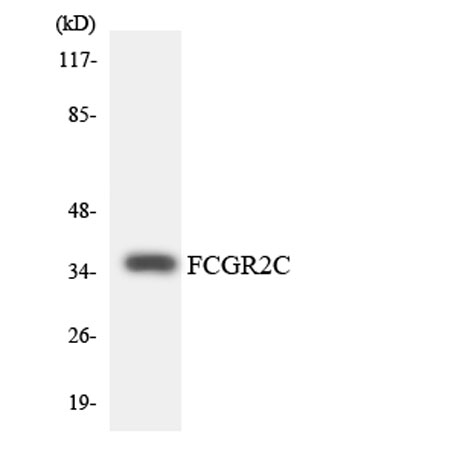
| Observed band (KD) | 35kD |
| Background | caution:Has sometimes been attributed to correspond to FcR-IIB.,caution:Has sometimes been attributed to correspond to FcR-IIC.,disease:A chromosomal aberration involving FCGR2B is found in a follicular lymphoma. Translocation t(1;22)(q22;q11). The translocation leads to the hyperexpression of the receptor. This may play a role in the tumor progression.,domain:Contains 1 copy of a cytoplasmic motif that is referred to as the immunoreceptor tyrosine-based inhibitor motif (ITIM). This motif is involved in modulation of cellular responses. The phosphorylated ITIM motif can bind the SH2 domain of several SH2-containing phosphatases.,domain:Contains an intracytoplasmic twice repeated motif referred as immunoreceptor tyrosine-based activator motif (ITAM). These motifs are involved in triggering cell activation upon receptors aggregation.,function:Receptor for the Fc region of complexed immunoglobulins gamma. Low affinity receptor. Involved in a variety of effector and regulatory functions such as phagocytosis of immune complexes and modulation of antibody production by B-cells.,function:Receptor for the Fc region of complexed or aggregated immunoglobulins gamma. Low affinity receptor. Involved in a variety of effector and regulatory functions such as phagocytosis of immune complexes and modulation of antibody production by B-cells. Binding to this receptor results in down-modulation of previous state of cell activation triggered via antigen receptors on B-cells (BCR), T-cells (TCR) or via another Fc receptor. Isoform IIB1 fails to mediate endocytosis or phagocytosis. Isoform IIB2 does not trigger phagocytosis.,similarity:Contains 2 Ig-like C2-type (immunoglobulin-like) domains.,subunit:Isoform IIB1 interacts with measles virus N protein. N protein is released in the blood following lysis of measles infected cells. This interaction presumably block inflammatory immune response. Interacts with INPP5D/SHIP1.,tissue specificity:Is the most broadly distributed Fc-gamma-receptor. Expressed in monocyte, neutrophils, macrophages, basophils, eosinophils, Langerhans cells, B-cells, platelets cells and placenta (endothelial cells). Not detected in natural killer cells.,tissue specificity:Isoform IIC1 is detected in monocytes, macrophages, polymorphonuclear cells and natural killer cells., |
| Function | caution:Has sometimes been attributed to correspond to FcR-IIB.,caution:Has sometimes been attributed to correspond to FcR-IIC.,disease:A chromosomal aberration involving FCGR2B is found in a follicular lymphoma. Translocation t(1;22)(q22;q11). The translocation leads to the hyperexpression of the receptor. This may play a role in the tumor progression.,domain:Contains 1 copy of a cytoplasmic motif that is referred to as the immunoreceptor tyrosine-based inhibitor motif (ITIM). This motif is involved in modulation of cellular responses. The phosphorylated ITIM motif can bind the SH2 domain of several SH2-containing phosphatases.,domain:Contains an intracytoplasmic twice repeated motif referred as immunoreceptor tyrosine-based activator motif (ITAM). These motifs are involved in triggering cell activation upon receptors aggregation.,function:Receptor for the Fc region of complexed immunog |
| Subcellular location | [Isoform IIC4]: Cytoplasm .; [Isoform IIC3]: Cell membrane; Single-pass type I membrane protein.; [Isoform IIC2]: Cell membrane; Single-pass type I membrane protein.; [Isoform IIC1]: Cell membrane; Single-pass type I membrane protein. |
| Expression | Isoform IIC1 is detected in monocytes, macrophages, polymorphonuclear cells and natural killer cells. |

Use collapsible tabs for more detailed information that will help customers make a purchasing decision.
Ex: Shipping and return policies, size guides, and other common questions.