 Français
 English

| ELK.No | ES7982 |
| Product name | NCKX1 rabbit pAb |
| Reactivity | Human;Rat;Mouse; |
| Applications | WB;ELISA |
| Other name | SLC24A1; KIAA0702; NCKX1; Sodium/potassium/calcium exchanger 1; Na(+)/K(+)/Ca(2+)-exchange protein 1; Retinal rod Na-Ca+K exchanger |
| Size | 100μL |
| Unit price ($) | 248 |
| Human gene ID | 9187 |
| Human Swiss-Prot | O60721 |
| Source | Rabbit |
| Isotype | IgG |
| Target | NCKX1 |
| Fields | >>Phototransduction |
| Gene name | SLC24A1 |
| Protein name | Sodium/potassium/calcium exchanger 1 |
| Human gene link | View Human Gene |
| Human Swiss link | View Human Swiss-Prot |
| Mouse gene ID | |
| Mouse gene link | |
| Mouse Swiss-Prot | |
| Mouse Swiss link | |
| Rat gene ID | |
| Rat gene link | |
| Rat Swiss-Prot | |
| Rat Swiss link | |
| Immunogen | The antiserum was produced against synthesized peptide derived from human SLC24A1. AA range:154-203 |
| Specificity | NCKX1 Polyclonal Antibody detects endogenous levels of NCKX1 protein. |
| Formulation | Liquid in PBS containing 50% glycerol, 0.5% BSA and 0.02% sodium azide. |
| Clonality | Polyclonal |
| Dilution | Western Blot: 1/500 - 1/2000. ELISA: 1/10000. Not yet tested in other applications. |
| Purification | The antibody was affinity-purified from rabbit antiserum by affinity-chromatography using epitope-specific immunogen. |
| Concentration | 1 mg/ml |
| Storage stability | -20°C/1 year |
| Molecular Weight (Da) | |
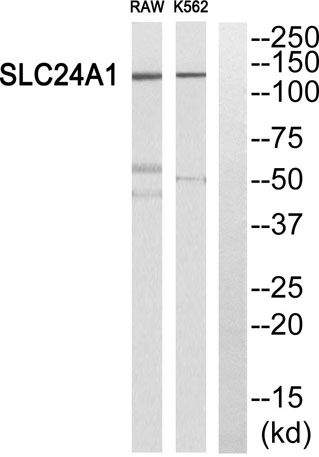
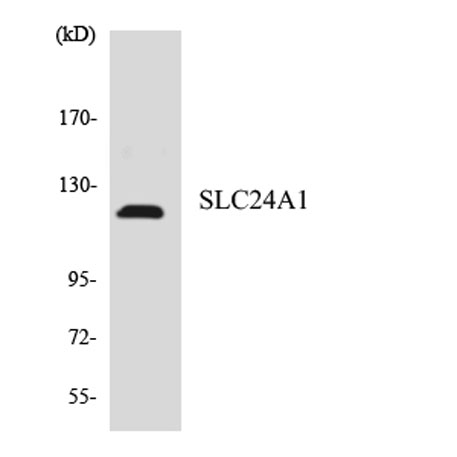
| Observed band (KD) | 125kD |
| Background | This gene encodes a member of the potassium-dependent sodium/calcium exchanger protein family. The encoded protein plays an important role in sodium/calcium exchange in retinal rod and cone photoreceptors by mediating the extrusion of one calcium ion and one potassium ion in exchange for four sodium ions. Mutations in this gene may play a role in congenital stationary night blindness. Alternatively spliced transcript variants encoding multiple isoforms have been observed for this gene. [provided by RefSeq, Dec 2011], |
| Function | function:Critical component of the visual transduction cascade, controlling the calcium concentration of outer segments during light and darkness. Light causes a rapid lowering of cytosolic free calcium in the outer segment of both retinal rod and cone photoreceptors and the light-induced lowering of calcium is caused by extrusion via this protein which plays a key role in the process of light adaptation. Transports 1 Ca(2+) and 1 K(+) in exchange for 4 Na(+).,PTM:The uncleaved signal sequence is required for efficient membrane targeting and proper membrane integration.,similarity:Belongs to the sodium/potassium/calcium exchanger family. SLC24A subfamily.,tissue specificity:Found only in the outer segments of retinal rod photoreceptors., |
| Subcellular location | Cell membrane ; Multi-pass membrane protein . |
| Expression | Expressed in the retina, particularly in the inner segment, outer and inner nuclear layers, and ganglion cell layer. |

Use collapsible tabs for more detailed information that will help customers make a purchasing decision.
Ex: Shipping and return policies, size guides, and other common questions.