 Français
 English
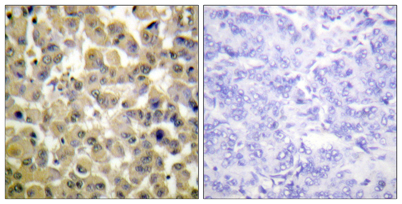
MSK1 (phospho Ser360) rabbit pAb
AO-06-ES8000-100

| ELK.No | ES8000 |
| Product name | MSK1 (phospho Ser360) rabbit pAb |
| Reactivity | Human;Mouse |
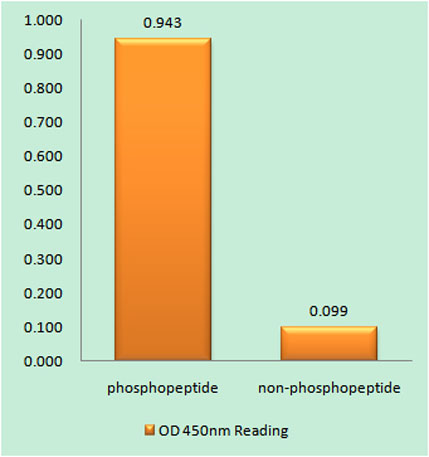
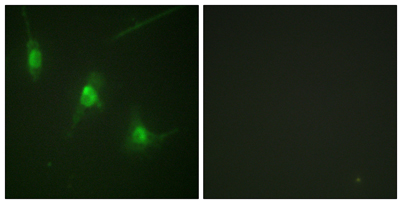
| Applications | IHC;IF;ELISA |
| Other name | RPS6KA5; MSK1; Ribosomal protein S6 kinase alpha-5; S6K-alpha-5; 90 kDa ribosomal protein S6 kinase 5; Nuclear mitogen- and stress-activated protein kinase 1; RSK-like protein kinase; RSKL |
| Size | 100μL |
| Unit price ($) | 248 |
| Human gene ID | 9252 |
| Human Swiss-Prot | O75582 |
| Source | Rabbit |
| Isotype | IgG |
| Target | MSK1 |
| Fields | >>MAPK signaling pathway;>>Adrenergic signaling in cardiomyocytes;>>TNF signaling pathway;>>Circadian entrainment;>>Neurotrophin signaling pathway;>>Shigellosis;>>Pathways in cancer;>>MicroRNAs in cancer;>>Bladder cancer |
| Gene name | RPS6KA5 |
| Protein name | Ribosomal protein S6 kinase alpha-5 |
| Human gene link | View Human Gene |
| Human Swiss link | View Human Swiss-Prot |
| Mouse gene ID | 73086 |
| Mouse gene link | View Mouse Gene |
| Mouse Swiss-Prot | Q8C050 |
| Mouse Swiss link | View Mouse Swiss-Prot |
| Rat gene ID | |
| Rat gene link | |
| Rat Swiss-Prot | |
| Rat Swiss link | |
| Immunogen | The antiserum was produced against synthesized peptide derived from human MSK1 around the phosphorylation site of Ser360. AA range:331-380 |
| Specificity | Phospho-MSK1 (S360) Polyclonal Antibody detects endogenous levels of MSK1 protein only when phosphorylated at S360. |
| Formulation | Liquid in PBS containing 50% glycerol, 0.5% BSA and 0.02% sodium azide. |
| Clonality | Polyclonal |
| Dilution | Immunohistochemistry: 1/100 - 1/300. Immunofluorescence: 1/200 - 1/1000. ELISA: 1/10000. Not yet tested in other applications. |
| Purification | The antibody was affinity-purified from rabbit antiserum by affinity-chromatography using epitope-specific immunogen. |
| Concentration | 1 mg/ml |
| Storage stability | -20°C/1 year |
| Molecular Weight (Da) | 90kD |
| Observed band (KD) | |
| Background | catalytic activity:ATP + a protein = ADP + a phosphoprotein.,cofactor:Magnesium.,enzyme regulation:Appears to be activated by multiple phosphorylations on threonine and serine residues. ERK1/2 and MAPK14/p38-alpha may play a role in this process.,function:Serine/threonine kinase required for the mitogen or stress-induced phosphorylation of the transcription factors CREB (cAMP response element-binding protein) and ATF1 (activating transcription factor-1). Essential role in the control of RELA transcriptional activity in response to TNF. Directly represses transcription via phosphorylation of 'Ser-1' of histone H2A. Phosphorylates 'Ser-10' of histone H3 in response to mitogenics, stress stimuli and epidemal growth-factor (EGF), which results in the transcriptional activation of several immediate early genes, including proto-oncogenes c-fos/FOS and c-jun/JUN. May also phosphorylate 'Ser-28' of histone H3. Mediates the mitogen- and stress-induced phosphorylation of high mobility group protein 14 (HMG-14).,miscellaneous:Enzyme activity requires the presence of both kinase domains.,PTM:Ser-376 and Thr-581 phosphorylation is required for kinase activity. Ser-376 and Ser-212 are autophosphorylated by the C-terminal kinase domain, and their phosphorylation is essential for the catalytic activity of the N-terminal kinase domain.,similarity:Belongs to the protein kinase superfamily. AGC Ser/Thr protein kinase family. S6 kinase subfamily.,similarity:Contains 1 AGC-kinase C-terminal domain.,similarity:Contains 2 protein kinase domains.,subcellular location:Predominantly nuclear. Partially cytoplasmic.,subunit:Forms a complex with either ERK1 or ERK2 in quiescent cells which transiently dissociates following mitogenic stimulation. Also associates with MAPK14/p38-alpha. Activated RPS6KA5 associates with and phosphorylates the NF-kappa-B p65 subunit RELA.,tissue specificity:Widely expressed with high levels in heart, brain and placenta. Less abundant in lung, kidney and liver., |
| Function | catalytic activity:ATP + a protein = ADP + a phosphoprotein.,cofactor:Magnesium.,enzyme regulation:Appears to be activated by multiple phosphorylations on threonine and serine residues. ERK1/2 and MAPK14/p38-alpha may play a role in this process.,function:Serine/threonine kinase required for the mitogen or stress-induced phosphorylation of the transcription factors CREB (cAMP response element-binding protein) and ATF1 (activating transcription factor-1). Essential role in the control of RELA transcriptional activity in response to TNF. Directly represses transcription via phosphorylation of 'Ser-1' of histone H2A. Phosphorylates 'Ser-10' of histone H3 in response to mitogenics, stress stimuli and epidemal growth-factor (EGF), which results in the transcriptional activation of several immediate early genes, including proto-oncogenes c-fos/FOS and c-jun/JUN. May also phosphorylate 'Ser-28' |
| Subcellular location | Nucleus. Cytoplasm. Predominantly nuclear. Exported into cytoplasm in response to glucocorticoid. |
| Expression | Widely expressed with high levels in heart, brain and placenta. Less abundant in lung, kidney and liver. |

Use collapsible tabs for more detailed information that will help customers make a purchasing decision.
Ex: Shipping and return policies, size guides, and other common questions.
