 Français
 English
Cdc25A (phospho Ser124) rabbit pAb
AO-06-ES8128-50

| ELK.No | ES8128 |
| Product name | Cdc25A (phospho Ser124) rabbit pAb |
| Reactivity | Human;Mouse;Rat |
| Applications | WB;ELISA |
| Other name | CDC25A; M-phase inducer phosphatase 1; Dual specificity phosphatase Cdc25A |
| Size | 50μL |
| Unit price ($) | 148 |
| Human gene ID | 993 |
| Human Swiss-Prot | P30304 |
| Source | Rabbit |
| Isotype | IgG |
| Target | Cdc25A |
| Fields | >>Cell cycle;>>Cellular senescence;>>Progesterone-mediated oocyte maturation;>>MicroRNAs in cancer;>>Chemical carcinogenesis - receptor activation |
| Gene name | CDC25A |
| Protein name | M-phase inducer phosphatase 1 |
| Human gene link | View Human Gene |
| Human Swiss link | View Human Swiss-Prot |
| Mouse gene ID | |
| Mouse gene link | |
| Mouse Swiss-Prot | P48964 |
| Mouse Swiss link | View Mouse Swiss-Prot |
| Rat gene ID | 171102 |
| Rat gene link | View Rat Gene |
| Rat Swiss-Prot | P48965 |
| Rat Swiss link | View Rat Swiss-Prot |
| Immunogen | The antiserum was produced against synthesized peptide derived from human CDC25A around the phosphorylation site of Ser124. AA range:90-139 |
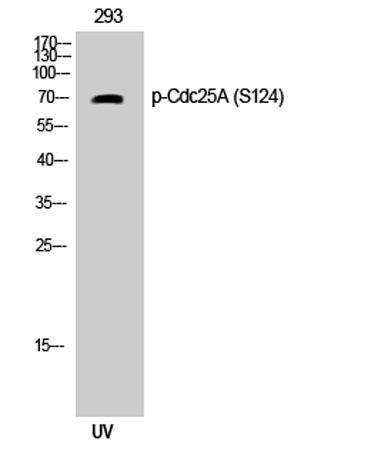
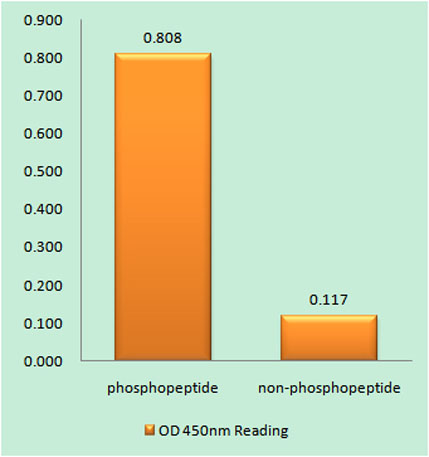
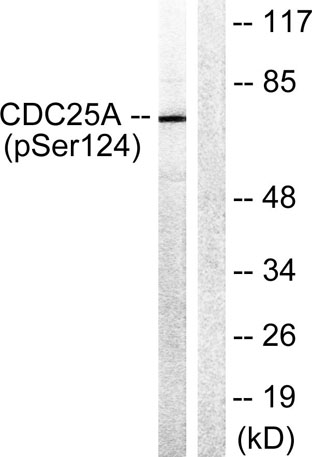
| Specificity | Phospho-Cdc25A (S124) Polyclonal Antibody detects endogenous levels of Cdc25A protein only when phosphorylated at S124. |
| Formulation | Liquid in PBS containing 50% glycerol, 0.5% BSA and 0.02% sodium azide. |
| Clonality | Polyclonal |
| Dilution | Western Blot: 1/500 - 1/2000. ELISA: 1/5000. Not yet tested in other applications. |
| Purification | The antibody was affinity-purified from rabbit antiserum by affinity-chromatography using epitope-specific immunogen. |
| Concentration | 1 mg/ml |
| Storage stability | -20°C/1 year |
| Molecular Weight (Da) | |
| Observed band (KD) | 70kD |
| Background | cell division cycle 25A(CDC25A) Homo sapiens CDC25A is a member of the CDC25 family of phosphatases. CDC25A is required for progression from G1 to the S phase of the cell cycle. It activates the cyclin-dependent kinase CDC2 by removing two phosphate groups. CDC25A is specifically degraded in response to DNA damage, which prevents cells with chromosomal abnormalities from progressing through cell division. CDC25A is an oncogene, although its exact role in oncogenesis has not been demonstrated. Two transcript variants encoding different isoforms have been found for this gene. [provided by RefSeq, Jul 2008], |
| Function | catalytic activity:Protein tyrosine phosphate + H(2)O = protein tyrosine + phosphate.,domain:The phosphodegron motif mediates interaction with specific F-box proteins when phosphorylated. Putative phosphorylation sites at Ser-79 and Ser-82 appear to be essential for this interaction.,enzyme regulation:Stimulated by B-type cyclins.,function:Tyrosine protein phosphatase which functions as a dosage-dependent inducer of mitotic progression. Directly dephosphorylates CDC2 and stimulates its kinase activity. Also dephosphorylates CDK2 in complex with cyclin E, in vitro.,PTM:Phosphorylated by CHEK1 on Ser-76, Ser-124, Ser-178, Ser-279, Ser-293 and Thr-507 during checkpoint mediated cell cycle arrest. Also phosphorylated by CHEK2 on Ser-124, Ser-279, and Ser-293 during checkpoint mediated cell cycle arrest. Phosphorylation on Ser-178 and Thr-507 creates binding sites for YWHAE/14-3-3 epsilon whi |
| Subcellular location | intracellular,nucleus,nucleoplasm,cytoplasm,cytosol, |
| Expression | Lymph, |

Use collapsible tabs for more detailed information that will help customers make a purchasing decision.
Ex: Shipping and return policies, size guides, and other common questions.