 Français
 English
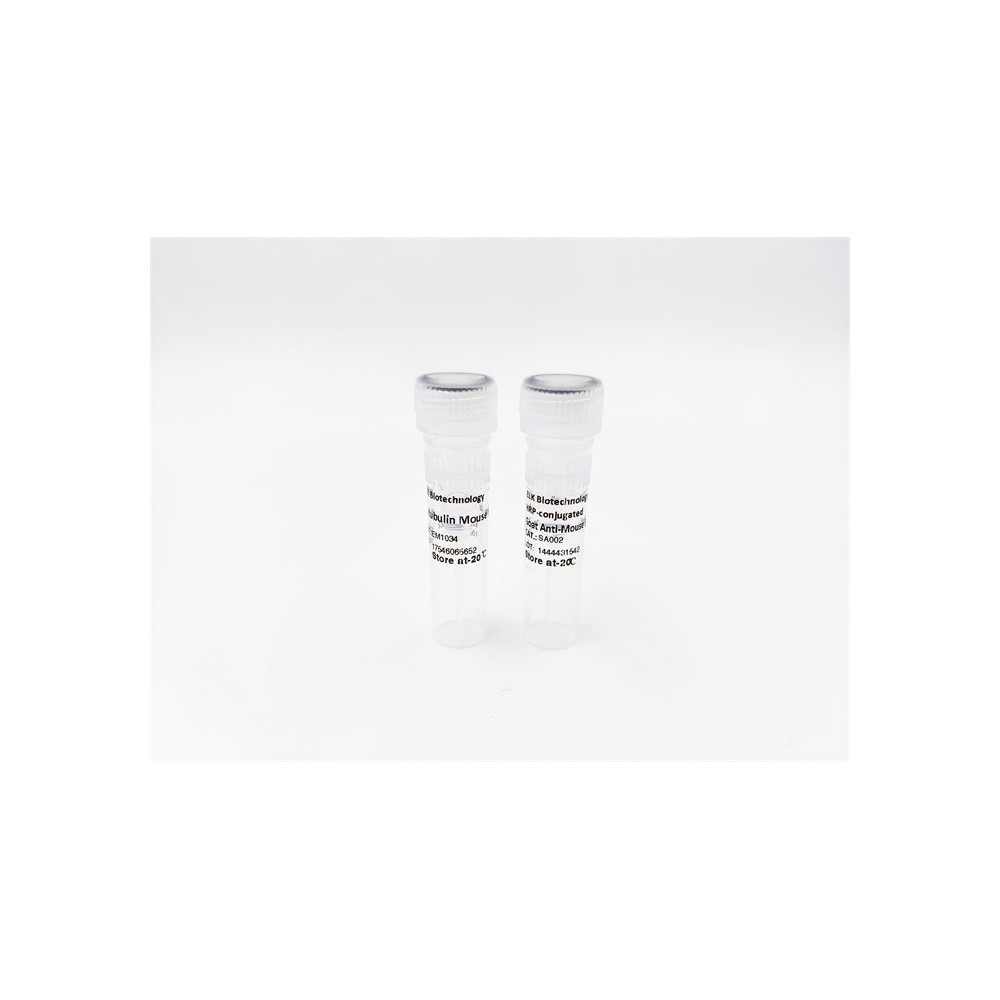

| ELK.No | ES8355 |
| Product name | ADAMTS-2 rabbit pAb |
| Reactivity | Human;Rat;Mouse; |
| Applications | WB;ELISA |
| Other name | ADAMTS2; PCINP; PCPNI; A disintegrin and metalloproteinase with thrombospondin motifs 2; ADAM-TS 2; ADAM-TS2; ADAMTS-2; Procollagen I N-proteinase; PC I-NP; Procollagen I/II amino propeptide-processing enzyme; Procollagen N-endopeptidase; pNPI |
| Size | 50μL |
| Unit price ($) | 148 |
| Human gene ID | 9509 |
| Human Swiss-Prot | O95450 |
| Source | Rabbit |
| Isotype | IgG |
| Target | ADAMTS-2 |
| Fields | |
| Gene name | ADAMTS2 |
| Protein name | A disintegrin and metalloproteinase with thrombospondin motifs 2 |
| Human gene link | View Human Gene |
| Human Swiss link | View Human Swiss-Prot |
| Mouse gene ID | |
| Mouse gene link | |
| Mouse Swiss-Prot | Q8C9W3 |
| Mouse Swiss link | View Mouse Swiss-Prot |
| Rat gene ID | |
| Rat gene link | |
| Rat Swiss-Prot | |
| Rat Swiss link | |
| Immunogen | Synthesized peptide derived from ADAMTS-2 . at AA range: 1140-1220 |
| Specificity | ADAMTS-2 Polyclonal Antibody detects endogenous levels of ADAMTS-2 protein. |
| Formulation | Liquid in PBS containing 50% glycerol, 0.5% BSA and 0.02% sodium azide. |
| Clonality | Polyclonal |
| Dilution | Western Blot: 1/500 - 1/2000. ELISA: 1/10000. Not yet tested in other applications. |
| Purification | The antibody was affinity-purified from rabbit antiserum by affinity-chromatography using epitope-specific immunogen. |
| Concentration | 1 mg/ml |
| Storage stability | -20°C/1 year |
| Molecular Weight (Da) | |
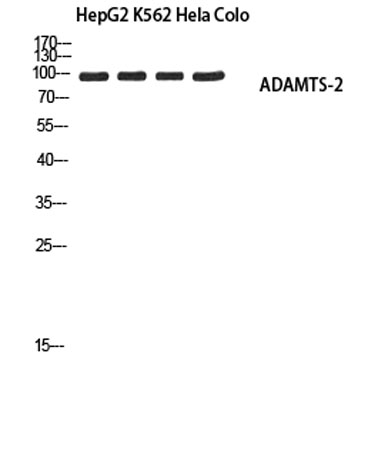
| Observed band (KD) | 100kD |
| Background | This gene encodes a member of the ADAMTS (a disintegrin and metalloproteinase with thrombospondin motifs) protein family. Members of the family share several distinct protein modules, including a propeptide region, a metalloproteinase domain, a disintegrin-like domain, and a thrombospondin type 1 (TS) motif. Individual members of this family differ in the number of C-terminal TS motifs, and some have unique C-terminal domains. The encoded preproprotein is proteolytically processed to generate the mature procollagen N-proteinase. This proteinase excises the N-propeptide of the fibrillar procollagens types I-III and type V. Mutations in this gene cause Ehlers-Danlos syndrome type VIIC, a recessively inherited connective-tissue disorder. Alternative splicing results in multiple transcript variants, at least one of which encodes an isoform that is proteolytically |
| Function | catalytic activity:Cleaves the N-propeptide of collagen chain alpha-1(I) at Pro-|-Gln and of alpha-1(II) and alpha-2(I) at Ala-|-Gln.,caution:Has sometimes been referred to as ADAMTS3.,cofactor:Binds 1 zinc ion per subunit.,disease:Defects in ADAMTS2 are the cause of Ehlers-Danlos syndrome type 7C (EDS7C) [MIM:225410]. EDS is a connective tissue disorder characterized by hyperextensible skin, atrophic cutaneous scars due to tissue fragility and joint hyperlaxity. EDS7C is marked by extremely fragile tissues, hyperextensible skin and easy bruising. Facial skin contains numerous folds, as in the cutis laxa syndrome.,domain:The spacer domain and the TSP type-1 domains are important for a tight interaction with the extracellular matrix.,function:Cleaves the propeptides of type I and II collagen prior to fibril assembly. Does not act on type III collagen. May also play a role in development t |
| Subcellular location | Secreted, extracellular space, extracellular matrix . |
| Expression | Expressed at high level in skin, bone, tendon and aorta and at low levels in thymus and brain. |

Use collapsible tabs for more detailed information that will help customers make a purchasing decision.
Ex: Shipping and return policies, size guides, and other common questions.