 Français
 English

| ELK.No | ES8486 |
| Product name | Collagen IV rabbit pAb |
| Reactivity | Human;Mouse;Rat |
| Applications | WB;ELISA |
| Other name | collagen, type IV, alpha 1 |
| Size | 100μL |
| Unit price ($) | 248 |
| Human gene ID | 1282 |
| Human Swiss-Prot | P02462 |
| Source | Rabbit |
| Isotype | IgG |
| Target | Collagen IV |
| Fields | >>PI3K-Akt signaling pathway;>>Focal adhesion;>>ECM-receptor interaction;>>Relaxin signaling pathway;>>AGE-RAGE signaling pathway in diabetic complications;>>Protein digestion and absorption;>>Amoebiasis;>>Human papillomavirus infection;>>Pathways in cancer;>>Small cell lung cancer |
| Gene name | COL4A1 |
| Protein name | Collagen IV |
| Human gene link | View Human Gene |
| Human Swiss link | View Human Swiss-Prot |
| Mouse gene ID | 12826 |
| Mouse gene link | |
| Mouse Swiss-Prot | P02463 |
| Mouse Swiss link | View Mouse Swiss-Prot |
| Rat gene ID | |
| Rat gene link | |
| Rat Swiss-Prot | |
| Rat Swiss link | |
| Immunogen | Synthesized peptide derived from Collagen IV . at AA range: 1428-1443 |
| Specificity | Collagen IV Polyclonal Antibody detects endogenous levels of Collagen IV |
| Formulation | Liquid in PBS containing 50% glycerol, 0.5% BSA and 0.02% sodium azide. |
| Clonality | Polyclonal |
| Dilution | WB 1:500-2000, ELISA 1:10000-20000 |
| Purification | The antibody was affinity-purified from rabbit antiserum by affinity-chromatography using epitope-specific immunogen. |
| Concentration | 1 mg/ml |
| Storage stability | -20°C/1 year |
| Molecular Weight (Da) | |
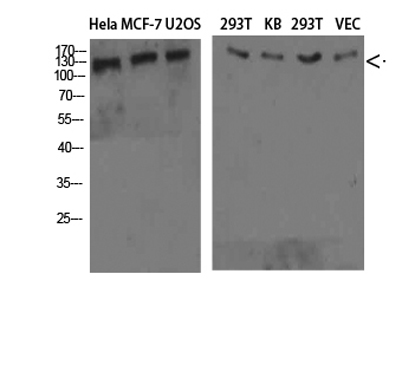
| Observed band (KD) | 130kD |
| Background | This gene encodes a type IV collagen alpha protein. Type IV collagen proteins are integral components of basement membranes. This gene shares a bidirectional promoter with a paralogous gene on the opposite strand. The protein consists of an amino-terminal 7S domain, a triple-helix forming collagenous domain, and a carboxy-terminal non-collagenous domain. It functions as part of a heterotrimer and interacts with other extracellular matrix components such as perlecans, proteoglycans, and laminins. In addition, proteolytic cleavage of the non-collagenous carboxy-terminal domain results in a biologically active fragment known as arresten, which has anti-angiogenic and tumor suppressor properties. Mutations in this gene cause porencephaly, cerebrovascular disease, and renal and muscular defects. Alternative splicing results in multiple transcript variants. [provided by RefSeq, Dec 2014], |
| Function | disease:Defects in COL4A1 are a cause of brain small vessel disease with hemorrhage [MIM:607595]. Brain small vessel diseases underlie 20 to 30 percent of ischemic strokes and a larger proportion of intracerebral hemorrhages. Inheritance is autosomal dominant.,disease:Defects in COL4A1 are a cause of porencephaly type 1 [MIM:175780]; also known as encephaloclastic porencephaly. Porencephaly is a term used for any cavitation or cerebrospinal fluid-filled cyst in the brain. Porencephaly type 1 is usually unilateral and results from focal destructive lesions such as fetal vascular occlusion or birth trauma. Inheritance is autosomal dominant.,disease:Defects in COL4A1 are the cause of hereditary angiopathy with nephropathy, aneurysms, and muscle cramps (HANAC) [MIM:611773]. The clinical renal manifestations include hematuria and bilateral large cysts. Histologic analysis revealed complex bas |
| Subcellular location | Secreted, extracellular space, extracellular matrix, basement membrane . |
| Expression | Highly expressed in placenta. |

Use collapsible tabs for more detailed information that will help customers make a purchasing decision.
Ex: Shipping and return policies, size guides, and other common questions.