 Français
 English

| ELK.No | ES8523 |
| Product name | Factor IX rabbit pAb |
| Reactivity | Human;Mouse;Rat |
| Applications | WB;ELISA |
| Other name | Coagulation factor IX (EC 3.4.21.22) (Christmas factor) (Plasma thromboplastin component) (PTC) [Cleaved into: Coagulation factor IXa light chain; Coagulation factor IXa heavy chain] |
| Size | 50μL |
| Unit price ($) | 148 |
| Human gene ID | 2158 |
| Human Swiss-Prot | P00740 |
| Source | Rabbit |
| Isotype | IgG |
| Target | FA9 |
| Fields | >>Complement and coagulation cascades |
| Gene name | F9 |
| Protein name | Factor IX |
| Human gene link | View Human Gene |
| Human Swiss link | View Human Swiss-Prot |
| Mouse gene ID | 14071 |
| Mouse gene link | |
| Mouse Swiss-Prot | P16294 |
| Mouse Swiss link | View Mouse Swiss-Prot |
| Rat gene ID | |
| Rat gene link | |
| Rat Swiss-Prot | P16296 |
| Rat Swiss link | View Rat Swiss-Prot |
| Immunogen | Synthesized peptide derived from Factor IX at AA range: 412-461 |
| Specificity | Factor IX Polyclonal Antibody detects endogenous levels of Factor IX |
| Formulation | Liquid in PBS containing 50% glycerol, 0.5% BSA and 0.02% sodium azide. |
| Clonality | Polyclonal |
| Dilution | WB 1:500-2000, ELISA 1:10000-20000 |
| Purification | The antibody was affinity-purified from rabbit antiserum by affinity-chromatography using epitope-specific immunogen. |
| Concentration | 1 mg/ml |
| Storage stability | -20°C/1 year |
| Molecular Weight (Da) | |
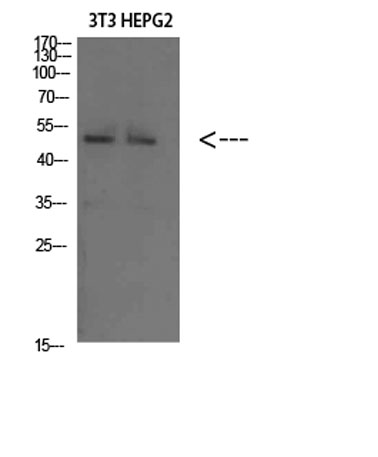
| Observed band (KD) | 52kD |
| Background | This gene encodes vitamin K-dependent coagulation factor IX that circulates in the blood as an inactive zymogen. This factor is converted to an active form by factor XIa, which excises the activation peptide and thus generates a heavy chain and a light chain held together by one or more disulfide bonds. The role of this activated factor IX in the blood coagulation cascade is to activate factor X to its active form through interactions with Ca+2 ions, membrane phospholipids, and factor VIII. Alterations of this gene, including point mutations, insertions and deletions, cause factor IX deficiency, which is a recessive X-linked disorder, also called hemophilia B or Christmas disease. Alternative splicing results in multiple transcript variants encoding different isoforms that may undergo similar proteolytic processing. [provided by RefSeq, Sep 2015], |
| Function | catalytic activity:Selective cleavage of Arg-|-Ile bond in factor X to form factor Xa.,disease:Defects in F9 are the cause of recessive X-linked hemophilia B (HEMB) [MIM:306900]; also known as Christmas disease.,disease:Mutations in position 43 (Oxford-3, San Dimas) and 46 (Cambridge) prevents cleavage of the propeptide, mutation in position 93 (Alabama) probably fails to bind to cell membranes, mutation in position 191 (Chapel-Hill) or in position 226 (Nagoya OR Hilo) prevent cleavage of the activation peptide.,domain:Calcium binds to the gamma-carboxyglutamic acid (Gla) residues and, with stronger affinity, to another site, beyond the Gla domain.,function:Factor IX is a vitamin K-dependent plasma protein that participates in the intrinsic pathway of blood coagulation by converting factor X to its active form in the presence of Ca(2+) ions, phospholipids, and factor VIIIa.,miscellaneous |
| Subcellular location | Secreted . |
| Expression | Detected in blood plasma (at protein level) (PubMed:3857619, PubMed:8295821, PubMed:2592373, PubMed:9169594, PubMed:19846852). Synthesized primarily in the liver and secreted in plasma. |

Use collapsible tabs for more detailed information that will help customers make a purchasing decision.
Ex: Shipping and return policies, size guides, and other common questions.