 Français
 English
HNF-4α (Acetyl Lys106) rabbit pAb
AO-06-ES8628-50

| ELK.No | ES8628 |
| Product name | HNF-4α (Acetyl Lys106) rabbit pAb |
| Reactivity | Human;Rat;Mouse |
| Applications | WB;ELISA |
| Other name | Hepatocyte nuclear factor 4-alpha (HNF-4-alpha) (Nuclear receptor subfamily 2 group A member 1) (Transcription factor 14) (TCF-14) (Transcription factor HNF-4) |
| Size | 50μL |
| Unit price ($) | 148 |
| Human gene ID | 3172 |
| Human Swiss-Prot | P41235 |
| Source | Rabbit |
| Isotype | IgG |
| Target | HNF4α |
| Fields | >>AMPK signaling pathway;>>Maturity onset diabetes of the young |
| Gene name | HNF4A HNF4 NR2A1 TCF14 |
| Protein name | Hepatocyte nuclear factor 4-alpha (HNF-4-alpha) (Nuclear receptor subfamily 2 group A member 1) (Transcription factor 14) (TCF-14) (Transcription factor HNF-4) |
| Human gene link | View Human Gene |
| Human Swiss link | View Human Swiss-Prot |
| Mouse gene ID | |
| Mouse gene link | |
| Mouse Swiss-Prot | P49698 |
| Mouse Swiss link | View Mouse Swiss-Prot |
| Rat gene ID | |
| Rat gene link | |
| Rat Swiss-Prot | P22449 |
| Rat Swiss link | View Rat Swiss-Prot |
| Immunogen | Synthetic Acetyl peptide from human protein at AA range: 106 |
| Specificity | The antibody detects endogenous HNF-4α when Acetyl occurs at Lys106 |
| Formulation | Liquid in PBS containing 50% glycerol, 0.5% BSA and 0.02% sodium azide. |
| Clonality | Polyclonal |
| Dilution | WB 1:500-2000, ELISA 1:10000-20000 |
| Purification | The antibody was affinity-purified from rabbit antiserum by affinity-chromatography using epitope-specific immunogen. |
| Concentration | 1 mg/ml |
| Storage stability | -20°C/1 year |
| Molecular Weight (Da) | |
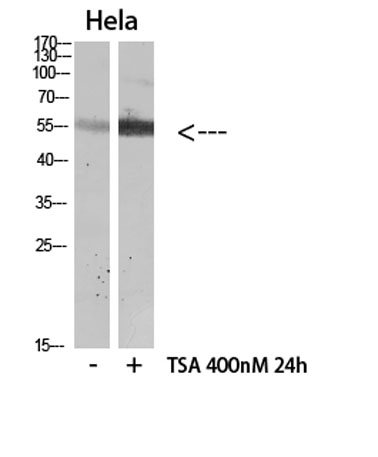
| Observed band (KD) | 55kD |
| Background | The protein encoded by this gene is a nuclear transcription factor which binds DNA as a homodimer. The encoded protein controls the expression of several genes, including hepatocyte nuclear factor 1 alpha, a transcription factor which regulates the expression of several hepatic genes. This gene may play a role in development of the liver, kidney, and intestines. Mutations in this gene have been associated with monogenic autosomal dominant non-insulin-dependent diabetes mellitus type I. Alternative splicing of this gene results in multiple transcript variants encoding several different isoforms. [provided by RefSeq, Apr 2012], |
| Function | alternative products:Additional isoforms seem to exist,disease:Defects in HNF4A are the cause of maturity onset diabetes of the young type 1 (MODY1) [MIM:125850]; also shortened MODY-1. MODY [MIM:606391] is a form of diabetes that is characterized by an autosomal dominant mode of inheritance, onset in childhood or early adulthood (usually before 25 years of age) and a primary defect in insulin secretion. The clinical phenotype of MODY1 is characterized by severe insulin secretory defects, and by major hyperglycemia associated with microvascular complications.,function:Transcriptionally controlled transcription factor. Binds to DNA sites required for the transcription of alpha 1-antitrypsin, apolipoprotein CIII, transthyretin genes and HNF1-alpha. May be essential for development of the liver, kidney and intestine.,miscellaneous:Binds fatty acids.,online information:Hepatocyte nuclear fac |
| Subcellular location | Nucleus. |
| Expression | Kidney,Liver, |

Use collapsible tabs for more detailed information that will help customers make a purchasing decision.
Ex: Shipping and return policies, size guides, and other common questions.