 Français
 English
Tyrosine Hydroxylase rabbit pAb
AO-06-ES8886-100

| ELK.No | ES8886 |
| Product name | Tyrosine Hydroxylase rabbit pAb |
| Reactivity | Human;Mouse;Rat |
| Applications | WB;ELISA |
| Other name | Tyrosine 3-monooxygenase (EC 1.14.16.2) (Tyrosine 3-hydroxylase) (TH) |
| Size | 100μL |
| Unit price ($) | 248 |
| Human gene ID | 7054 |
| Human Swiss-Prot | P07101 |
| Source | Rabbit |
| Isotype | IgG |
| Target | Tyrosine Hydroxylase |
| Fields | >>Tyrosine metabolism;>>Folate biosynthesis;>>Metabolic pathways;>>Dopaminergic synapse;>>Prolactin signaling pathway;>>Parkinson disease;>>Cocaine addiction;>>Amphetamine addiction;>>Alcoholism |
| Gene name | TH TYH |
| Protein name | Tyrosine 3-monooxygenase (EC 1.14.16.2) (Tyrosine 3-hydroxylase) (TH),Tyrosine Hydrolase |
| Human gene link | View Human Gene |
| Human Swiss link | View Human Swiss-Prot |
| Mouse gene ID | 21823 |
| Mouse gene link | |
| Mouse Swiss-Prot | P24529 |
| Mouse Swiss link | View Mouse Swiss-Prot |
| Rat gene ID | 25085 |
| Rat gene link | |
| Rat Swiss-Prot | P04177 |
| Rat Swiss link | View Rat Swiss-Prot |
| Immunogen | Synthesized peptide derived from human Tyrosine Hydroxylase Polyclonal |
| Specificity | This antibody detects endogenous levels of Tyrosine Hydroxylase. |
| Formulation | Liquid in PBS containing 50% glycerol, 0.5% BSA and 0.02% sodium azide. |
| Clonality | Polyclonal |
| Dilution | WB 1:500-2000, ELISA 1:10000-20000 |
| Purification | The antibody was affinity-purified from rabbit antiserum by affinity-chromatography using epitope-specific immunogen. |
| Concentration | 1 mg/ml |
| Storage stability | -20°C/1 year |
| Molecular Weight (Da) | |
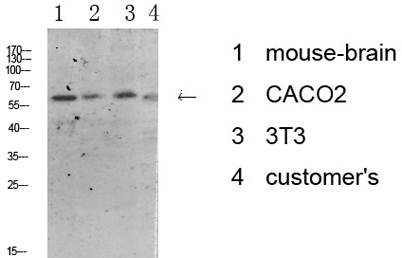
| Observed band (KD) | 60kD |
| Background | The protein encoded by this gene is involved in the conversion of tyrosine to dopamine. It is the rate-limiting enzyme in the synthesis of catecholamines, hence plays a key role in the physiology of adrenergic neurons. Mutations in this gene have been associated with autosomal recessive Segawa syndrome. Alternatively spliced transcript variants encoding different isoforms have been noted for this gene. [provided by RefSeq, Jul 2008], |
| Function | catalytic activity:L-tyrosine + tetrahydrobiopterin + O(2) = 3,4-dihydroxy-L-phenylalanine + 4a-hydroxytetrahydrobiopterin.,cofactor:Fe(2+) ion.,disease:Defects in TH are the cause of dystonia DOPA-responsive autosomal recessive (ARDRD) [MIM:605407]; also known as autosomal recessive Segawa syndrome. ARDRD is a form of DOPA-responsive dystonia presenting in infancy or early childhood. Dystonia is defined by the presence of sustained involuntary muscle contractions, often leading to abnormal postures. Some cases of ARDRD present with parkinsonian symptoms in infancy. Unlike all other forms of dystonia, it is an eminently treatable condition, due to a favorable response to L-DOPA.,enzyme regulation:Phosphorylation leads to an increase in the catalytic activity.,function:Plays an important role in the physiology of adrenergic neurons.,online information:Tyrosine hydroxylase entry,pathway:Ca |
| Subcellular location | Cytoplasm, perinuclear region . Nucleus . Cell projection, axon . Cytoplasm . Cytoplasmic vesicle, secretory vesicle, synaptic vesicle . When phosphorylated at Ser-19 shows a nuclear distribution and when phosphorylated at Ser-31 as well at Ser-40 shows a cytosolic distribution (By similarity). Expressed in dopaminergic axons and axon terminals. . |
| Expression | Mainly expressed in the brain and adrenal glands. |

Use collapsible tabs for more detailed information that will help customers make a purchasing decision.
Ex: Shipping and return policies, size guides, and other common questions.