 Français
 English

| ELK.No | ES8960 |
| Product name | EI2BE rabbit pAb |
| Reactivity | Human;Rat;Mouse; |
| Applications | WB;ELISA |
| Other name | |
| Size | 50μL |
| Unit price ($) | 148 |
| Human gene ID | 8893 |
| Human Swiss-Prot | Q13144 |
| Source | Rabbit |
| Isotype | IgG |
| Target | EI2BE |
| Fields | >>Herpes simplex virus 1 infection |
| Gene name | EIF2B5 EIF2BE |
| Protein name | Translation initiation factor eIF-2B subunit epsilon (eIF-2B GDP-GTP exchange factor subunit epsilon) |
| Human gene link | |
| Human Swiss link | View Human Swiss-Prot |
| Mouse gene ID | |
| Mouse gene link | |
| Mouse Swiss-Prot | Q8CHW4 |
| Mouse Swiss link | View Mouse Swiss-Prot |
| Rat gene ID | |
| Rat gene link | |
| Rat Swiss-Prot | Q64350 |
| Rat Swiss link | View Rat Swiss-Prot |
| Immunogen | Synthesized peptide derived from human protein . at AA range: 480-560 |
| Specificity | EI2BE Polyclonal Antibody detects endogenous levels of protein. |
| Formulation | Liquid in PBS containing 50% glycerol, and 0.02% sodium azide. |
| Clonality | Polyclonal |
| Dilution | WB 1:500-2000 ELISA 1:5000-20000 |
| Purification | The antibody was affinity-purified from rabbit antiserum by affinity-chromatography using epitope-specific immunogen. |
| Concentration | 1 mg/ml |
| Storage stability | -20°C/1 year |
| Molecular Weight (Da) | |
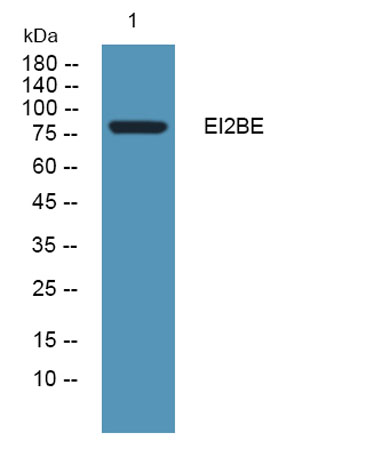
| Observed band (KD) | 79kD |
| Background | This gene encodes one of five subunits of eukaryotic translation initiation factor 2B (EIF2B), a GTP exchange factor for eukaryotic initiation factor 2 and an essential regulator for protein synthesis. Mutations in this gene and the genes encoding other EIF2B subunits have been associated with leukoencephalopathy with vanishing white matter. [provided by RefSeq, Nov 2009], |
| Function | disease:Defects in EIF2B5 are a cause of leukodystrophy with vanishing white matter (VWM) [MIM:603896]. VWM is a leukodystrophy that occurs mainly in children. Neurological signs include progressive cerebellar ataxia, spasticity, inconstant optic atrophy and relatively preserved mental abilities. The disease is chronic-progressive with, in most individuals, additional episodes of rapid deterioration following febrile infections or minor head trauma. While childhood onset is the most common form of the disorder, some severe forms are apparent at birth. A severe, early-onset form seen among the Cree and Chippewayan populations of Quebec and Manitoba is called Cree leukoencephalopathy. Milder forms may not become evident until adolescence or adulthood. Some females with milder forms of the disease who survive to adolescence exhibit ovarian dysfunction. This variant of the disorder is called |
| Subcellular location | nucleus,cytoplasm,cytosol,eukaryotic translation initiation factor 2B complex, |
| Expression | Brain,Epithelium,Hepatocyte,Lung,Platelet, |

Use collapsible tabs for more detailed information that will help customers make a purchasing decision.
Ex: Shipping and return policies, size guides, and other common questions.