 Français
 English

| ELK.No | ES9068 |
| Product name | AGK rabbit pAb |
| Reactivity | Human;Mouse |
| Applications | WB;ELISA |
| Other name | |
| Size | 100μL |
| Unit price ($) | 248 |
| Human gene ID | 55750 |
| Human Swiss-Prot | Q53H12 |
| Source | Rabbit |
| Isotype | IgG |
| Target | AGK |
| Fields | >>Glycerolipid metabolism;>>Metabolic pathways |
| Gene name | AGK MULK |
| Protein name | Acylglycerol kinase, mitochondrial (hAGK) (EC 2.7.1.107) (EC 2.7.1.94) (Multiple substrate lipid kinase) (HsMuLK) (MuLK) (Multi-substrate lipid kinase) |
| Human gene link | |
| Human Swiss link | View Human Swiss-Prot |
| Mouse gene ID | |
| Mouse gene link | |
| Mouse Swiss-Prot | Q9ESW4 |
| Mouse Swiss link | View Mouse Swiss-Prot |
| Rat gene ID | |
| Rat gene link | |
| Rat Swiss-Prot | |
| Rat Swiss link | |
| Immunogen | Synthesized peptide derived from human protein . at AA range: 330-410 |
| Specificity | AGK Polyclonal Antibody detects endogenous levels of protein. |
| Formulation | Liquid in PBS containing 50% glycerol, and 0.02% sodium azide. |
| Clonality | Polyclonal |
| Dilution | WB 1:500-2000 ELISA 1:5000-20000 |
| Purification | The antibody was affinity-purified from rabbit antiserum by affinity-chromatography using epitope-specific immunogen. |
| Concentration | 1 mg/ml |
| Storage stability | -20°C/1 year |
| Molecular Weight (Da) | |
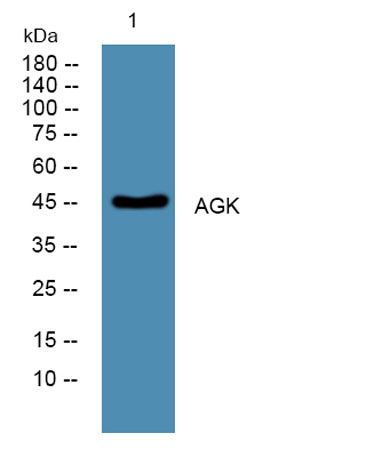
| Observed band (KD) | 46kD |
| Background | The protein encoded by this gene is a mitochondrial membrane protein involved in lipid and glycerolipid metabolism. The encoded protein is a lipid kinase that catalyzes the formation of phosphatidic and lysophosphatidic acids. Defects in this gene have been associated with mitochondrial DNA depletion syndrome 10. [provided by RefSeq, Feb 2012], |
| Function | catalytic activity:ATP + 1,2-diacylglycerol = ADP + 1,2-diacyl-sn-glycerol 3-phosphate.,catalytic activity:ATP + acylglycerol = ADP + acyl-sn-glycerol 3-phosphate.,cofactor:Magnesium.,function:Lipid kinase that can phosphorylate both monoacylglycerol and diacylglycerol to form lysophosphatidic acid (LPA) and phosphatidic acid (PA), respectively. Does not phosphorylate sphingosine. Overexpression increases the formation and secretion of LPA, resulting in transactivation of EGFR and activation of the downstream MAPK signaling pathway, leading to increased cell growth.,miscellaneous:Overexpressed in prostate cancer, suggesting that it may play a role in initiation and progression of prostate cancer, processes in which LPA plays key roles.,pathway:Lipid metabolism; glycerolipid metabolism.,similarity:Contains 1 DAGKc domain.,tissue specificity:Highly expressed in muscle, heart, kidney and br |
| Subcellular location | Mitochondrion inner membrane ; Peripheral membrane protein . Mitochondrion intermembrane space . Localizes in the mitochondrion intermembrane space, where it associates with the inner membrane (PubMed:28712724). It is unclear whether the N-terminal hydrophobic region forms a transmembrane region or associates with the membrane without crossing it (PubMed:28712724, PubMed:28712726). . |
| Expression | Highly expressed in muscle, heart, kidney and brain. |

Use collapsible tabs for more detailed information that will help customers make a purchasing decision.
Ex: Shipping and return policies, size guides, and other common questions.