 Français
 English

| ELK.No | ES9131 |
| Product name | CP4FN rabbit pAb |
| Reactivity | Human;Rat;Mouse; |
| Applications | WB;ELISA |
| Other name | |
| Size | 50μL |
| Unit price ($) | 148 |
| Human gene ID | 126410 |
| Human Swiss-Prot | Q6NT55 |
| Source | Rabbit |
| Isotype | IgG |
| Target | CP4FN |
| Fields | |
| Gene name | CYP4F22 |
| Protein name | Cytochrome P450 4F22 (EC 1.14.14.-) |
| Human gene link | |
| Human Swiss link | View Human Swiss-Prot |
| Mouse gene ID | |
| Mouse gene link | |
| Mouse Swiss-Prot | |
| Mouse Swiss link | |
| Rat gene ID | |
| Rat gene link | |
| Rat Swiss-Prot | |
| Rat Swiss link | |
| Immunogen | Synthesized peptide derived from human protein . at AA range: 440-520 |
| Specificity | CP4FN Polyclonal Antibody detects endogenous levels of protein. |
| Formulation | Liquid in PBS containing 50% glycerol, and 0.02% sodium azide. |
| Clonality | Polyclonal |
| Dilution | WB 1:500-2000 ELISA 1:5000-20000 |
| Purification | The antibody was affinity-purified from rabbit antiserum by affinity-chromatography using epitope-specific immunogen. |
| Concentration | 1 mg/ml |
| Storage stability | -20°C/1 year |
| Molecular Weight (Da) | |
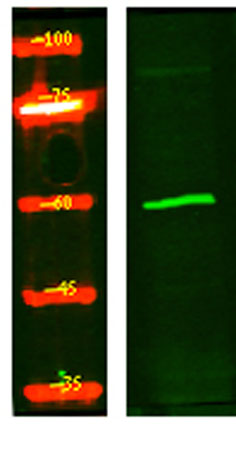
| Observed band (KD) | 58kD |
| Background | cytochrome P450 family 4 subfamily F member 22(CYP4F22) Homo sapiens This gene encodes a member of the cytochrome P450 superfamily of enzymes. The cytochrome P450 proteins are monooxygenases which catalyze many reactions involved in drug metabolism and synthesis of cholesterol, steroids and other lipids. This gene is part of a cluster of cytochrome P450 genes on chromosome 19 and encodes an enzyme thought to play a role in the 12(R)-lipoxygenase pathway. Mutations in this gene are the cause of ichthyosis lamellar type 3. [provided by RefSeq, Jul 2008], |
| Function | cofactor:Heme group.,disease:Defects in CYP4F22 are the cause of ichthyosis lamellar type 3 (LI3) [MIM:604777]. LI is a non-bullous ichthyosis, a skin disorder characterized by abnormal cornification of the epidermis. It is one the most severe forms of ichthyoses apparent at birth and persisting throughout life. LI patients are born encased in a tight, shiny, translucent covering called collodion membrane. Over the first weeks of life, the collodion membrane is gradually replaced by generalized large, dark brown, plate-like scales with minimal to no erythroderma. Tautness of facial skin commonly results in ectropion, eclabium and scarring alopecia of the scalp. Common complications are severe heat intolerance and recurrent ear infections.,similarity:Belongs to the cytochrome P450 family., |
| Subcellular location | Endoplasmic reticulum membrane ; Single-pass type I membrane protein . Microsome membrane ; Single-pass type I membrane protein . |
| Expression | Prostate, |

Use collapsible tabs for more detailed information that will help customers make a purchasing decision.
Ex: Shipping and return policies, size guides, and other common questions.