 Français
 English

| ELK.No | ES9144 |
| Product name | FGF10 rabbit pAb |
| Reactivity | Human;Mouse;Rat |
| Applications | WB;ELISA |
| Other name | |
| Size | 50μL |
| Unit price ($) | 148 |
| Human gene ID | 2255 |
| Human Swiss-Prot | O15520 |
| Source | Rabbit |
| Isotype | IgG |
| Target | FGF10 |
| Fields | >>MAPK signaling pathway;>>Ras signaling pathway;>>Rap1 signaling pathway;>>Calcium signaling pathway;>>PI3K-Akt signaling pathway;>>Regulation of actin cytoskeleton;>>Pathways in cancer;>>Chemical carcinogenesis - receptor activation;>>Melanoma;>>Breast cancer;>>Gastric cancer |
| Gene name | FGF10 |
| Protein name | Fibroblast growth factor 10 (FGF-10) (Keratinocyte growth factor 2) |
| Human gene link | |
| Human Swiss link | View Human Swiss-Prot |
| Mouse gene ID | |
| Mouse gene link | |
| Mouse Swiss-Prot | O35565 |
| Mouse Swiss link | View Mouse Swiss-Prot |
| Rat gene ID | |
| Rat gene link | |
| Rat Swiss-Prot | P70492 |
| Rat Swiss link | View Rat Swiss-Prot |
| Immunogen | Synthesized peptide derived from human protein . at AA range: 120-200 |
| Specificity | FGF10 Polyclonal Antibody detects endogenous levels of protein. |
| Formulation | Liquid in PBS containing 50% glycerol, and 0.02% sodium azide. |
| Clonality | Polyclonal |
| Dilution | WB 1:500-2000 ELISA 1:5000-20000 |
| Purification | The antibody was affinity-purified from rabbit antiserum by affinity-chromatography using epitope-specific immunogen. |
| Concentration | 1 mg/ml |
| Storage stability | -20°C/1 year |
| Molecular Weight (Da) | |
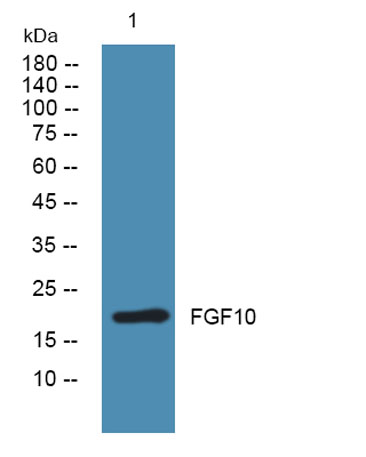
| Observed band (KD) | 22kD |
| Background | The protein encoded by this gene is a member of the fibroblast growth factor (FGF) family. FGF family members possess broad mitogenic and cell survival activities, and are involved in a variety of biological processes, including embryonic development, cell growth, morphogenesis, tissue repair, tumor growth and invasion. This protein exhibits mitogenic activity for keratinizing epidermal cells, but essentially no activity for fibroblasts, which is similar to the biological activity of FGF7. Studies of the mouse homolog of suggested that this gene is required for embryonic epidermal morphogenesis including brain development, lung morphogenesis, and initiation of lim bud formation. This gene is also implicated to be a primary factor in the process of wound healing. [provided by RefSeq, Jul 2008], |
| Function | disease:Defects in FGF10 are a cause of lacrimo-auriculo-dento-digital syndrome (LADDS) [MIM:149730]; also known as Levy-Hollister syndrome. LADDS is a form of ectodermal dysplasia, a heterogeneous group of disorders due to abnormal development of two or more ectodermal structures. LADDS is an autosomal dominant syndrome characterized by aplastic/hypoplastic lacrimal and salivary glands and ducts, cup-shaped ears, hearing loss, hypodontia and enamel hypoplasia, and distal limb segments anomalies. In addition to these cardinal features, facial dysmorphism, malformations of the kidney and respiratory system and abnormal genitalia have been reported. Craniosynostosis and severe syndactyly are not observed.,disease:Defects in FGF10 are the cause of autosomal dominant aplasia of lacrimal and salivary glands (ALSG) [MIM:180920]. ALSG has variable expressivity, and affected individuals may have |
| Subcellular location | Secreted . |
| Expression | Bladder,Brain,Lung, |

Use collapsible tabs for more detailed information that will help customers make a purchasing decision.
Ex: Shipping and return policies, size guides, and other common questions.