 Français
 English

| ELK.No | ES9186 |
| Product name | JAM3 rabbit pAb |
| Reactivity | Human;Mouse;Rat |
| Applications | WB;ELISA |
| Other name | |
| Size | 50μL |
| Unit price ($) | 148 |
| Human gene ID | 83700 |
| Human Swiss-Prot | Q9BX67 |
| Source | Rabbit |
| Isotype | IgG |
| Target | JAM3 |
| Fields | >>Cell adhesion molecules;>>Tight junction;>>Leukocyte transendothelial migration;>>Epithelial cell signaling in Helicobacter pylori infection |
| Gene name | JAM3 UNQ859/PRO1868 |
| Protein name | Junctional adhesion molecule C (JAM-C) (JAM-2) (Junctional adhesion molecule 3) (JAM-3) |
| Human gene link | |
| Human Swiss link | View Human Swiss-Prot |
| Mouse gene ID | |
| Mouse gene link | |
| Mouse Swiss-Prot | Q9D8B7 |
| Mouse Swiss link | View Mouse Swiss-Prot |
| Rat gene ID | |
| Rat gene link | |
| Rat Swiss-Prot | Q68FQ2 |
| Rat Swiss link | View Rat Swiss-Prot |
| Immunogen | Synthesized peptide derived from human protein . at AA range: 60-140 |
| Specificity | JAM3 Polyclonal Antibody detects endogenous levels of protein. |
| Formulation | Liquid in PBS containing 50% glycerol, and 0.02% sodium azide. |
| Clonality | Polyclonal |
| Dilution | WB 1:500-2000 ELISA 1:5000-20000 |
| Purification | The antibody was affinity-purified from rabbit antiserum by affinity-chromatography using epitope-specific immunogen. |
| Concentration | 1 mg/ml |
| Storage stability | -20°C/1 year |
| Molecular Weight (Da) | |
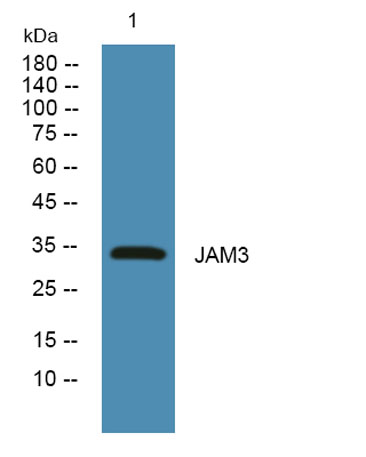
| Observed band (KD) | 34kD |
| Background | Tight junctions represent one mode of cell-to-cell adhesion in epithelial or endothelial cell sheets, forming continuous seals around cells and serving as a physical barrier to prevent solutes and water from passing freely through the paracellular space. The protein encoded by this immunoglobulin superfamily gene member is localized in the tight junctions between high endothelial cells. Unlike other proteins in this family, the this protein is unable to adhere to leukocyte cell lines and only forms weak homotypic interactions. The encoded protein is a member of the junctional adhesion molecule protein family and acts as a receptor for another member of this family. A mutation in an intron of this gene is associated with hemorrhagic destruction of the brain, subependymal calcification, and congenital cataracts. Alternative splicing results in multiple transcript variants.[provided by RefSeq, |
| Function | function:May participate in cell-cell adhesion distinct from tight junctions.,similarity:Belongs to the immunoglobulin superfamily.,similarity:Contains 1 Ig-like C2-type (immunoglobulin-like) domain.,similarity:Contains 1 Ig-like V-type (immunoglobulin-like) domain.,subunit:Interacts with JAM2.,tissue specificity:Widely expressed. Highest expression in placenta, brain and kidney., |
| Subcellular location | Cell membrane ; Single-pass type I membrane protein . Cell junction . Cell junction, desmosome . Cell junction, tight junction . Detected in the acrosome region in developing spermatids (By similarity). In epithelial cells, it is expressed at desmosomes but not at tight junctions (PubMed:15194813). Localizes at the cell surface of endothelial cells; treatment of endothelial cells with vascular endothelial growth factor stimulates recruitment of JAM3 to cell-cell contacts (PubMed:15994945). .; [Soluble form of JAM-C]: Secreted . |
| Expression | Detected on round and elongated spermatids (at protein level) (PubMed:15372036). Highest expression in placenta, brain and kidney. Significant expression is detected on platelets. Expressed in intestinal mucosa cells. Expressed in the vascular endothelium. Found in serum (at protein level). Also detected in the synovial fluid of patients with rheumatoid arthritis, psoriatic arthritis or ostearthritis (at protein level). |

Use collapsible tabs for more detailed information that will help customers make a purchasing decision.
Ex: Shipping and return policies, size guides, and other common questions.