 Français
 English

| ELK.No | ES9217 |
| Product name | PDC10 rabbit pAb |
| Reactivity | Human;Mouse;Rat |
| Applications | WB;ELISA |
| Other name | |
| Size | 100μL |
| Unit price ($) | 248 |
| Human gene ID | 11235 |
| Human Swiss-Prot | Q9BUL8 |
| Source | Rabbit |
| Isotype | IgG |
| Target | PDC10 |
| Fields | |
| Gene name | PDCD10 CCM3 TFAR15 |
| Protein name | Programmed cell death protein 10 (Cerebral cavernous malformations 3 protein) (TF-1 cell apoptosis-related protein 15) |
| Human gene link | |
| Human Swiss link | View Human Swiss-Prot |
| Mouse gene ID | |
| Mouse gene link | |
| Mouse Swiss-Prot | Q8VE70 |
| Mouse Swiss link | View Mouse Swiss-Prot |
| Rat gene ID | |
| Rat gene link | |
| Rat Swiss-Prot | Q6NX65 |
| Rat Swiss link | View Rat Swiss-Prot |
| Immunogen | Synthesized peptide derived from human protein . at AA range: 40-120 |
| Specificity | PDC10 Polyclonal Antibody detects endogenous levels of protein. |
| Formulation | Liquid in PBS containing 50% glycerol, and 0.02% sodium azide. |
| Clonality | Polyclonal |
| Dilution | WB 1:500-2000 ELISA 1:5000-20000 |
| Purification | The antibody was affinity-purified from rabbit antiserum by affinity-chromatography using epitope-specific immunogen. |
| Concentration | 1 mg/ml |
| Storage stability | -20°C/1 year |
| Molecular Weight (Da) | |
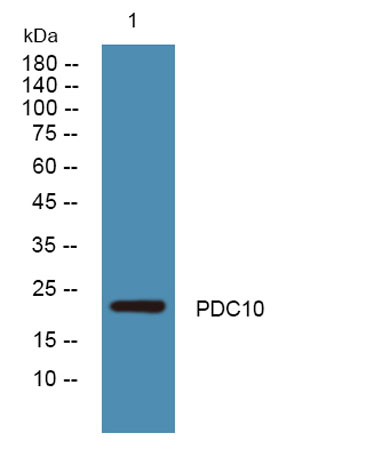
| Observed band (KD) | 23kD |
| Background | This gene encodes an evolutionarily conserved protein associated with cell apoptosis. The protein interacts with the serine/threonine protein kinase MST4 to modulate the extracellular signal-regulated kinase (ERK) pathway. It also interacts with and is phosphoryated by serine/threonine kinase 25, and is thought to function in a signaling pathway essential for vascular developent. Mutations in this gene are one cause of cerebral cavernous malformations, which are vascular malformations that cause seizures and cerebral hemorrhages. Multiple alternatively spliced variants, encoding the same protein, have been identified. [provided by RefSeq, Jul 2008], |
| Function | disease:Defects in PDCD10 are the cause of cerebral cavernous malformations type 3 (CCM3) [MIM:603285]. Cerebral cavernous malformations (CCMs) are congenital vascular anomalies of the central nervous system that can result in hemorrhagic stroke, seizures, recurrent headaches, and focal neurologic deficits. CCMs have an incidence of 0.1%-0.5% in the general population and usually present clinically during the 3rd to 5th decade of life. The lesions are characterized by grossly enlarged blood vessels consisting of a single layer of endothelium and without any intervening neural tissue, ranging in diameter from a few millimeters to several centimeters.,function:May play a role in apoptotic pathways.,similarity:Belongs to the PDCD10 family.,tissue specificity:Ubiquitous., |
| Subcellular location | Cytoplasm. Golgi apparatus membrane; Peripheral membrane protein; Cytoplasmic side. Cell membrane; Peripheral membrane protein; Cytoplasmic side. Partially co-localizes with endogenous PXN at the leading edges of migrating cells. |
| Expression | Ubiquitous. |

Use collapsible tabs for more detailed information that will help customers make a purchasing decision.
Ex: Shipping and return policies, size guides, and other common questions.