 Français
 English

| ELK.No | ES9364 |
| Product name | ADA rabbit pAb |
| Reactivity | Human;Rat;Mouse; |
| Applications | WB;ELISA |
| Other name | |
| Size | 50μL |
| Unit price ($) | 148 |
| Human gene ID | 100 |
| Human Swiss-Prot | P00813 |
| Source | Rabbit |
| Isotype | IgG |
| Target | ADA |
| Fields | >>Purine metabolism;>>Metabolic pathways;>>Nucleotide metabolism;>>Primary immunodeficiency |
| Gene name | ADA ADA1 |
| Protein name | Adenosine deaminase (EC 3.5.4.4) (Adenosine aminohydrolase) |
| Human gene link | |
| Human Swiss link | View Human Swiss-Prot |
| Mouse gene ID | |
| Mouse gene link | |
| Mouse Swiss-Prot | P03958 |
| Mouse Swiss link | View Mouse Swiss-Prot |
| Rat gene ID | |
| Rat gene link | |
| Rat Swiss-Prot | Q920P6 |
| Rat Swiss link | View Rat Swiss-Prot |
| Immunogen | Synthesized peptide derived from human protein . at AA range: 80-160 |
| Specificity | ADA Polyclonal Antibody detects endogenous levels of protein. |
| Formulation | Liquid in PBS containing 50% glycerol, and 0.02% sodium azide. |
| Clonality | Polyclonal |
| Dilution | WB 1:500-2000 ELISA 1:5000-20000 |
| Purification | The antibody was affinity-purified from rabbit antiserum by affinity-chromatography using epitope-specific immunogen. |
| Concentration | 1 mg/ml |
| Storage stability | -20°C/1 year |
| Molecular Weight (Da) | |
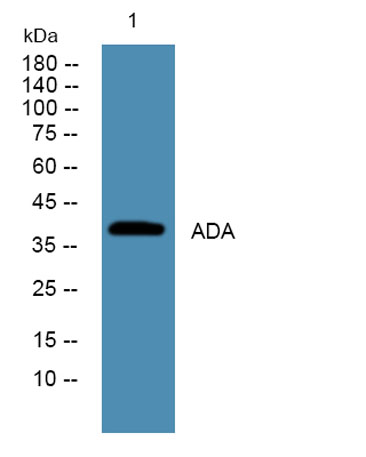
| Observed band (KD) | 39kD |
| Background | This gene encodes an enzyme that catalyzes the hydrolysis of adenosine to inosine. Various mutations have been described for this gene and have been linked to human diseases. Deficiency in this enzyme causes a form of severe combined immunodeficiency disease (SCID), in which there is dysfunction of both B and T lymphocytes with impaired cellular immunity and decreased production of immunoglobulins, whereas elevated levels of this enzyme have been associated with congenital hemolytic anemia. [provided by RefSeq, Jul 2008], |
| Function | catalytic activity:Adenosine + H(2)O = inosine + NH(3).,disease:Defects in ADA are the cause of severe combined immunodeficiency autosomal recessive T-cell-negative/B-cell-negative/NK-cell-negative due to adenosine deaminase deficiency (ADASCID) [MIM:102700]. SCID refers to a genetically and clinically heterogeneous group of rare congenital disorders characterized by impairment of both humoral and cell-mediated immunity, leukopenia, and low or absent antibody levels. Patients with SCID present in infancy with recurrent, persistent infections by opportunistic organisms. The common characteristic of all types of SCID is absence of T-cell-mediated cellular immunity due to a defect in T-cell development. ADA-SCID is an autosomal recessive form accounting for about 50% of non-X-linked SCIDs. ADA deficiency has been diagnosed in chronically ill teenagers and adults (late or adult onset). Popul |
| Subcellular location | Cell membrane ; Peripheral membrane protein; Extracellular side. Cell junction . Cytoplasmic vesicle lumen . Cytoplasm . Lysosome . Colocalized with DPP4 at the cell surface. . |
| Expression | Found in all tissues, occurs in large amounts in T-lymphocytes (PubMed:20959412). Expressed at the time of weaning in gastrointestinal tissues. |

Use collapsible tabs for more detailed information that will help customers make a purchasing decision.
Ex: Shipping and return policies, size guides, and other common questions.