 Français
 English

| ELK.No | ES9379 |
| Product name | A1ATR rabbit pAb |
| Reactivity | Human;Rat;Mouse; |
| Applications | WB;ELISA |
| Other name | |
| Size | 50μL |
| Unit price ($) | 148 |
| Human gene ID | |
| Human Swiss-Prot | P20848 |
| Source | Rabbit |
| Isotype | IgG |
| Target | A1ATR |
| Fields | |
| Gene name | SERPINA2 ARGS ATR PIL |
| Protein name | Putative alpha-1-antitrypsin-related protein (Serpin A2) |
| Human gene link | |
| Human Swiss link | View Human Swiss-Prot |
| Mouse gene ID | |
| Mouse gene link | |
| Mouse Swiss-Prot | |
| Mouse Swiss link | |
| Rat gene ID | |
| Rat gene link | |
| Rat Swiss-Prot | |
| Rat Swiss link | |
| Immunogen | Synthesized peptide derived from human protein . at AA range: 110-190 |
| Specificity | A1ATR Polyclonal Antibody detects endogenous levels of protein. |
| Formulation | Liquid in PBS containing 50% glycerol, and 0.02% sodium azide. |
| Clonality | Polyclonal |
| Dilution | WB 1:500-2000 ELISA 1:5000-20000 |
| Purification | The antibody was affinity-purified from rabbit antiserum by affinity-chromatography using epitope-specific immunogen. |
| Concentration | 1 mg/ml |
| Storage stability | -20°C/1 year |
| Molecular Weight (Da) | |
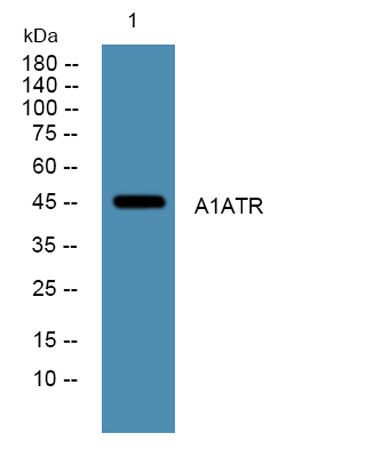
| Observed band (KD) | 46kD |
| Background | This gene encodes a member of the serpin family of proteins, a group of proteins that inhibit serine proteases. The encoded intracellular glycoprotein is localized at the endoplasmic reticulum. This gene is a polymorphic pseudogene, with the non-functional allele being predominant in some populations. Some individuals, as represented by the reference genome allele, contain a 2kb coding region deletion and a start code mutation. [provided by RefSeq, Feb 2014], |
| Function | caution:Could be the product of a pseudogene.,domain:The reactive center loop (RCL) extends out from the body of the protein and directs binding to the target protease. The protease cleaves the serpin at the reactive site within the RCL, establishing a covalent linkage between the carboxyl group of the serpin reactive site and the serine hydroxyl of the protease. The resulting inactive serpin-protease complex is highly stable.,function:Could be a serine protease inhibitor.,similarity:Belongs to the serpin family., |
| Subcellular location | Endoplasmic reticulum . |
| Expression | Expressed in the liver, leukocytes and testis. Also detected in brain, colon, uterus, esophagus, spleen, trachea, kidney and lung. |

Use collapsible tabs for more detailed information that will help customers make a purchasing decision.
Ex: Shipping and return policies, size guides, and other common questions.