 Français
 English
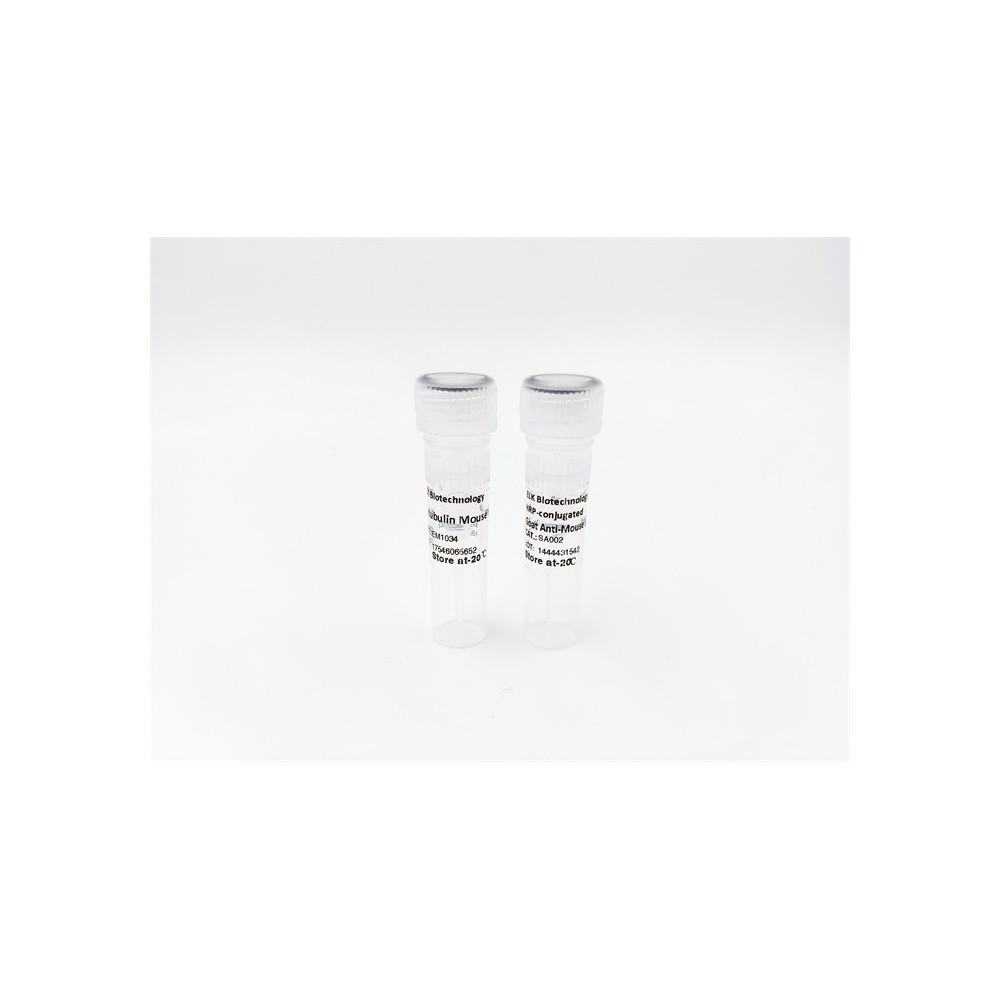

| ELK.No | ES9547 |
| Product name | CLD14 rabbit pAb |
| Reactivity | Human;Mouse |
| Applications | WB;ELISA |
| Other name | |
| Size | 100μL |
| Unit price ($) | 248 |
| Human gene ID | 23562 |
| Human Swiss-Prot | O95500 |
| Source | Rabbit |
| Isotype | IgG |
| Target | CLD14 |
| Fields | >>Cell adhesion molecules;>>Tight junction;>>Leukocyte transendothelial migration;>>Pathogenic Escherichia coli infection;>>Hepatitis C |
| Gene name | CLDN14 UNQ777/PRO1571 |
| Protein name | Claudin-14 |
| Human gene link | |
| Human Swiss link | View Human Swiss-Prot |
| Mouse gene ID | |
| Mouse gene link | |
| Mouse Swiss-Prot | Q9Z0S3 |
| Mouse Swiss link | View Mouse Swiss-Prot |
| Rat gene ID | |
| Rat gene link | |
| Rat Swiss-Prot | |
| Rat Swiss link | |
| Immunogen | Synthesized peptide derived from part region of human protein |
| Specificity | CLD14 Polyclonal Antibody detects endogenous levels of protein. |
| Formulation | Liquid in PBS containing 50% glycerol, and 0.02% sodium azide. |
| Clonality | Polyclonal |
| Dilution | WB 1:500-2000 ELISA 1:5000-20000 |
| Purification | The antibody was affinity-purified from rabbit antiserum by affinity-chromatography using epitope-specific immunogen. |
| Concentration | 1 mg/ml |
| Storage stability | -20°C/1 year |
| Molecular Weight (Da) | |
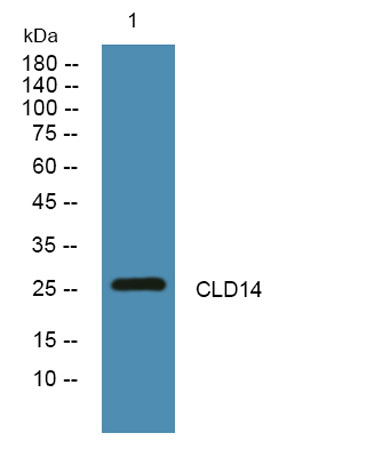
| Observed band (KD) | 26kD |
| Background | Tight junctions represent one mode of cell-to-cell adhesion in epithelial or endothelial cell sheets, forming continuous seals around cells and serving as a physical barrier to prevent solutes and water from passing freely through the paracellular space. These junctions are comprised of sets of continuous networking strands in the outwardly facing cytoplasmic leaflet, with complementary grooves in the inwardly facing extracytoplasmic leaflet. The protein encoded by this gene, a member of the claudin family, is an integral membrane protein and a component of tight junction strands. The encoded protein also binds specifically to the WW domain of Yes-associated protein. Defects in this gene are the cause of an autosomal recessive form of nonsyndromic sensorineural deafness. It is also reported that four synonymous variants in this gene are associated with kidney stones and reduced bone mineral density. Several |
| Function | disease:Defects in CLDN14 are the cause of non-syndromic sensorineural deafness autosomal recessive type 29 (DFNB29) [MIM:605608]. DFNB29 is a form of sensorineural hearing loss. Sensorineural deafness results from damage to the neural receptors of the inner ear, the nerve pathways to the brain, or the area of the brain that receives sound information.,function:Plays a major role in tight junction-specific obliteration of the intercellular space, through calcium-independent cell-adhesion activity.,similarity:Belongs to the claudin family.,tissue specificity:Liver, kidney. Also found in ear., |
| Subcellular location | Cell junction, tight junction. Cell membrane; Multi-pass membrane protein. |
| Expression | Liver, kidney. Also found in ear. |

Use collapsible tabs for more detailed information that will help customers make a purchasing decision.
Ex: Shipping and return policies, size guides, and other common questions.