 Français
 English

| ELK.No | ES9568 |
| Product name | DHI2 rabbit pAb |
| Reactivity | Human;Rat;Mouse; |
| Applications | WB;ELISA |
| Other name | |
| Size | 100μL |
| Unit price ($) | 248 |
| Human gene ID | 3291 |
| Human Swiss-Prot | P80365 |
| Source | Rabbit |
| Isotype | IgG |
| Target | DHI2 |
| Fields | >>Steroid hormone biosynthesis;>>Metabolic pathways;>>Aldosterone-regulated sodium reabsorption |
| Gene name | HSD11B2 HSD11K |
| Protein name | Corticosteroid 11-beta-dehydrogenase isozyme 2 (EC 1.1.1.-) (11-beta-hydroxysteroid dehydrogenase type 2) (11-DH2) (11-beta-HSD2) (11-beta-hydroxysteroid dehydrogenase type II) (-HSD11 type II) (NAD-d |
| Human gene link | |
| Human Swiss link | View Human Swiss-Prot |
| Mouse gene ID | |
| Mouse gene link | |
| Mouse Swiss-Prot | P51661 |
| Mouse Swiss link | View Mouse Swiss-Prot |
| Rat gene ID | |
| Rat gene link | |
| Rat Swiss-Prot | P50233 |
| Rat Swiss link | View Rat Swiss-Prot |
| Immunogen | Synthesized peptide derived from part region of human protein |
| Specificity | DHI2 Polyclonal Antibody detects endogenous levels of protein. |
| Formulation | Liquid in PBS containing 50% glycerol, and 0.02% sodium azide. |
| Clonality | Polyclonal |
| Dilution | WB 1:500-2000 ELISA 1:5000-20000 |
| Purification | The antibody was affinity-purified from rabbit antiserum by affinity-chromatography using epitope-specific immunogen. |
| Concentration | 1 mg/ml |
| Storage stability | -20°C/1 year |
| Molecular Weight (Da) | |
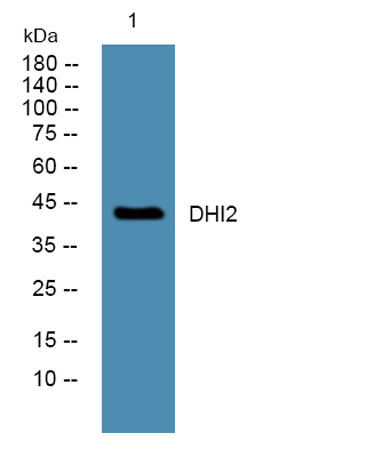
| Observed band (KD) | 44kD |
| Background | hydroxysteroid 11-beta dehydrogenase 2(HSD11B2) Homo sapiens There are at least two isozymes of the corticosteroid 11-beta-dehydrogenase, a microsomal enzyme complex responsible for the interconversion of cortisol and cortisone. The type I isozyme has both 11-beta-dehydrogenase (cortisol to cortisone) and 11-oxoreductase (cortisone to cortisol) activities. The type II isozyme, encoded by this gene, has only 11-beta-dehydrogenase activity. In aldosterone-selective epithelial tissues such as the kidney, the type II isozyme catalyzes the glucocorticoid cortisol to the inactive metabolite cortisone, thus preventing illicit activation of the mineralocorticoid receptor. In tissues that do not express the mineralocorticoid receptor, such as the placenta and testis, it protects cells from the growth-inhibiting and/or pro-apoptotic effects of cortisol, particularly during embryonic development. Mutations in this gene cause the syndrome of apparent mine |
| Function | catalytic activity:An 11-beta-hydroxysteroid + NAD(+) = an 11-oxosteroid + NADH.,disease:Defects in HSD11B2 are the cause of apparent mineralocorticoid excess (AME) [MIM:218030]. AME is a potentially fatal disease characterized by severe juvenile low-renin hypertension, sodium retention, hypokalemia and low levels of aldosterone. It often leads to nephrocalcinosis.,enzyme regulation:Inhibited by glycyrrhetinic acid (derived from liquorice), carbenoloxone and 11-alpha-OH-progesterone.,function:Catalyzes the conversion of cortisol to the inactive metabolite cortisone. Modulates intracellular glucocorticoid levels, thus protecting the nonselective mineralocorticoid receptor from occupation by glucocorticoids.,miscellaneous:Consumption of large amounts of liquorice can lead to apparent mineralocorticoid excess and hypertension.,similarity:Belongs to the short-chain dehydrogenases/reductases |
| Subcellular location | Microsome . Endoplasmic reticulum . |
| Expression | Expressed in kidney, placenta, pancreas, prostate, ovary, small intestine and colon, and in lower levels in the spleen and testis (PubMed:7859916). At midgestation, expressed at high levels in placenta and in fetal kidney and, at much lower levels, in fetal lung and testis (PubMed:8530071). |

Use collapsible tabs for more detailed information that will help customers make a purchasing decision.
Ex: Shipping and return policies, size guides, and other common questions.