 Français
 English

| ELK.No | ES9652 |
| Product name | DHB12 rabbit pAb |
| Reactivity | Human;Rat;Mouse; |
| Applications | WB;ELISA |
| Other name | |
| Size | 50μL |
| Unit price ($) | 148 |
| Human gene ID | 51144 |
| Human Swiss-Prot | Q53GQ0 |
| Source | Rabbit |
| Isotype | IgG |
| Target | DHB12 |
| Fields | >>Fatty acid elongation;>>Steroid hormone biosynthesis;>>Biosynthesis of unsaturated fatty acids;>>Metabolic pathways;>>Fatty acid metabolism |
| Gene name | HSD17B12 |
| Protein name | Estradiol 17-beta-dehydrogenase 12 (EC 1.1.1.62) (17-beta-hydroxysteroid dehydrogenase 12) (17-beta-HSD 12) (3-ketoacyl-CoA reductase) (KAR) (EC 1.3.1.-) |
| Human gene link | |
| Human Swiss link | View Human Swiss-Prot |
| Mouse gene ID | |
| Mouse gene link | |
| Mouse Swiss-Prot | O70503 |
| Mouse Swiss link | View Mouse Swiss-Prot |
| Rat gene ID | |
| Rat gene link | |
| Rat Swiss-Prot | Q6P7R8 |
| Rat Swiss link | View Rat Swiss-Prot |
| Immunogen | Synthesized peptide derived from part region of human protein |
| Specificity | DHB12 Polyclonal Antibody detects endogenous levels of protein. |
| Formulation | Liquid in PBS containing 50% glycerol, and 0.02% sodium azide. |
| Clonality | Polyclonal |
| Dilution | WB 1:500-2000 ELISA 1:5000-20000 |
| Purification | The antibody was affinity-purified from rabbit antiserum by affinity-chromatography using epitope-specific immunogen. |
| Concentration | 1 mg/ml |
| Storage stability | -20°C/1 year |
| Molecular Weight (Da) | |
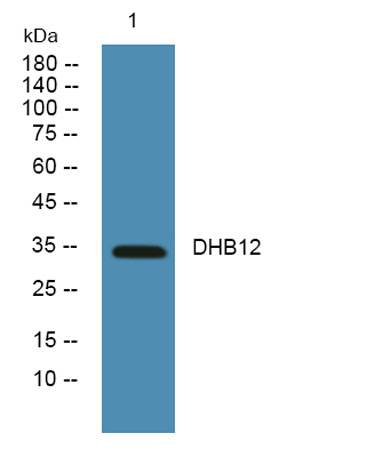
| Observed band (KD) | 34kD |
| Background | This gene encodes a very important 17beta-hydroxysteroid dehydrogenase (17beta-HSD) that converts estrone into estradiol in ovarian tissue. This enzyme is also involved in fatty acid elongation. [provided by RefSeq, Oct 2011], |
| Function | catalytic activity:Estradiol-17-beta + NAD(P)(+) = estrone + NAD(P)H.,domain:The di-lysine motif confers endoplasmic reticulum localization for type I membrane proteins.,function:Catalyzes the transformation of estrone (E1) into estradiol (E2), suggesting a central role in estrogen formation. Its strong expression in ovary and mammary gland suggest that it may constitute the major enzyme responsible for the conversion of E1 to E2 in women. Also has 3-ketoacyl-CoA reductase activity, reducing both long chain 3-ketoacyl-CoAs and long chain fatty acyl-CoAs, suggesting a role in long fatty acid elongation.,pathway:Lipid metabolism; fatty acid biosynthesis.,pathway:Steroid biosynthesis; estrogen biosynthesis.,similarity:Belongs to the short-chain dehydrogenases/reductases (SDR) family. 17-beta-HSD 3 subfamily.,tissue specificity:Expressed in most tissues tested. Highly expressed in the ovary |
| Subcellular location | Endoplasmic reticulum membrane ; Multi-pass membrane protein . |
| Expression | Expressed in most tissues tested. Highly expressed in the ovary and mammary. Expressed in platelets. |

Use collapsible tabs for more detailed information that will help customers make a purchasing decision.
Ex: Shipping and return policies, size guides, and other common questions.
