 Français
 English
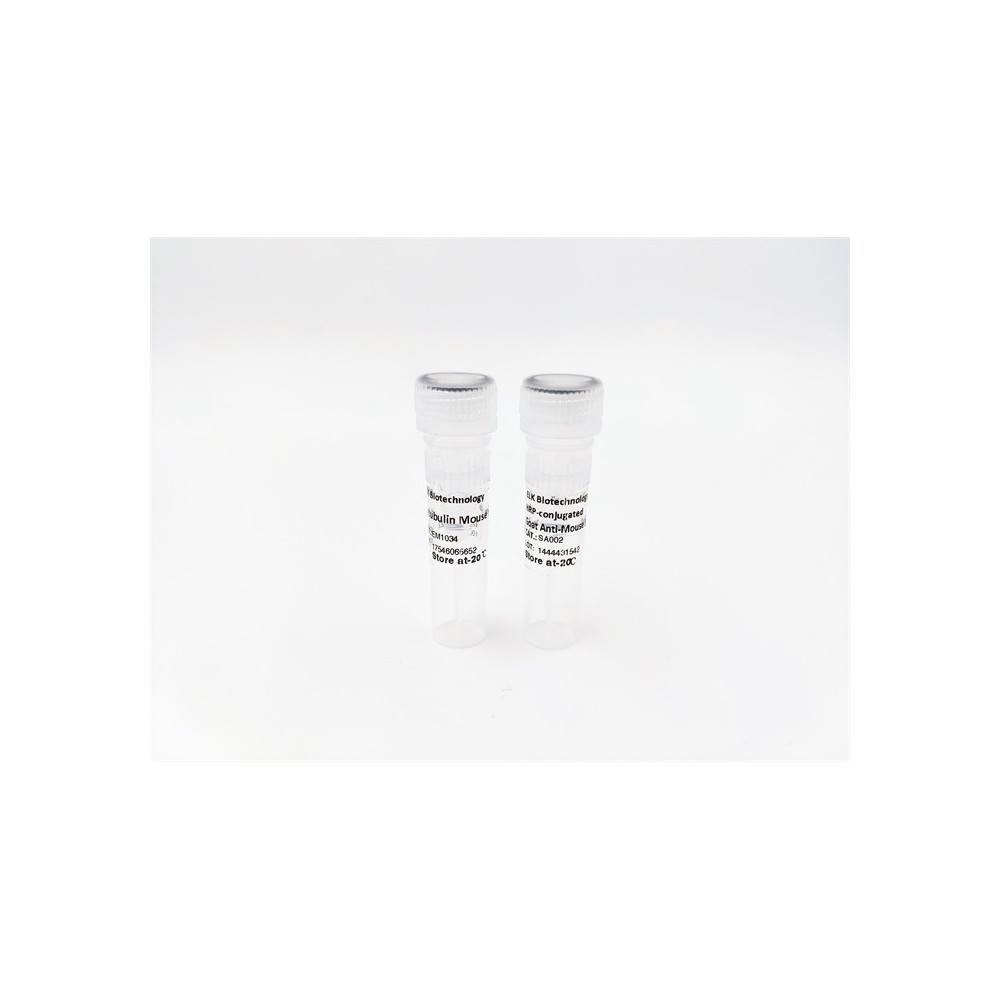

| ELK.No | ES9691 |
| Product name | GEM rabbit pAb |
| Reactivity | Human;Rat;Mouse; |
| Applications | WB;ELISA |
| Other name | |
| Size | 100μL |
| Unit price ($) | 248 |
| Human gene ID | 2669 |
| Human Swiss-Prot | P55040 |
| Source | Rabbit |
| Isotype | IgG |
| Target | GEM |
| Fields | |
| Gene name | GEM KIR |
| Protein name | GTP-binding protein GEM (GTP-binding mitogen-induced T-cell protein) (RAS-like protein KIR) |
| Human gene link | |
| Human Swiss link | View Human Swiss-Prot |
| Mouse gene ID | |
| Mouse gene link | |
| Mouse Swiss-Prot | P55041 |
| Mouse Swiss link | View Mouse Swiss-Prot |
| Rat gene ID | |
| Rat gene link | |
| Rat Swiss-Prot | |
| Rat Swiss link | |
| Immunogen | Synthesized peptide derived from part region of human protein |
| Specificity | GEM Polyclonal Antibody detects endogenous levels of protein. |
| Formulation | Liquid in PBS containing 50% glycerol, and 0.02% sodium azide. |
| Clonality | Polyclonal |
| Dilution | WB 1:500-2000 ELISA 1:5000-20000 |
| Purification | The antibody was affinity-purified from rabbit antiserum by affinity-chromatography using epitope-specific immunogen. |
| Concentration | 1 mg/ml |
| Storage stability | -20°C/1 year |
| Molecular Weight (Da) | |
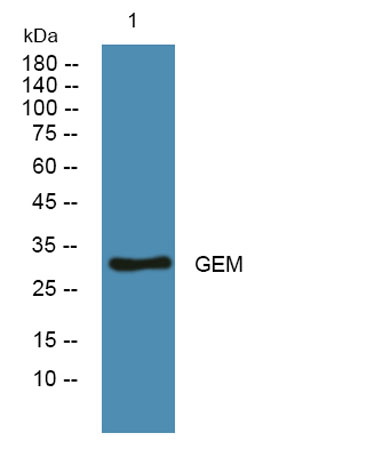
| Observed band (KD) | 32kD |
| Background | The protein encoded by this gene belongs to the RAD/GEM family of GTP-binding proteins. It is associated with the inner face of the plasma membrane and could play a role as a regulatory protein in receptor-mediated signal transduction. Alternative splicing occurs at this locus and two transcript variants encoding the same protein have been identified. [provided by RefSeq, Jul 2008], |
| Function | function:Could be a regulatory protein, possibly participating in receptor-mediated signal transduction at the plasma membrane. Has guanine nucleotide-binding activity but undetectable intrinsic GTPase activity.,induction:By mitogens.,PTM:Phosphorylated on tyrosine residues.,similarity:Belongs to the small GTPase superfamily. RGK family.,subunit:Interacts with calmodulin in a Ca(2+)-dependent manner. Binds ROCK1.,tissue specificity:Most abundant in thymus, spleen, kidney, lung, and testis. Less abundant in heart, brain, liver and skeletal muscle., |
| Subcellular location | Cell membrane; Peripheral membrane protein; Cytoplasmic side. |
| Expression | Most abundant in thymus, spleen, kidney, lung, and testis. Less abundant in heart, brain, liver and skeletal muscle. |

Use collapsible tabs for more detailed information that will help customers make a purchasing decision.
Ex: Shipping and return policies, size guides, and other common questions.
