 Français
 English
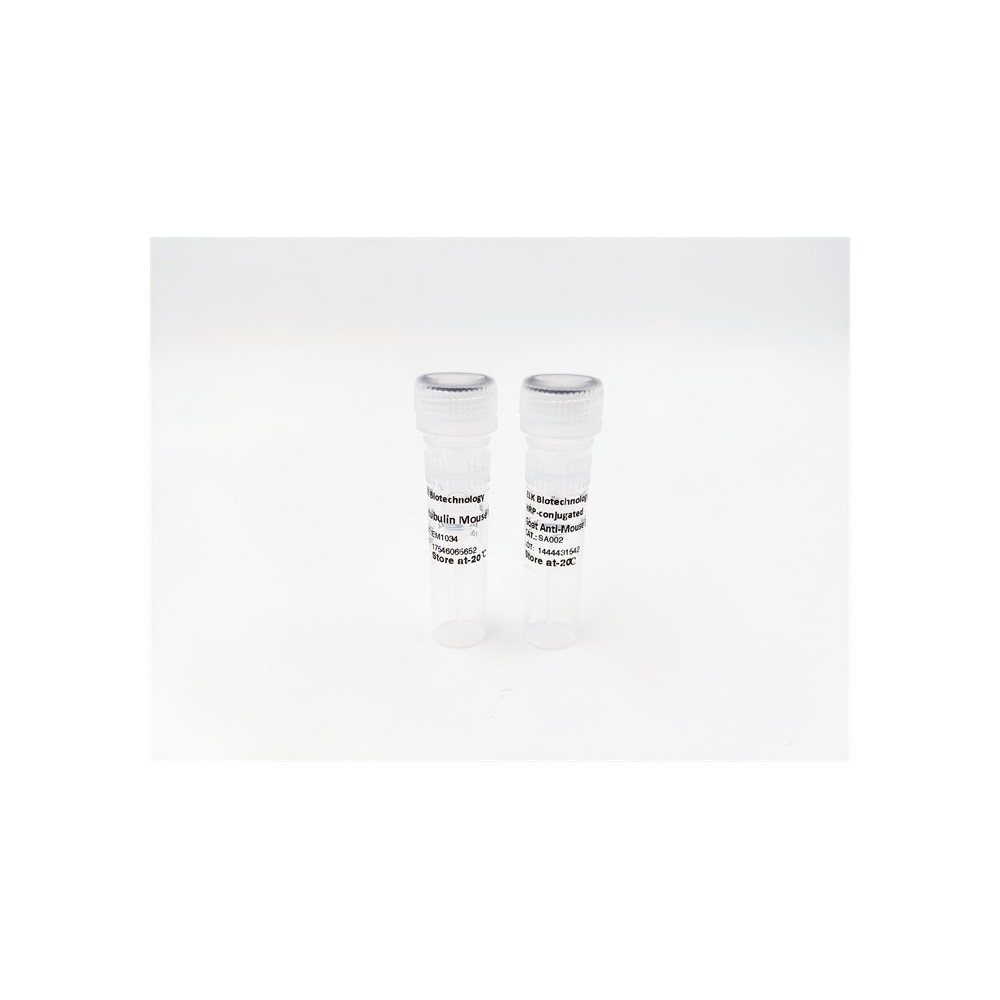

| ELK.No | ES9755 |
| Product name | IRK13 rabbit pAb |
| Reactivity | Human;Rat;Mouse; |
| Applications | WB;ELISA |
| Other name | |
| Size | 50μL |
| Unit price ($) | 148 |
| Human gene ID | 3769 |
| Human Swiss-Prot | O60928 |
| Source | Rabbit |
| Isotype | IgG |
| Target | IRK13 |
| Fields | >>Protein digestion and absorption |
| Gene name | KCNJ13 |
| Protein name | Inward rectifier potassium channel 13 (Inward rectifier K(+) channel Kir7.1) (Potassium channel, inwardly rectifying subfamily J member 13) |
| Human gene link | |
| Human Swiss link | View Human Swiss-Prot |
| Mouse gene ID | |
| Mouse gene link | |
| Mouse Swiss-Prot | P86046 |
| Mouse Swiss link | View Mouse Swiss-Prot |
| Rat gene ID | |
| Rat gene link | |
| Rat Swiss-Prot | O70617 |
| Rat Swiss link | View Rat Swiss-Prot |
| Immunogen | Synthesized peptide derived from part region of human protein |
| Specificity | IRK13 Polyclonal Antibody detects endogenous levels of protein. |
| Formulation | Liquid in PBS containing 50% glycerol, and 0.02% sodium azide. |
| Clonality | Polyclonal |
| Dilution | WB 1:500-2000 ELISA 1:5000-20000 |
| Purification | The antibody was affinity-purified from rabbit antiserum by affinity-chromatography using epitope-specific immunogen. |
| Concentration | 1 mg/ml |
| Storage stability | -20°C/1 year |
| Molecular Weight (Da) | |
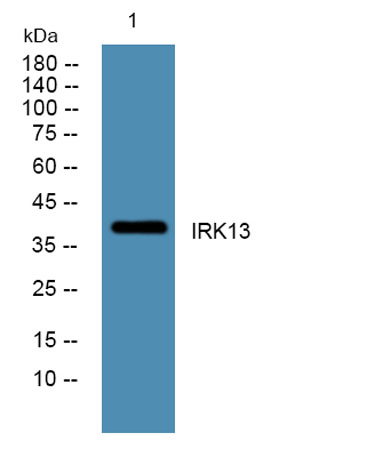
| Observed band (KD) | 39kD |
| Background | This gene encodes a member of the inwardly rectifying potassium channel family of proteins. Members of this family form ion channel pores that allow potassium ions to pass into a cell. The encoded protein belongs to a subfamily of low signal channel conductance proteins that have a low dependence on potassium concentration. Mutations in this gene are associated with snowflake vitreoretinal degeneration. Alternate splicing results in multiple transcript variants.[provided by RefSeq, Feb 2010], |
| Function | disease:Defects in KCNJ13 are the cause of snowflake vitreoretinal degeneration (SVD) [MIM:193230]. SVD is a developmental and progressive hereditary eye disorder that affects multiple tissues within the eye. Diagnostic features of SVD include fibrillar degeneration of the vitreous humor, early-onset cataract, minute crystalline deposits in the neurosensory retina, and retinal detachment.,function:Inward rectifier potassium channels are characterized by a greater tendency to allow potassium to flow into the cell rather than out of it. Their voltage dependence is regulated by the concentration of extracellular potassium; as external potassium is raised, the voltage range of the channel opening shifts to more positive voltages. The inward rectification is mainly due to the blockage of outward current by internal magnesium. KCNJ13 has a very low single channel conductance, low sensitivity t |
| Subcellular location | Membrane; Multi-pass membrane protein. |
| Expression | Predominantly expressed in small intestine. Expression is also detected in stomach, kidney, and all central nervous system regions tested with the exception of spinal cord. |

Use collapsible tabs for more detailed information that will help customers make a purchasing decision.
Ex: Shipping and return policies, size guides, and other common questions.
