 Français
 English

Product Information
|
Protein full name |
Cyclin-dependent kinase inhibitor 1 |
|
Synonyms |
CDKN1A, CAP20, CDKN1, CIP1, MDA-6, P21, SDI1, WAF1, p21CIP1, p21, cyclin-dependent kinase inhibitor 1A, cyclin dependent kinase inhibitor 1A |
|
Uniprot ID |
P38936 |
|
Immunogen |
Recombinant protein corresponding to Human p21 |
|
Isotype |
IgG |
|
Clone Number |
SB318 |
|
Predicted MW./Observed MW. |
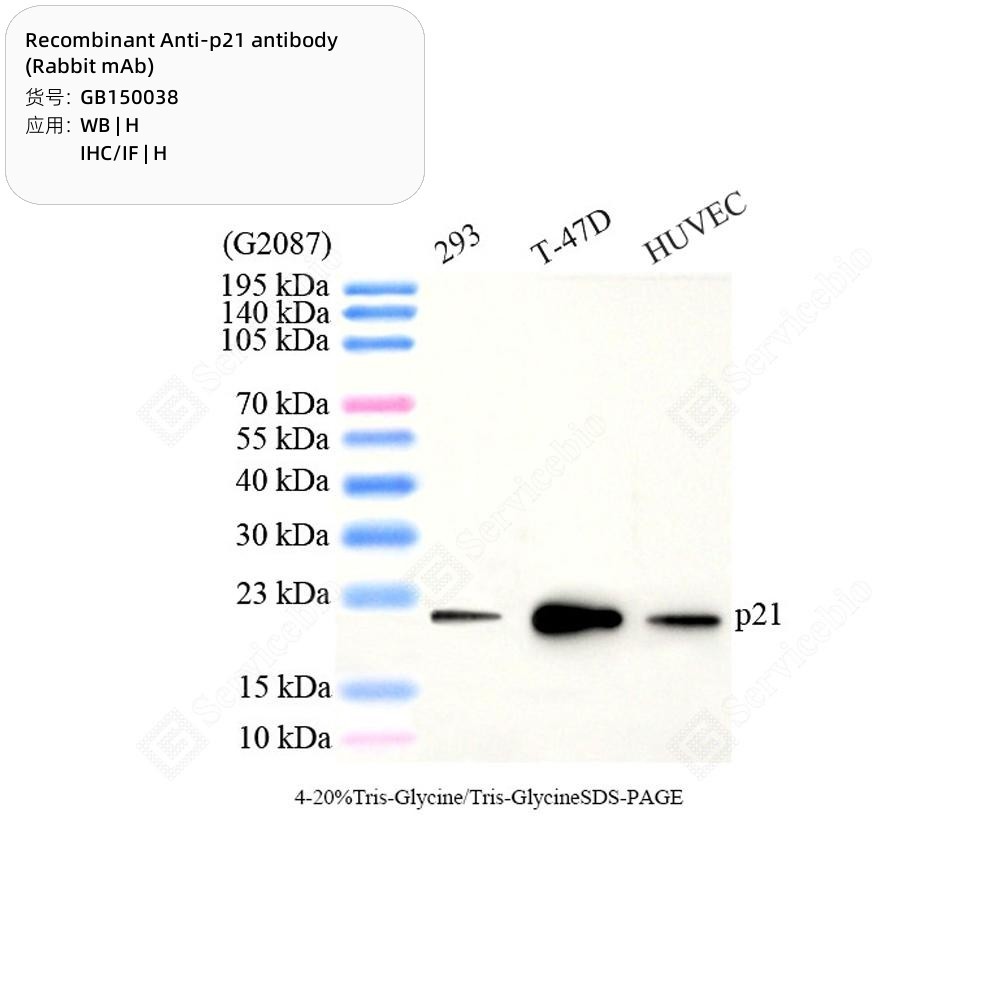
19 kDa / 20 kDa |
|
Purity |
Affinity purification |
|
Subcellular location |
Nucleus, Cytoplasm |
Applications
| Applications | Species | Dilution | Positive Tissue |
| WB | Human | 1: 1000-1: 2000 | 293, T-47D, HUVEC |
| IHC/IF | Human | 1: 300-1: 1000 | cervical carcinoma,lung cancer, skin squamous carcinoma |
Background
May be involved in p53/TP53 mediated inhibition of cellular proliferation in response to DNA damage. Binds to and inhibits cyclin-dependent kinase activity, preventing phosphorylation of critical cyclin-dependent kinase substrates and blocking cell cycle progression. Functions in the nuclear localization and assembly of cyclin D-CDK4 complex and promotes its kinase activity towards RB1. At higher stoichiometric ratios, inhibits the kinase activity of the cyclin D-CDK4 complex. Inhibits DNA synthesis by DNA polymerase delta by competing with POLD3 for PCNA binding.
Images
|
|
WB analysis of p21(GB150038). Sample: Protein treated by RIPA Lysis Buffer (G2002). Blocking buffer: 3% Nonfat dry milk (GC310001) in TBST, RT, 1h. Primary antibody: 1: 1000, 4℃ overnight. Secondary antibody: HRP conjugated Goat Anti-Rabbit lgG (H+L) (GB23303), 1: 5000, RT, 1h. |
|
|
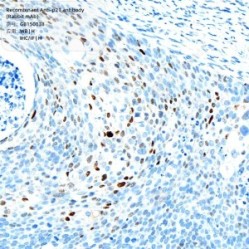
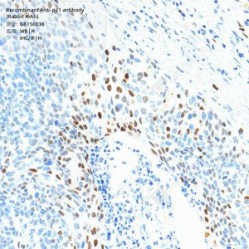
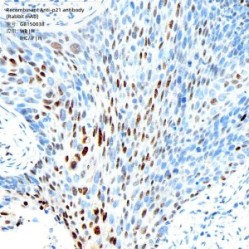
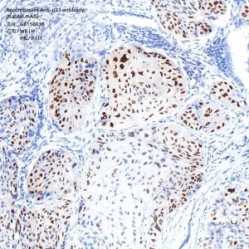
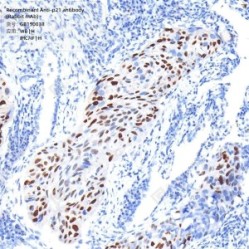
IHC analysis of p21(GB150038). Sample: Human cervical carcinoma, 4% PFA (G1101) 12-24h. Antigen retrieval: Citrate buffer (pH 6.0) (G1201), pressure cooker 2 min. Primary antibody: 1: 500, 4℃ overnight. Secondary antibody: S-vision poly-HRP conjugated Goat Anti-Rabbit lgG (H+L), Ready to use(G1302), RT, 20min. |
|
|
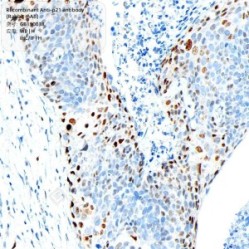
IHC analysis of p21(GB150038). Sample: Human cervical carcinoma, 4% PFA (G1101) 12-24h. Antigen retrieval: Citrate buffer (pH 6.0) (G1201), pressure cooker 2 min. Primary antibody: 1: 500, 4℃ overnight. Secondary antibody: S-vision poly-HRP conjugated Goat Anti-Rabbit lgG (H+L), Ready to use(G1302), RT, 20min. |
|
|
IHC analysis of p21(GB150038). Sample: Human cervical carcinoma, 4% PFA (G1101) 12-24h. Antigen retrieval: Citrate buffer (pH 6.0) (G1201), pressure cooker 2 min. Primary antibody: 1: 500, 4℃ overnight. Secondary antibody: S-vision poly-HRP conjugated Goat Anti-Rabbit lgG (H+L), Ready to use(G1302), RT, 20min. |
|
|
IHC analysis of p21(GB150038). Sample: Human cervical carcinoma, 4% PFA (G1101) 12-24h. Antigen retrieval: Citrate buffer (pH 6.0) (G1201), pressure cooker 2 min. Primary antibody: 1: 500, 4℃ overnight. Secondary antibody: S-vision poly-HRP conjugated Goat Anti-Rabbit lgG (H+L), Ready to use(G1302), RT, 20min. |
|
|
IHC analysis of p21(GB150038). Sample: Human lung cancer, 4% PFA (G1101) 12-24h. Antigen retrieval: Citrate buffer (pH 6.0) (G1201), pressure cooker 2 min. Primary antibody: 1: 500, 4℃ overnight. Secondary antibody: S-vision poly-HRP conjugated Goat Anti-Rabbit lgG (H+L), Ready to use(G1302), RT, 20min. |
|
|
IHC analysis of p21(GB150038). Sample: Human lung cancer, 4% PFA (G1101) 12-24h. Antigen retrieval: Citrate buffer (pH 6.0) (G1201), pressure cooker 2 min. Primary antibody: 1: 500, 4℃ overnight. Secondary antibody: S-vision poly-HRP conjugated Goat Anti-Rabbit lgG (H+L), Ready to use(G1302), RT, 20min. |
|
|
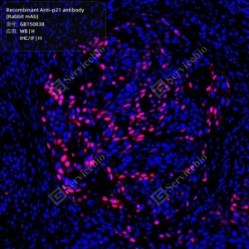
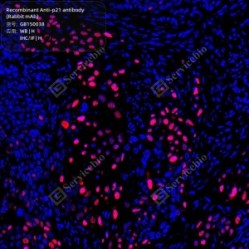
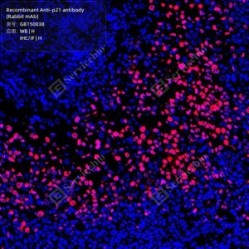
IF analysis of p21(GB150038)red. Sample: Human cervical carcinoma, 4% PFA (G1101) 12-24h. Antigen retrieval: Citrate buffer (pH 6.0) (G1201), pressure cooker 2 min. Blocking buffer: 3% BSA (GC305010) in PBS, RT, 30min. Primary antibody: 1: 300, 4℃ overnight. Secondary antibody: Cy3 conjugated Goat Anti-Rabbit IgG (H+L) (GB21303), 1: 300, RT, 1h. |
|
|
IF analysis of p21(GB150038)red. Sample: Human cervical carcinoma, 4% PFA (G1101) 12-24h. Antigen retrieval: Citrate buffer (pH 6.0) (G1201), pressure cooker 2 min. Blocking buffer: 3% BSA (GC305010) in PBS, RT, 30min. Primary antibody: 1: 300, 4℃ overnight. Secondary antibody: Cy3 conjugated Goat Anti-Rabbit IgG (H+L) (GB21303), 1: 300, RT, 1h. |
|
|
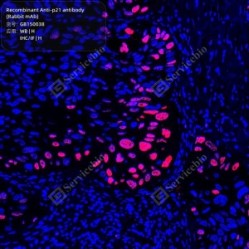
IF analysis of p21(GB150038)red. Sample: Human lung cancer, 4% PFA (G1101) 12-24h. Antigen retrieval: Citrate buffer (pH 6.0) (G1201), pressure cooker 2 min. Blocking buffer: 3% BSA (GC305010) in PBS, RT, 30min. Primary antibody: 1: 300, 4℃ overnight. Secondary antibody: Cy3 conjugated Goat Anti-Rabbit IgG (H+L) (GB21303), 1: 300, RT, 1h. |
|
|
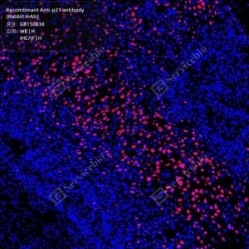
IF analysis of p21(GB150038)red. Sample: Human skin squamous carcinoma IF. svs, 4% PFA (G1101) 12-24h. Antigen retrieval: Citrate buffer (pH 6.0) (G1201), pressure cooker 2 min. Blocking buffer: 3% BSA (GC305010) in PBS, RT, 30min. Primary antibody: 1: 300, 4℃ overnight. Secondary antibody: Cy3 conjugated Goat Anti-Rabbit IgG (H+L) (GB21303), 1: 300, RT, 1h. |
|
|
IF analysis of p21(GB150038)red. Sample: Human skin squamous carcinoma IF. svs, 4% PFA (G1101) 12-24h. Antigen retrieval: Citrate buffer (pH 6.0) (G1201), pressure cooker 2 min. Blocking buffer: 3% BSA (GC305010) in PBS, RT, 30min. Primary antibody: 1: 300, 4℃ overnight. Secondary antibody: Cy3 conjugated Goat Anti-Rabbit IgG (H+L) (GB21303), 1: 300, RT, 1h. |
Storage
| Storage | Store at -20℃ for one year. Avoid repeated freeze/thaw cycles. |
| Storage Buffer | PBS with 0.15% ProClin300, 100 μg/mL BSA and 50% glycerol. |
NOTE:
1.This product is intended for research only.
2.This product is recommended to dilute with the Primary Antibody Dilution Buffer (G2025).

Use collapsible tabs for more detailed information that will help customers make a purchasing decision.
Ex: Shipping and return policies, size guides, and other common questions.


