 Français
 English

| ELK.No | EM1071 |
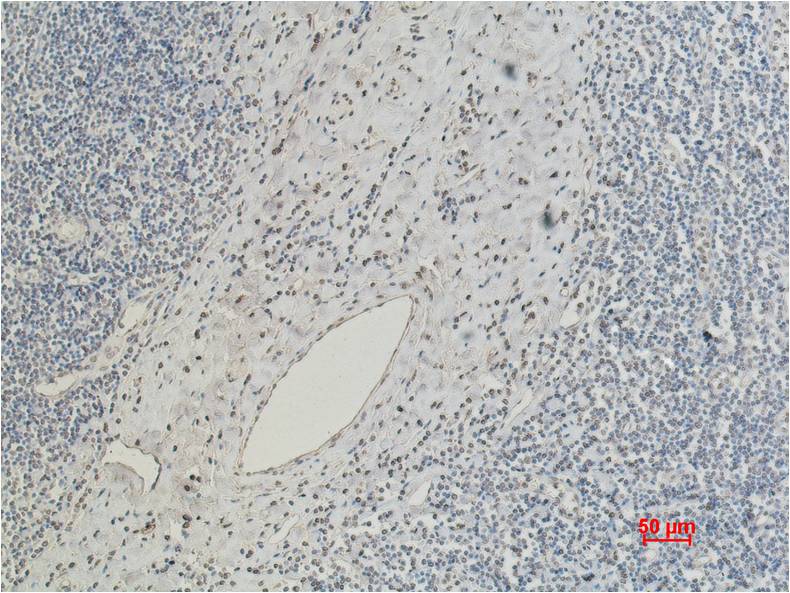
| Product name | CD5 Mouse mAb |
| Reactivity | Human, Rat, Mouse |
| Applications | IHC |
| Other name | CD5 molecule, LEU1, Lymphocyte antigen T1/Leu 1, T1 |
| Size | 100μL |
| Unit price ($) | 248 |
| Human gene ID | 921 |
| Human Swiss-Prot | P06127 |
| Source | Mouse |
| Isotype | IgG1 |
| Target | |
| Fields | |
| Gene name | |
| Protein name | |
| Human gene link | |
| Human Swiss link | |
| Mouse gene ID | |
| Mouse gene link | |
| Mouse Swiss-Prot | |
| Mouse Swiss link | |
| Rat gene ID | |
| Rat gene link | |
| Rat Swiss-Prot | |
| Rat Swiss link | |
| Immunogen | Synthetic Peptide |
| Specificity | |
| Formulation | |
| Clonality | Monoclonal |
| Dilution | IHC 1:100-200 |
| Purification | |
| Concentration | 1mg/mL |
| Storage stability | PBS with 0.02% sodium azide and 50% glycerol pH 7.4. Store at -20°C. Avoid repeated freeze-thaw cycles. |
| Molecular Weight (Da) | |
| Observed band (KD) | |
| Background | CD5 is a cluster of differentiation found on a subset of IgM-secreting B cells called B-1 cells, and also on T cells. B-1 cells have limited diversity of their B-cell receptor due to their lack of the enzyme terminal deoxynucleotidyl transferase (TdT) and are potentially self-reactive. CD5 serves to mitigate activating signals from the BCR so that the B-1 cells can only be activated by very strong stimuli (such as bacterial proteins) and not by normal tissue proteins. |
| Function | |
| Subcellular location | Membrane |
| Expression |

Use collapsible tabs for more detailed information that will help customers make a purchasing decision.
Ex: Shipping and return policies, size guides, and other common questions.