Français
 English



Product Information
|
Protein full name |
Prostatic acid phosphatase |
|
Synonyms |
ACPP, 5'-NT, ACP-3, ACP3, acid phosphatase prostate, PAP, PPAP,Prostatic acid phosphatase, TMPase |
|
Uniprot ID |
Q8CE08 |
|
Immunogen |
Recombinant protein corresponding to Mouse PAP |
|
Isotype |
IgG |
|
Predicted MW./Observed MW. |
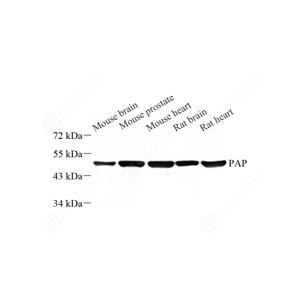
48 kDa / 48 kDa |
|
Purity |
Affinity purification |
Applications
| Applications | Species | Dilution | Positive Tissue |
| WB | Mouse, Rat | 1: 500-1: 1000 | brain, heart, prostate |
Background
Prostatic acid phosphatase (PAP) is an enzyme produced by the prostate. It may be found in increased amounts in men who have prostate cancer or other diseases.The highest levels of acid phosphatase are found in metastasized prostate cancer. Diseases of the bone, such as Paget's disease or hyperparathyroidism, diseases of blood cells, such as sickle-cell disease or multiple myeloma or lysosomal storage diseases, such as Gaucher's disease, will show moderately increased levels.
Images
|
|
WB analysis of PAP(GB11873). Sample: Protein treated by RIPA Lysis Buffer (G2002). Blocking buffer: 3% Nonfat dry milk (GC310001) in TBST, RT, 1h. Primary antibody: 1: 500, 4℃ overnight. Secondary antibody: HRP conjugated Goat Anti-Rabbit lgG (H+L) (GB23303), 1: 5000, RT, 1h. |
Storage
| Storage | Store at -20℃ for one year. Avoid repeated freeze/thaw cycles. |
| Storage Buffer | PBS with 0.15% ProClin300, 100 μg/mL BSA and 50% glycerol. |
NOTE:
1.This product is intended for research only.
2.This product is recommended to dilute with the Primary Antibody Dilution Buffer (G2025).
Use collapsible tabs for more detailed information that will help customers make a purchasing decision.
Ex: Shipping and return policies, size guides, and other common questions.