Français
 English



Product Information
Protein full name | Alkaline phosphatase, placental type (EC 3.1.3.1) (Alkaline phosphatase Regan isozyme) (Placental alkaline phosphatase 1) (PLAP-1) |
Gene Id | 250 |
Immunogen | Synthesized peptide derived from human Placental Alkaline Phosphatase(PLAP) |
Uniprot ID | P05187 |
Source | Mouse/IgG1, Kappa |
Concentration | 1 mg/ml |
Purity | The antibody was affinity-purified from mouse ascites by affinity-chromatography using specific immunogen. |
Applications
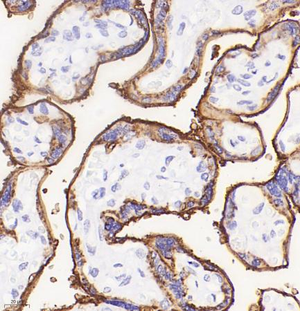
IHC/IF | Human | 1: 200-1: 500 | placenta |
Background
alkaline phosphatase, placental(ALPP) Homo sapiens The protein encoded by this gene is an alkaline phosphatase, a metalloenzyme that catalyzes the hydrolysis of phosphoric acid monoesters. It belongs to a multigene family composed of four alkaline phosphatase isoenzymes. The enzyme functions as a homodimer and has a catalytic site containing one magnesium and two zinc ions, which are required for its enzymatic function. The protein is primarily expressed in placental and endometrial tissue; however, strong ectopic expression has been detected in ovarian adenocarcinoma, serous cystadenocarcinoma, and other ovarian cancer cells. [provided by RefSeq, Jan 2015],
Images
|
Immunohistochemistry analysis of paraffin embedded human placenta using PLAP (GB14135) at dilution of 1: 200 |
Storage
| Storage | Store at -20 ℃ for one year. Avoid repeated freeze/thaw cycles. |
| Storage Buffer | Liquid in PBS containing 50% glycerol, 0.5% BSA and 0.02% sodium azide. |
NOTE:
1.This product is intended for research only.
2.This product is recommended to dilute with the Primary Antibody Dilution Buffer (G2025).
Use collapsible tabs for more detailed information that will help customers make a purchasing decision.
Ex: Shipping and return policies, size guides, and other common questions.