Recombinant Anti-MLKL antibody (Rabbit mAb)

AO-03-GB155699-50
hMLKL,Mixed lineage kinase domain like,Mixed lineage kinase domain like protein,Mixed lineage kinase domain-like protein,mixed lineage kinase domain like pseudokinase
check In Stock
Hurry! only 10 items left in stock.
€299.00
Tax excluded
Quantity

Product Information


Protein full name

Mixed lineage kinase domain-like protein

Synonyms

hMLKL, Mixed lineage kinase domain like, Mixed lineage kinase domain like protein, Mixed lineage kinase domain-like protein, mixed lineage kinase domain like pseudokinase

Uniprot ID

Q8NB16

Immunogen

Recombinant protein corresponding to Human MLKL

Isotype

IgG

Clone Number

SB386

Predicted MW./Observed MW.

54 kDa / 54 kDa

Purity

Affinity purification

Subcellular location

Cytoplasm, Cell membrane, Nucleus


Applications


Applications Species Dilution Positive Tissue
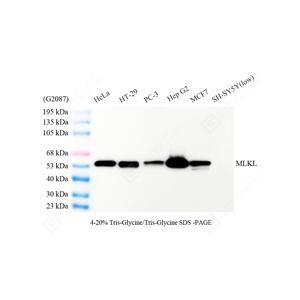
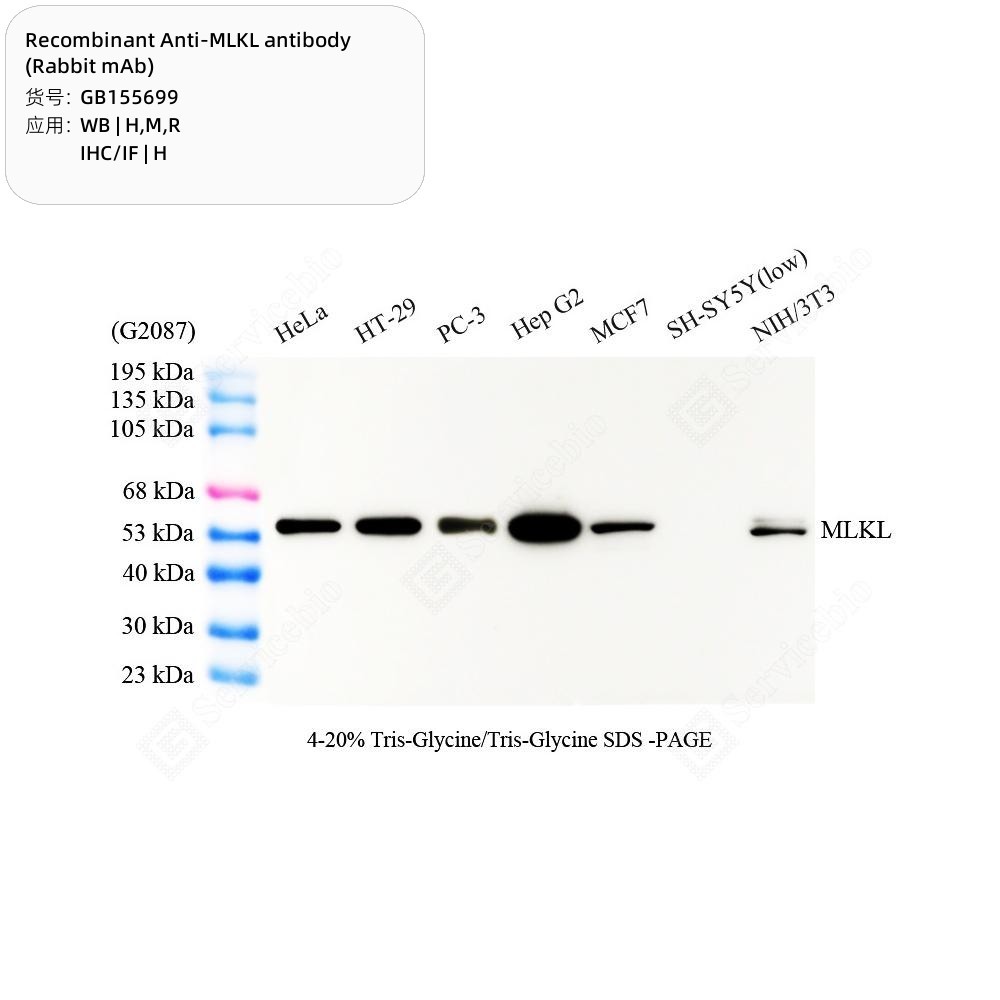
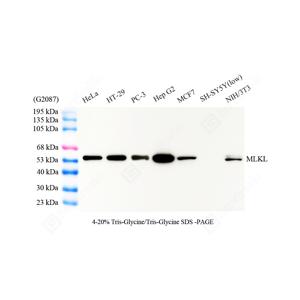
WB Human, Mouse, Rat 1: 1000-1: 2000 HeLa, HT-29, MCF7
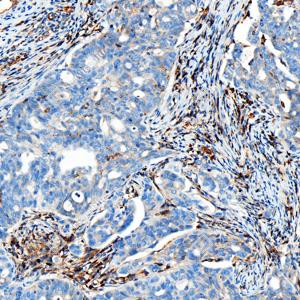
IHC/IF Human 1: 500-1: 1500 colon cancer, esophagus, ovarian cancer


Background

This gene belongs to the protein kinase superfamily. The encoded protein contains a protein kinase-like domain; however, is thought to be inactive because it lacks several residues required for activity. This protein plays a critical role in tumor necrosis factor (TNF)-induced necroptosis, a programmed cell death process, via interaction with receptor-interacting protein 3 (RIP3), which is a key signaling molecule in necroptosis pathway. Inhibitor studies and knockdown of this gene inhibited TNF-induced necrosis. High levels of this protein and RIP3 are associated with inflammatory bowel disease in children. Alternatively spliced transcript variants have been described for this gene.


Images

01bLbx4KRc49uMh.jpg

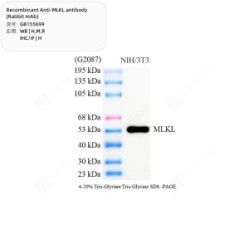
WB analysis of MLKL(GB155699).
Sample: Protein treated by RIPA Lysis Buffer (G2002).
Blocking buffer: 3% Nonfat dry milk (GC310001) in TBST, RT, 1h.
Primary antibody: 1: 1000, 4℃ overnight.
Secondary antibody: HRP conjugated Goat Anti-Rabbit lgG (H+L) (GB23303), 1: 5000, RT, 1h.

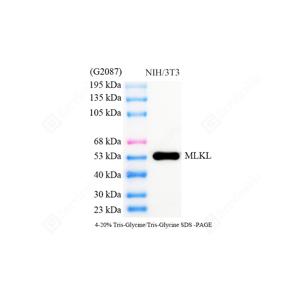
02kxdubWnVXIgQr.jpg

WB analysis of MLKL(GB155699).
Sample: Protein treated by RIPA Lysis Buffer (G2002).
Blocking buffer: 3% Nonfat dry milk (GC310001) in TBST, RT, 1h.
Primary antibody: 1: 1000, 4℃ overnight.
Secondary antibody: HRP conjugated Goat Anti-Rabbit lgG (H+L) (GB23303), 1: 5000, RT, 1h.

03sHTguZ0oKB9Ab.jpg

WB analysis of MLKL(GB155699).
Sample: Protein treated by RIPA Lysis Buffer (G2002).
Blocking buffer: 3% Nonfat dry milk (GC310001) in TBST, RT, 1h.
Primary antibody: 1: 1000, 4℃ overnight.
Secondary antibody: HRP conjugated Goat Anti-Rabbit lgG (H+L) (GB23303), 1: 5000, RT, 1h.

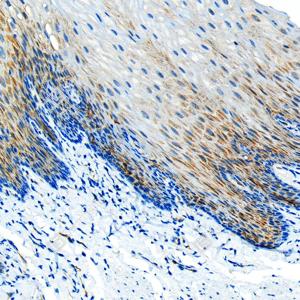
04wu8wvDLYr3NqI.jpg

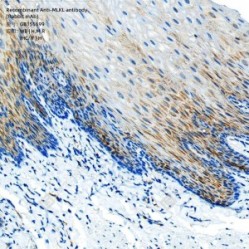
IHC analysis of MLKL(GB155699).
Sample: Human esophagus, 4% PFA (G1101) 12-24h.
Antigen retrieval: Citrate buffer (pH 6.0) (G1201), pressure cooker 2 min.
Primary antibody: 1: 750, 4℃ overnight.
Secondary antibody: S-vision poly-HRP conjugated Goat Anti-Rabbit lgG (H+L), Ready to use(G1302), RT, 20min.

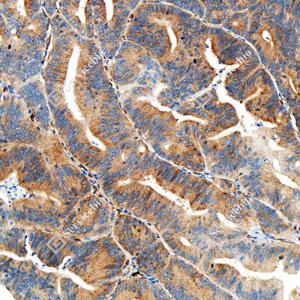
051tYOm5AoOsvUP.jpg

IHC analysis of MLKL(GB155699).
Sample: Human colon cancer, 4% PFA (G1101) 12-24h.
Antigen retrieval: Citrate buffer (pH 6.0) (G1201), pressure cooker 2 min.
Primary antibody: 1: 750, 4℃ overnight.
Secondary antibody: S-vision poly-HRP conjugated Goat Anti-Rabbit lgG (H+L), Ready to use(G1302), RT, 20min.

06Z7Ya1hUf3upYu.jpg

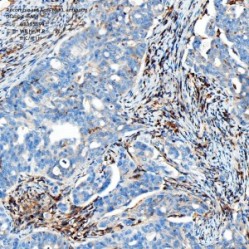
IHC analysis of MLKL(GB155699).
Sample: Human ovarian cancer, 4% PFA (G1101) 12-24h.
Antigen retrieval: Citrate buffer (pH 6.0) (G1201), pressure cooker 2 min.
Primary antibody: 1: 750, 4℃ overnight.
Secondary antibody: S-vision poly-HRP conjugated Goat Anti-Rabbit lgG (H+L), Ready to use(G1302), RT, 20min.


Storage


Storage Store at -20℃ for one year. Avoid repeated freeze/thaw cycles.
Storage Buffer PBS with 0.15% ProClin300, 100 μg/mL BSA and 50% glycerol.


NOTE:

1.This product is intended for research only.

2.This product is recommended to dilute with the Primary Antibody Dilution Buffer (G2025).


: AO-03-GB155699-50
: 10 Items
Hurry! only 10 items left in stock.

Use collapsible tabs for more detailed information that will help customers make a purchasing decision.

Ex: Shipping and return policies, size guides, and other common questions.

  • Paste the label on a flat surface on the package
  • Make sure that both 1D and 2D barcodes are clearly visible
  • Ensure that the label is smooth and isn’t creased or wrinkled
  • Check for any tears, dents, holes or scratches
  • Pack your product tightly, with the right size packaging
  • Ensure both barcodes are on a flat surface of the package