 Français
 English

| ELK.No | EA304 |
| Product name | KChIP1 Rabbit pAb |
| Reactivity | Human, Mouse |
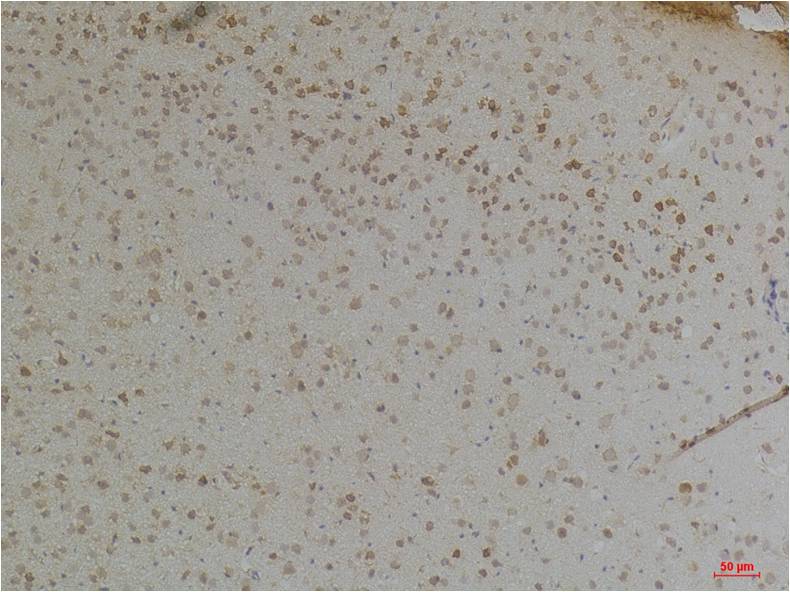
| Applications | IHC |
| Other name | KCNIP1,MGC9,MGC95,A type potassium channel modulatory protein 1 |
| Size | 50μL |
| Unit price ($) | 148 |
| Human gene ID | 30820 |
| Human Swiss-Prot | Q9NZI2 |
| Source | Rabbit |
| Isotype | IgG |
| Target | |
| Fields | |
| Gene name | |
| Protein name | |
| Human gene link | |
| Human Swiss link | |
| Mouse gene ID | |
| Mouse gene link | |
| Mouse Swiss-Prot | |
| Mouse Swiss link | |
| Rat gene ID | |
| Rat gene link | |
| Rat Swiss-Prot | |
| Rat Swiss link | |
| Immunogen | Synthetic Peptide |
| Specificity | |
| Formulation | |
| Clonality | Polyclonal |
| Dilution | IHC 1:100-200 |
| Purification | |
| Concentration | 1mg/mL |
| Storage stability | PBS with 0.02% sodium azide and 50% glycerol pH 7.4. Store at -20°C. Avoid repeated freeze-thaw cycles. |
| Molecular Weight (Da) | |
| Observed band (KD) | 30kDa |
| Background | Human K(v) channel interacting protein 1 (KCHIP1) is a new member of the neural calcium binding protein superfamily. Members of the KCNIP family are small calcium binding proteins. They all have EF-hand-like domains, and differ from each other in the N-terminus. They are integral subunit components of native Kv4 channel complexes. They may regulate A-type currents, and hence neuronal excitability, in response to changes in intracellular calcium. KChIP1 is a neuronal calcium sensor protein that is predominantly expressed at GABAergic synapses and it has been related with modulation of K(+) channels, GABAergic transmission and cell death. |
| Function | |
| Subcellular location | Cell membrane, Cell projection, Cytoplasm, Membrane |
| Expression |

Use collapsible tabs for more detailed information that will help customers make a purchasing decision.
Ex: Shipping and return policies, size guides, and other common questions.