 Français
 English

| ELK.No | ES10025 |
| Product name | KCNE1 rabbit pAb |
| Reactivity | Human;Rat;Mouse |
| Applications | WB;ELISA |
| Other name | |
| Size | 50μL |
| Unit price ($) | 148 |
| Human gene ID | 3753 |
| Human Swiss-Prot | P15382 |
| Source | Rabbit |
| Isotype | IgG |
| Target | KCNE1 |
| Fields | >>Adrenergic signaling in cardiomyocytes |
| Gene name | KCNE1 |
| Protein name | Potassium voltage-gated channel subfamily E member 1 (Delayed rectifier potassium channel subunit IsK) (IKs producing slow voltage-gated potassium channel subunit beta Mink) (Minimal potassium channel |
| Human gene link | |
| Human Swiss link | View Human Swiss-Prot |
| Mouse gene ID | |
| Mouse gene link | |
| Mouse Swiss-Prot | P23299 |
| Mouse Swiss link | View Mouse Swiss-Prot |
| Rat gene ID | |
| Rat gene link | |
| Rat Swiss-Prot | P15383 |
| Rat Swiss link | View Rat Swiss-Prot |
| Immunogen | Synthesized peptide derived from human protein . at AA range: 40-120 |
| Specificity | KCNE1 Polyclonal Antibody detects endogenous levels of protein. |
| Formulation | Liquid in PBS containing 50% glycerol, and 0.02% sodium azide. |
| Clonality | Polyclonal |
| Dilution | WB 1:500-2000 ELISA 1:5000-20000 |
| Purification | The antibody was affinity-purified from rabbit antiserum by affinity-chromatography using epitope-specific immunogen. |
| Concentration | 1 mg/ml |
| Storage stability | -20°C/1 year |
| Molecular Weight (Da) | |
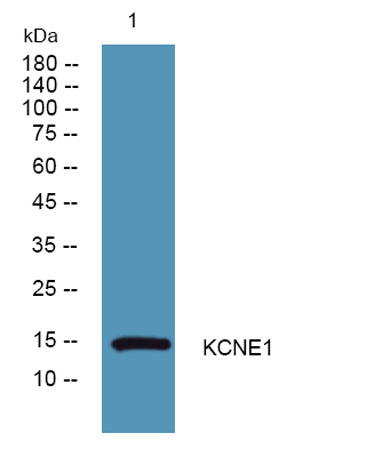
| Observed band (KD) | 14kD |
| Background | potassium voltage-gated channel subfamily E regulatory subunit 1(KCNE1) Homo sapiens The product of this gene belongs to the potassium channel KCNE family. Potassium ion channels are essential to many cellular functions and show a high degree of diversity, varying in their electrophysiologic and pharmacologic properties. This gene encodes a transmembrane protein known to associate with the product of the KVLQT1 gene to form the delayed rectifier potassium channel. Mutation in this gene are associated with both Jervell and Lange-Nielsen and Romano-Ward forms of long-QT syndrome. Alternatively spliced transcript variants encoding the same protein have been identified. [provided by RefSeq, Jul 2008], |
| Function | disease:Defects in KCNE1 are the cause of Jervell and Lange-Nielsen syndrome type 2 (JLNS2) [MIM:612347]. JLNS2 is an autosomal recessive disorder characterized by congenital deafness, prolongation of the QT interval, syncopal attacks due to ventricular arrhythmias, and a high risk of sudden death.,disease:Defects in KCNE1 are the cause of long QT syndrome type 5 (LQT5) [MIM:176261]. Long QT syndromes are heart disorders characterized by a prolonged QT interval on the ECG and polymorphic ventricular arrhythmias. They cause syncope and sudden death in response to exercise or emotional stress. KCNE1 mutants form channels that open slowly and close rapidly, thereby diminishing potassium currents.,function:Ancillary protein that assembles as a beta subunit with a voltage-gated potassium channel complex of pore-forming alpha subunits. Modulates the gating kinetics and enhances stability of th |
| Subcellular location | Cell membrane ; Single-pass type I membrane protein . Apical cell membrane . Membrane raft . Colocalizes with KCNB1 at the plasma membrane (By similarity). Targets to the membrane raft when associated with KCNQ1 (PubMed:20533308). . |
| Expression | Expressed in lung, kidney, testis, ovaries, small intestine, peripheral blood leukocytes. Expressed in the heart (PubMed:19219384). Not detected in pancreas, spleen, prostate and colon. Restrictively localized in the apical membrane portion of epithelial cells. |

Use collapsible tabs for more detailed information that will help customers make a purchasing decision.
Ex: Shipping and return policies, size guides, and other common questions.