 Français
 English
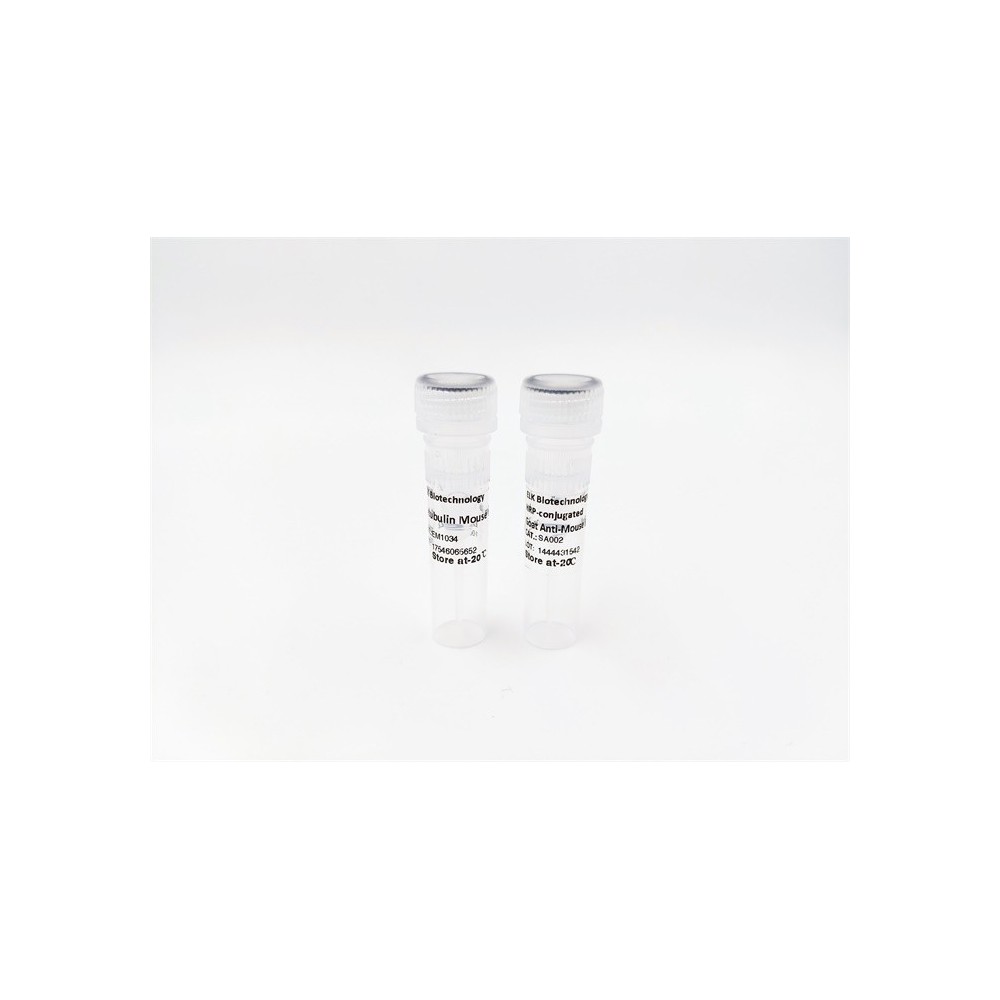

| ELK.No | ES10028 |
| Product name | KCNE3 rabbit pAb |
| Reactivity | Human;Mouse;Rat |
| Applications | WB;ELISA |
| Other name | |
| Size | 100μL |
| Unit price ($) | 248 |
| Human gene ID | 10008 |
| Human Swiss-Prot | Q9Y6H6 |
| Source | Rabbit |
| Isotype | IgG |
| Target | KCNE3 |
| Fields | >>Protein digestion and absorption |
| Gene name | KCNE3 |
| Protein name | Potassium voltage-gated channel subfamily E member 3 (MinK-related peptide 2) (Minimum potassium ion channel-related peptide 2) (Potassium channel subunit beta MiRP2) |
| Human gene link | |
| Human Swiss link | View Human Swiss-Prot |
| Mouse gene ID | |
| Mouse gene link | |
| Mouse Swiss-Prot | Q9WTW2 |
| Mouse Swiss link | View Mouse Swiss-Prot |
| Rat gene ID | |
| Rat gene link | |
| Rat Swiss-Prot | Q9JJV7 |
| Rat Swiss link | View Rat Swiss-Prot |
| Immunogen | Synthesized peptide derived from human protein . at AA range: 30-110 |
| Specificity | KCNE3 Polyclonal Antibody detects endogenous levels of protein. |
| Formulation | Liquid in PBS containing 50% glycerol, and 0.02% sodium azide. |
| Clonality | Polyclonal |
| Dilution | WB 1:500-2000 ELISA 1:5000-20000 |
| Purification | The antibody was affinity-purified from rabbit antiserum by affinity-chromatography using epitope-specific immunogen. |
| Concentration | 1 mg/ml |
| Storage stability | -20°C/1 year |
| Molecular Weight (Da) | |
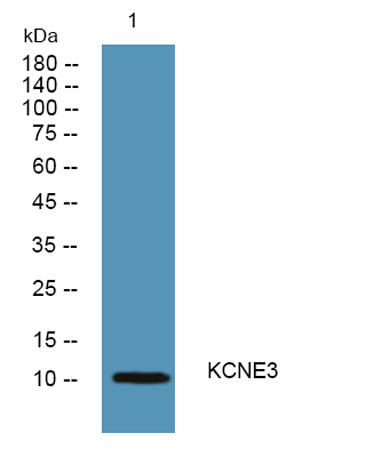
| Observed band (KD) | 11kD |
| Background | potassium voltage-gated channel subfamily E regulatory subunit 3(KCNE3) Homo sapiens Voltage-gated potassium (Kv) channels represent the most complex class of voltage-gated ion channels from both functional and structural standpoints. Their diverse functions include regulating neurotransmitter release, heart rate, insulin secretion, neuronal excitability, epithelial electrolyte transport, smooth muscle contraction, and cell volume. This gene encodes a member of the potassium channel, voltage-gated, isk-related subfamily. This member is a type I membrane protein, and a beta subunit that assembles with a potassium channel alpha-subunit to modulate the gating kinetics and enhance stability of the multimeric complex. This gene is prominently expressed in the kidney. A missense mutation in this gene is associated with hypokalemic periodic paralysis. [provided by RefSeq, Jul 2008], |
| Function | disease:Defects in KCNE3 are a cause of periodic paralysis hypokalemic (HOKPP) [MIM:170400]; also designated HYPOPP. HOKPP is an autosomal dominant disorder manifested by episodic flaccid generalized muscle weakness associated with falls of serum potassium levels.,disease:Defects in KCNE3 are a cause of thyrotoxic hypokalemic periodic paralysis (TPP) [MIM:188580]. TPP is seen in individuals of all races and manifests as attacks of episodic weakness with hypokalemia during thyrotoxicosis. TPP is seen most commonly in young Latin American or Asian men where up to 10% of thyrotoxic patients may have periodic paralysis. In such patients thyrotoxicosis has often been overlooked for many months. TPP generally occurs as a sporadic disease, and the periodic paralysis resolves completely with treatment of the thyrotoxicosis, although the muscle phenotype returns if the patient becomes thyrotoxic |
| Subcellular location | Cell membrane ; Single-pass type I membrane protein . Cytoplasm . Perikaryon . Cell projection, dendrite . Membrane raft . Colocalizes with KCNB1 at high-density somatodendritic clusters on the surface of hippocampal neurons. . |
| Expression | Expressed in hippocampal neurons (at protein level) (PubMed:12954870). Widely expressed with highest levels in kidney and moderate levels in small intestine. |

Use collapsible tabs for more detailed information that will help customers make a purchasing decision.
Ex: Shipping and return policies, size guides, and other common questions.