 Français
 English

| ELK.No | ES10050 |
| Product name | PNKD rabbit pAb |
| Reactivity | Human;Mouse |
| Applications | WB;ELISA |
| Other name | |
| Size | 50μL |
| Unit price ($) | 148 |
| Human gene ID | 25953 |
| Human Swiss-Prot | Q8N490 |
| Source | Rabbit |
| Isotype | IgG |
| Target | PNKD |
| Fields | |
| Gene name | PNKD KIAA1184 MR1 TAHCCP2 FKSG19 UNQ2491/PRO5778 |
| Protein name | Probable hydrolase PNKD (EC 3.-.-.-) (Myofibrillogenesis regulator 1) (MR-1) (Paroxysmal nonkinesiogenic dyskinesia protein) (Trans-activated by hepatitis C virus core protein 2) |
| Human gene link | |
| Human Swiss link | View Human Swiss-Prot |
| Mouse gene ID | |
| Mouse gene link | |
| Mouse Swiss-Prot | Q69ZP3 |
| Mouse Swiss link | View Mouse Swiss-Prot |
| Rat gene ID | |
| Rat gene link | |
| Rat Swiss-Prot | |
| Rat Swiss link | |
| Immunogen | Synthesized peptide derived from human protein . at AA range: 140-220 |
| Specificity | PNKD Polyclonal Antibody detects endogenous levels of protein. |
| Formulation | Liquid in PBS containing 50% glycerol, and 0.02% sodium azide. |
| Clonality | Polyclonal |
| Dilution | WB 1:500-2000 ELISA 1:5000-20000 |
| Purification | The antibody was affinity-purified from rabbit antiserum by affinity-chromatography using epitope-specific immunogen. |
| Concentration | 1 mg/ml |
| Storage stability | -20°C/1 year |
| Molecular Weight (Da) | |
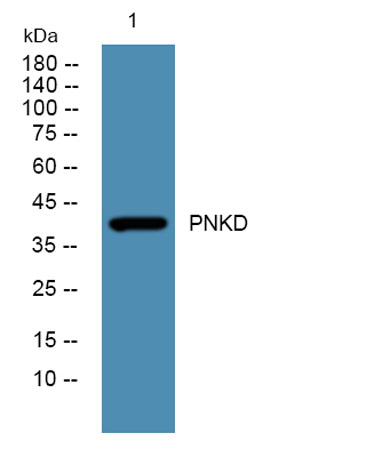
| Observed band (KD) | 42kD |
| Background | This gene is thought to play a role in the regulation of myofibrillogenesis. Mutations in this gene have been associated with the movement disorder paroxysmal non-kinesigenic dyskinesia. Alternative splicing results in multiple transcript variants. [provided by RefSeq, Mar 2010], |
| Function | disease:Defects in PNKD are the cause of dystonia type 8 (DYT8) [MIM:118800]. DYT8 is a paroxysmal non-kinesigenic dystonia/dyskinesia. Dystonia is defined by the presence of sustained involuntary muscle contractions, often leading to abnormal postures. DYT8 is characterized by attacks of involuntary movements brought on by stress, alcohol, fatigue or caffeine. The attacks generally last between a few seconds and four hours or longer. The attacks may begin in one limb and spread throughout the body, including the face.,function:Probable hydrolase that plays an aggravative role in the development of cardiac hypertrophy via activation of the NF-kappa-B signaling pathway.,induction:By Hepatitis C virus core protein.,PTM:Isoform 2 is phosphorylated at Ser-121 upon DNA damage, probably by ATM or ATR.,similarity:Belongs to the metallo-beta-lactamase superfamily. Glyoxalase II family.,subunit:I |
| Subcellular location | [Isoform 1]: Membrane; Peripheral membrane protein.; [Isoform 2]: Cytoplasm. Nucleus.; [Isoform 3]: Mitochondrion. |
| Expression | Isoform 1 is only expressed in the brain. Isoform 2 is ubiquitously detected with highest expression in skeletal muscle and detected in myocardial myofibrils. Variant Val-7 and Val-9 are detected in the brain only. |

Use collapsible tabs for more detailed information that will help customers make a purchasing decision.
Ex: Shipping and return policies, size guides, and other common questions.