 Français
 English

| ELK.No | ES10147 |
| Product name | RGS17 rabbit pAb |
| Reactivity | Human;Mouse |
| Applications | WB;ELISA |
| Other name | |
| Size | 100μL |
| Unit price ($) | 248 |
| Human gene ID | 26575 |
| Human Swiss-Prot | Q9UGC6 |
| Source | Rabbit |
| Isotype | IgG |
| Target | RGS17 |
| Fields | |
| Gene name | RGS17 |
| Protein name | Regulator of G-protein signaling 17 (RGS17) |
| Human gene link | |
| Human Swiss link | View Human Swiss-Prot |
| Mouse gene ID | |
| Mouse gene link | |
| Mouse Swiss-Prot | Q9QZB0 |
| Mouse Swiss link | View Mouse Swiss-Prot |
| Rat gene ID | |
| Rat gene link | |
| Rat Swiss-Prot | |
| Rat Swiss link | |
| Immunogen | Synthesized peptide derived from human protein . at AA range: 70-150 |
| Specificity | RGS17 Polyclonal Antibody detects endogenous levels of protein. |
| Formulation | Liquid in PBS containing 50% glycerol, and 0.02% sodium azide. |
| Clonality | Polyclonal |
| Dilution | WB 1:500-2000 ELISA 1:5000-20000 |
| Purification | The antibody was affinity-purified from rabbit antiserum by affinity-chromatography using epitope-specific immunogen. |
| Concentration | 1 mg/ml |
| Storage stability | -20°C/1 year |
| Molecular Weight (Da) | |
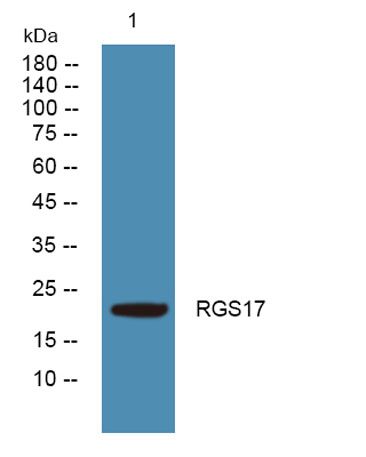
| Observed band (KD) | 23kD |
| Background | This gene encodes a member of the regulator of G-protein signaling family. This protein contains a conserved, 120 amino acid motif called the RGS domain and a cysteine-rich region. The protein attenuates the signaling activity of G-proteins by binding to activated, GTP-bound G alpha subunits and acting as a GTPase activating protein (GAP), increasing the rate of conversion of the GTP to GDP. This hydrolysis allows the G alpha subunits to bind G beta/gamma subunit heterodimers, forming inactive G-protein heterotrimers, thereby terminating the signal. [provided by RefSeq, Jul 2008], |
| Function | function:Inhibits signal transduction by increasing the GTPase activity of G protein alpha subunits thereby driving them into their inactive GDP-bound form. Binds selectively to G(z)-alpha and G(alpha)-i2 subunits, accelerates their GTPase activity and regulates their signaling activities. The G(z)-alpha activity is inhibited by the phosphorylation and palmitoylation of the G-protein. Negatively regulates mu-opioid receptor-mediated activation of the G-proteins.,PTM:Fatty acylated. Heavily palmitoylated in the cysteine string motif.,PTM:N- and O-glycosylated in synapsomal membranes.,PTM:Serine phosphorylated in synapsomal membranes.,PTM:Sumoylated by SUMO1 and SUM02 in synaptosomes. The sumoylated forms act as a scaffold for sequestering mu-opioid receptor-activated G(alpha) subunits.,similarity:Contains 1 RGS domain.,subcellular location:Shuttles between the cytoplasm/cell membrane and |
| Subcellular location | Membrane . Cell junction, synapse, synaptosome . Nucleus . Cytoplasm . |
| Expression | Predominantly expressed in the cerebellum. Also expressed in the cortex and medulla. Weakly expressed in a number of peripheral tissues notably spleen, lung and leukocytes. |

Use collapsible tabs for more detailed information that will help customers make a purchasing decision.
Ex: Shipping and return policies, size guides, and other common questions.