 Français
 English
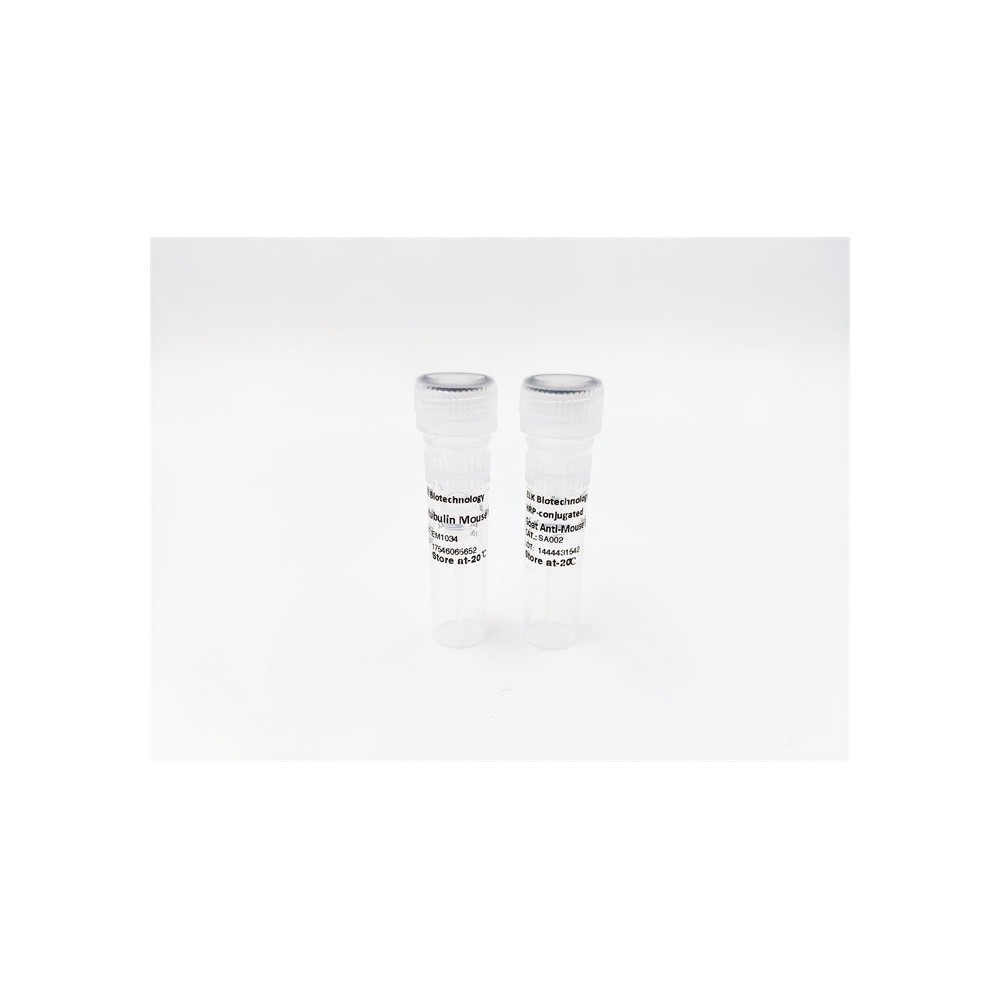
Cleaved-Caspase-5 p20 (D121) rabbit pAb
AO-06-ES1021-50

| ELK.No | ES1021 |
| Product name | Cleaved-Caspase-5 p20 (D121) rabbit pAb |
| Reactivity | Human;Rat;Mouse; |
| Applications | WB;ELISA |
| Other name | CASP5; ICH3; Caspase-5; CASP-5; ICE(rel)-III; Protease ICH-3; Protease TY |
| Size | 50μL |
| Unit price ($) | 148 |
| Human gene ID | 838 |
| Human Swiss-Prot | P51878 |
| Source | Rabbit |
| Isotype | IgG |
| Target | Caspase-5 |
| Fields | >>NOD-like receptor signaling pathway;>>Salmonella infection |
| Gene name | CASP5 |
| Protein name | Caspase5 |
| Human gene link | View Human Gene |
| Human Swiss link | View Human Swiss-Prot |
| Mouse gene ID | |
| Mouse gene link | |
| Mouse Swiss-Prot | |
| Mouse Swiss link | |
| Rat gene ID | |
| Rat gene link | |
| Rat Swiss-Prot | |
| Rat Swiss link | |
| Immunogen | The antiserum was produced against synthesized peptide derived from human Caspase 5. AA range:102-151 |
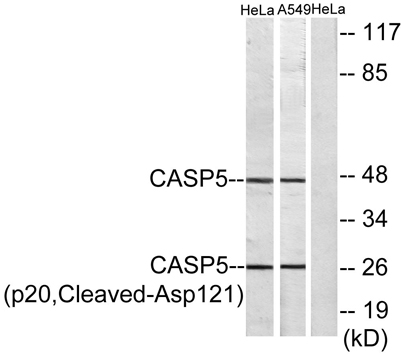
| Specificity | Cleaved-Caspase-5 p20 (D121) Polyclonal Antibody detects endogenous levels of fragment of activated Caspase-5 p20 protein resulting from cleavage adjacent to D121. |
| Formulation | Liquid in PBS containing 50% glycerol, 0.5% BSA and 0.02% sodium azide. |
| Clonality | Polyclonal |
| Dilution | Western Blot: 1/500 - 1/2000. ELISA: 1/20000. Not yet tested in other applications. |
| Purification | The antibody was affinity-purified from rabbit antiserum by affinity-chromatography using epitope-specific immunogen. |
| Concentration | 1 mg/ml |
| Storage stability | -20°C/1 year |
| Molecular Weight (Da) | |
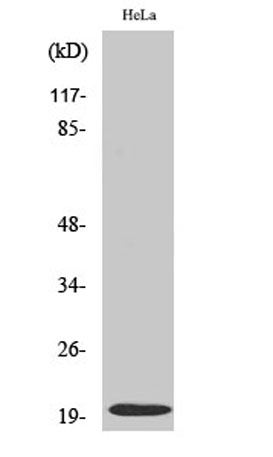
| Observed band (KD) | 22kD |
| Background | This gene encodes a member of the cysteine-aspartic acid protease (caspase) family. Sequential activation of caspases plays a central role in the execution-phase of cell apoptosis. Caspases exist as inactive proenzymes which undergo proteolytic processing at conserved aspartic residues to produce two subunits, large and small, that dimerize to form the active enzyme. Overexpression of the active form of this enzyme induces apoptosis in fibroblasts. Max, a central component of the Myc/Max/Mad transcription regulation network important for cell growth, differentiation, and apoptosis, is cleaved by this protein; this process requires Fas-mediated dephosphorylation of Max. The expression of this gene is regulated by interferon-gamma and lipopolysaccharide. Alternatively spliced transcript variants have been identified for this gene. [provided by RefSeq, Aug 2010], |
| Function | catalytic activity:Strict requirement for Asp at the P1 position. It has a preferred cleavage sequence of Tyr-Val-Ala-Asp-|- but also cleaves at Asp-Glu-Val-Asp-|-.,function:Mediator of programmed cell death (apoptosis).,PTM:The two subunits are derived from the precursor sequence by an autocatalytic mechanism.,similarity:Belongs to the peptidase C14A family.,similarity:Contains 1 CARD domain.,subunit:Heterotetramer that consists of two anti-parallel arranged heterodimers, each one formed by a 20 kDa (p20) and a 10 kDa (p10) subunits.,tissue specificity:Expressed in barely detectable amounts in most tissues except brain, highest levels being found in lung, liver and skeletal muscle., |
| Subcellular location | neuron projection,neuronal cell body,IPAF inflammasome complex,NLRP1 inflammasome complex,NLRP3 inflammasome complex,AIM2 inflammasome complex, |
| Expression | Expressed in barely detectable amounts in most tissues except brain, highest levels being found in lung, liver and skeletal muscle. |

Use collapsible tabs for more detailed information that will help customers make a purchasing decision.
Ex: Shipping and return policies, size guides, and other common questions.