 Français
 English

| ELK.No | ES10239 |
| Product name | SH21A rabbit pAb |
| Reactivity | Human;Mouse;Rat |
| Applications | WB;ELISA |
| Other name | |
| Size | 100μL |
| Unit price ($) | 248 |
| Human gene ID | 4068 |
| Human Swiss-Prot | O60880 |
| Source | Rabbit |
| Isotype | IgG |
| Target | SH21A |
| Fields | >>Natural killer cell mediated cytotoxicity |
| Gene name | SH2D1A DSHP SAP |
| Protein name | SH2 domain-containing protein 1A (Duncan disease SH2-protein) (Signaling lymphocytic activation molecule-associated protein) (SLAM-associated protein) (T-cell signal transduction molecule SAP) |
| Human gene link | |
| Human Swiss link | View Human Swiss-Prot |
| Mouse gene ID | |
| Mouse gene link | |
| Mouse Swiss-Prot | O88890 |
| Mouse Swiss link | View Mouse Swiss-Prot |
| Rat gene ID | |
| Rat gene link | |
| Rat Swiss-Prot | B2RZ59 |
| Rat Swiss link | View Rat Swiss-Prot |
| Immunogen | Synthesized peptide derived from part region of human protein |
| Specificity | SH21A Polyclonal Antibody detects endogenous levels of protein. |
| Formulation | Liquid in PBS containing 50% glycerol, and 0.02% sodium azide. |
| Clonality | Polyclonal |
| Dilution | WB 1:500-2000 ELISA 1:5000-20000 |
| Purification | The antibody was affinity-purified from rabbit antiserum by affinity-chromatography using epitope-specific immunogen. |
| Concentration | 1 mg/ml |
| Storage stability | -20°C/1 year |
| Molecular Weight (Da) | |
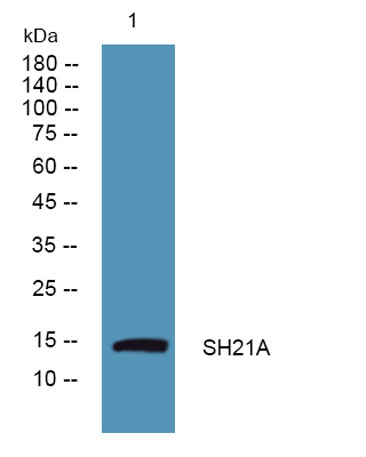
| Observed band (KD) | 14kD |
| Background | This gene encodes a protein that plays a major role in the bidirectional stimulation of T and B cells. This protein contains an SH2 domain and a short tail. It associates with the signaling lymphocyte-activation molecule, thereby acting as an inhibitor of this transmembrane protein by blocking the recruitment of the SH2-domain-containing signal-transduction molecule SHP-2 to its docking site. This protein can also bind to other related surface molecules that are expressed on activated T, B and NK cells, thereby modifying signal transduction pathways in these cells. Mutations in this gene cause lymphoproliferative syndrome X-linked type 1 or Duncan disease, a rare immunodeficiency characterized by extreme susceptibility to infection with Epstein-Barr virus, with symptoms including severe mononucleosis and malignant lymphoma. Multiple transcript variants encoding different isoforms have been f |
| Function | disease:Defects in SH2D1A are a cause of lymphoproliferative syndrome X-linked type 1 (XLP1) [MIM:308240]; also known as X-linked lymphoproliferative disease (XLPD) or Duncan disease. XLP is a rare immunodeficiency characterized by extreme susceptibility to infection with Epstein-Barr virus (EBV). Symptoms include severe or fatal mononucleosis, acquired hypogammaglobulinemia, pancytopenia and malignant lymphoma.,function:Inhibitor of the SLAM self-association. Acts by blocking recruitment of the SH2-domain-containing signal-transduction molecule SHP-2 to a docking site in the SLAM cytoplasmic region. Mediates interaction between FYN and SLAMF1.,online information:SH2D1A mutation db,similarity:Contains 1 SH2 domain.,subunit:Interacts with CD84, CD244, LY9, SLAMF1 and FYN.,tissue specificity:Expressed at a high level in thymus and lung, with a lower level of expression in spleen and liver. |
| Subcellular location | Cytoplasm . |
| Expression | Expressed at a high level in thymus and lung, with a lower level of expression in spleen and liver. Expressed in peripheral blood leukocytes, including T-lymphocytes. Tends to be expressed at lower levels in peripheral blood leukocytes in patients with rheumatoid arthritis. |

Use collapsible tabs for more detailed information that will help customers make a purchasing decision.
Ex: Shipping and return policies, size guides, and other common questions.