 Français
 English
Cleaved-Cathepsin C HC (R394) rabbit pAb
AO-06-ES1025-100

| ELK.No | ES1025 |
| Product name | Cleaved-Cathepsin C HC (R394) rabbit pAb |
| Reactivity | Human;Rat;Mouse; |
| Applications | WB;ELISA |
| Other name | CTSC; CPPI; Dipeptidyl peptidase 1; Cathepsin C; Cathepsin J; Dipeptidyl peptidase I; DPP-I; DPPI; Dipeptidyl transferase |
| Size | 100μL |
| Unit price ($) | 248 |
| Human gene ID | 1075 |
| Human Swiss-Prot | P53634 |
| Source | Rabbit |
| Isotype | IgG |
| Target | Cathepsin C HC |
| Fields | >>Lysosome;>>Apoptosis |
| Gene name | CTSC |
| Protein name | Dipeptidyl peptidase 1 |
| Human gene link | View Human Gene |
| Human Swiss link | View Human Swiss-Prot |
| Mouse gene ID | |
| Mouse gene link | |
| Mouse Swiss-Prot | P97821 |
| Mouse Swiss link | View Mouse Swiss-Prot |
| Rat gene ID | |
| Rat gene link | |
| Rat Swiss-Prot | |
| Rat Swiss link | |
| Immunogen | The antiserum was produced against synthesized peptide derived from human Dipeptidyl-peptidase 1. AA range:345-394 |
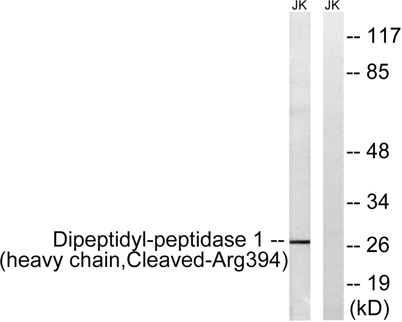
| Specificity | Cleaved-Cathepsin C HC (R394) Polyclonal Antibody detects endogenous levels of fragment of activated Cathepsin C HC protein resulting from cleavage adjacent to R394. |
| Formulation | Liquid in PBS containing 50% glycerol, 0.5% BSA and 0.02% sodium azide. |
| Clonality | Polyclonal |
| Dilution | Western Blot: 1/500 - 1/2000. ELISA: 1/20000. Not yet tested in other applications. |
| Purification | The antibody was affinity-purified from rabbit antiserum by affinity-chromatography using epitope-specific immunogen. |
| Concentration | 1 mg/ml |
| Storage stability | -20°C/1 year |
| Molecular Weight (Da) | |
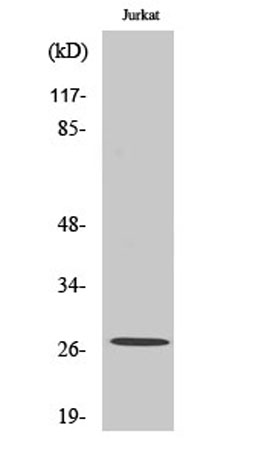
| Observed band (KD) | 27kD |
| Background | This gene encodes a member of the peptidase C1 family and lysosomal cysteine proteinase that appears to be a central coordinator for activation of many serine proteinases in cells of the immune system. Alternative splicing results in multiple transcript variants, at least one of which encodes a preproprotein that is proteolytically processed to generate heavy and light chains that form a disulfide-linked dimer. A portion of the propeptide acts as an intramolecular chaperone for the folding and stabilization of the mature enzyme. This enzyme requires chloride ions for activity and can degrade glucagon. Defects in the encoded protein have been shown to be a cause of Papillon-Lefevre syndrome, an autosomal recessive disorder characterized by palmoplantar keratosis and periodontitis. [provided by RefSeq, Nov 2015], |
| Function | catalytic activity:Release of an N-terminal dipeptide, Xaa-Yaa-|-Zaa-, except when Xaa is Arg or Lys, or Yaa or Zaa is Pro.,cofactor:Binds 1 chloride ion per heavy chain.,disease:Defects in CTSC are a cause of Haim-Munk syndrome (HMS) [MIM:245010]; also known as keratosis palmoplantaris with periodontopathia and onychogryposis or Cochin Jewish disorder. HMS is an autosomal recessive disorder characterized by palmoplantar keratosis, onychogryphosis and periodontitis. Additional features are pes planus, arachnodactyly, and acroosteolysis.,disease:Defects in CTSC are a cause of juvenile periodontitis (JPD) [MIM:170650]; also known as prepubertal periodontitis (PPP). JPD is characterized by severe and protracted gingival infections, leading to tooth loss. JPD inheritance is autosomal dominant.,disease:Defects in CTSC are a cause of Papillon-Lefevre syndrome (PLS) [MIM:245000]; also known as |
| Subcellular location | Lysosome. |
| Expression | Ubiquitous. Highly expressed in lung, kidney and placenta. Detected at intermediate levels in colon, small intestine, spleen and pancreas. |

Use collapsible tabs for more detailed information that will help customers make a purchasing decision.
Ex: Shipping and return policies, size guides, and other common questions.