 Français
 English
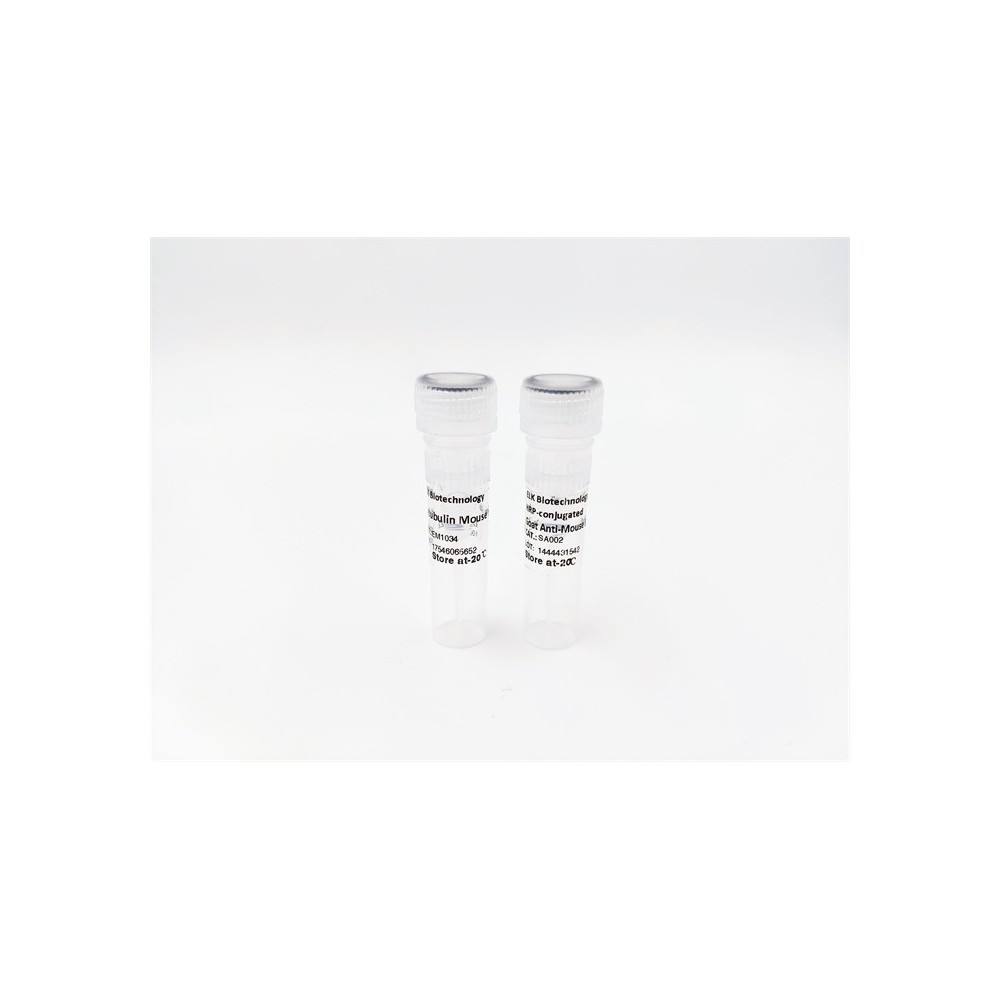

| ELK.No | ES10401 |
| Product name | TBCB rabbit pAb |
| Reactivity | Human;Mouse |
| Applications | WB;ELISA |
| Other name | |
| Size | 50μL |
| Unit price ($) | 148 |
| Human gene ID | 1155 |
| Human Swiss-Prot | Q99426 |
| Source | Rabbit |
| Isotype | IgG |
| Target | TBCB |
| Fields | |
| Gene name | TBCB CG22 CKAP1 |
| Protein name | Tubulin-folding cofactor B (Cytoskeleton-associated protein 1) (Cytoskeleton-associated protein CKAPI) (Tubulin-specific chaperone B) |
| Human gene link | |
| Human Swiss link | View Human Swiss-Prot |
| Mouse gene ID | |
| Mouse gene link | |
| Mouse Swiss-Prot | Q9D1E6 |
| Mouse Swiss link | View Mouse Swiss-Prot |
| Rat gene ID | |
| Rat gene link | |
| Rat Swiss-Prot | |
| Rat Swiss link | |
| Immunogen | Synthesized peptide derived from part region of human protein |
| Specificity | TBCB Polyclonal Antibody detects endogenous levels of protein. |
| Formulation | Liquid in PBS containing 50% glycerol, and 0.02% sodium azide. |
| Clonality | Polyclonal |
| Dilution | WB 1:500-2000 ELISA 1:5000-20000 |
| Purification | The antibody was affinity-purified from rabbit antiserum by affinity-chromatography using epitope-specific immunogen. |
| Concentration | 1 mg/ml |
| Storage stability | -20°C/1 year |
| Molecular Weight (Da) | |
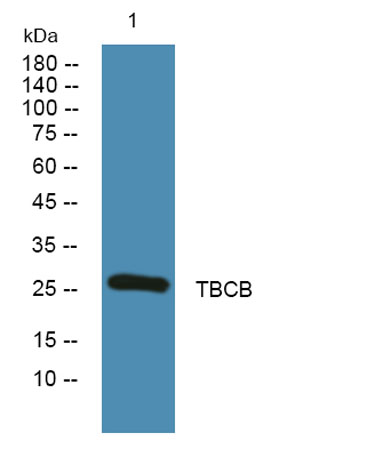
| Observed band (KD) | 26kD |
| Background | function:Binds to alpha-tubulin folding intermediates after their interaction with cytosolic chaperonin in the pathway leading from newly synthesized tubulin to properly folded heterodimer. Involved in regulation of tubulin heterodimer dissociation. May function as a negative regulator of axonal growth.,PTM:Phosphorylation by PAK1 is required for normal function. Phosphorylated upon DNA damage, probably by ATM or ATR.,PTM:Ubiquitinated in the presence of GAN which targets it for degradation by the proteasome.,similarity:Belongs to the TBCB family.,similarity:Contains 1 CAP-Gly domain.,subcellular location:Colocalizes with microtubules. In differentiated neurons, located in the cytoplasm. In differentiating neurons, accumulates at the growth cone.,subunit:Supercomplex made of cofactors A to E. Cofactors A and D function by capturing and stabilizing tubulin in a quasi-native conformation. Cofactor E binds to the cofactor D-tubulin complex; interaction with cofactor C then causes the release of tubulin polypeptides that are committed to the native state. Cofactors B and E can form a heterodimer which binds to alpha-tubulin and enhances their ability to dissociate tubulin heterodimers. Binds to GAN.,tissue specificity:Found in most tissues., |
| Function | function:Binds to alpha-tubulin folding intermediates after their interaction with cytosolic chaperonin in the pathway leading from newly synthesized tubulin to properly folded heterodimer. Involved in regulation of tubulin heterodimer dissociation. May function as a negative regulator of axonal growth.,PTM:Phosphorylation by PAK1 is required for normal function. Phosphorylated upon DNA damage, probably by ATM or ATR.,PTM:Ubiquitinated in the presence of GAN which targets it for degradation by the proteasome.,similarity:Belongs to the TBCB family.,similarity:Contains 1 CAP-Gly domain.,subcellular location:Colocalizes with microtubules. In differentiated neurons, located in the cytoplasm. In differentiating neurons, accumulates at the growth cone.,subunit:Supercomplex made of cofactors A to E. Cofactors A and D function by capturing and stabilizing tubulin in a quasi-native conformation. |
| Subcellular location | Cytoplasm . Cytoplasm, cytoskeleton . Colocalizes with microtubules. In differentiated neurons, located in the cytoplasm. In differentiating neurons, accumulates at the growth cone. . |
| Expression | Found in most tissues. |

Use collapsible tabs for more detailed information that will help customers make a purchasing decision.
Ex: Shipping and return policies, size guides, and other common questions.