 Français
 English

| ELK.No | ES10447 |
| Product name | UBE2K rabbit pAb |
| Reactivity | Human;Mouse |
| Applications | WB;ELISA |
| Other name | |
| Size | 50μL |
| Unit price ($) | 148 |
| Human gene ID | 3093 |
| Human Swiss-Prot | P61086 |
| Source | Rabbit |
| Isotype | IgG |
| Target | UBE2K |
| Fields | >>Ubiquitin mediated proteolysis |
| Gene name | UBE2K HIP2 LIG |
| Protein name | Ubiquitin-conjugating enzyme E2 K (EC 6.3.2.19) (Huntingtin-interacting protein 2) (HIP-2) (Ubiquitin carrier protein) (Ubiquitin-conjugating enzyme E2-25 kDa) (Ubiquitin-conjugating enzyme E2(25K)) ( |
| Human gene link | |
| Human Swiss link | View Human Swiss-Prot |
| Mouse gene ID | |
| Mouse gene link | |
| Mouse Swiss-Prot | P61087 |
| Mouse Swiss link | View Mouse Swiss-Prot |
| Rat gene ID | |
| Rat gene link | |
| Rat Swiss-Prot | |
| Rat Swiss link | |
| Immunogen | Synthesized peptide derived from part region of human protein |
| Specificity | UBE2K Polyclonal Antibody detects endogenous levels of protein. |
| Formulation | Liquid in PBS containing 50% glycerol, and 0.02% sodium azide. |
| Clonality | Polyclonal |
| Dilution | WB 1:500-2000 ELISA 1:5000-20000 |
| Purification | The antibody was affinity-purified from rabbit antiserum by affinity-chromatography using epitope-specific immunogen. |
| Concentration | 1 mg/ml |
| Storage stability | -20°C/1 year |
| Molecular Weight (Da) | |
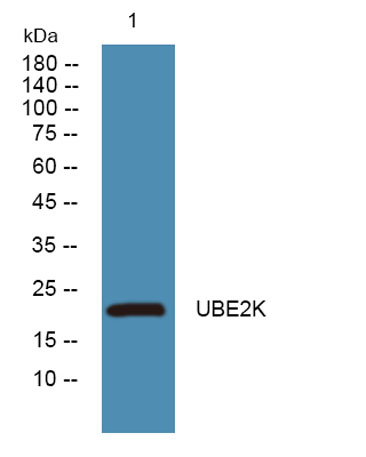
| Observed band (KD) | 22kD |
| Background | The protein encoded by this gene belongs to the ubiquitin-conjugating enzyme family. This protein interacts with RING finger proteins, and it can ubiquitinate huntingtin, the gene product for Huntington's disease. Known functions for this protein include a role in aggregate formation of expanded polyglutamine proteins and the suppression of apoptosis in polyglutamine diseases, a role in the dislocation of newly synthesized MHC class I heavy chains from the endoplasmic reticulum, and involvement in foam cell formation. Multiple transcript variants encoding different isoforms have been identified for this gene. [provided by RefSeq, Jul 2008], |
| Function | catalytic activity:ATP + ubiquitin + protein lysine = AMP + diphosphate + protein N-ubiquityllysine.,function:Catalyzes the covalent attachment of ubiquitin to other proteins. Mediates the selective degradation of short-lived and abnormal proteins. Ubiquitinates huntingtin. May mediate foam cell formation by the suppression of apoptosis of lipid-bearing macrophages through ubiquitination and subsequence degradation of p53.,induction:By aggregated low-density lipoprotein.,pathway:Protein modification; protein ubiquitination.,PTM:Sumoylation at Lys-14 impairs catalytic activity.,similarity:Belongs to the ubiquitin-conjugating enzyme family.,similarity:Contains 1 UBA domain.,subunit:Interacts with RNF138/NARF.,tissue specificity:Expressed in all tissues tested, including spleen, thymus, prostate, testis, ovary, small intestine, colon, peripheral blood leukocytes, T-lymphocytes, monocytes, g |
| Subcellular location | Cytoplasm . |
| Expression | Expressed in all tissues tested, including spleen, thymus, prostate, testis, ovary, small intestine, colon, peripheral blood leukocytes, T-lymphocytes, monocytes, granulocytes and bone marrow mononuclear cells. Highly expressed in brain, with highest levels found in cortex and striatum and at lower levels in cerebellum and brainstem. |

Use collapsible tabs for more detailed information that will help customers make a purchasing decision.
Ex: Shipping and return policies, size guides, and other common questions.