 Français
 English

| ELK.No | ES10469 |
| Product name | VDAC3 rabbit pAb |
| Reactivity | Human;Rat;Mouse |
| Applications | WB;ELISA |
| Other name | |
| Size | 50μL |
| Unit price ($) | 148 |
| Human gene ID | 7419 |
| Human Swiss-Prot | Q9Y277 |
| Source | Rabbit |
| Isotype | IgG |
| Target | VDAC3 |
| Fields | >>Calcium signaling pathway;>>cGMP-PKG signaling pathway;>>Ferroptosis;>>Necroptosis;>>Cellular senescence;>>Neutrophil extracellular trap formation;>>NOD-like receptor signaling pathway;>>Cholesterol metabolism;>>Alzheimer disease;>>Parkinson disease;>>Huntington disease;>>Spinocerebellar ataxia;>>Prion disease;>>Pathways of neurodegeneration - multiple diseases;>>Hepatitis B;>>Human T-cell leukemia virus 1 infection;>>Viral carcinogenesis;>>Chemical carcinogenesis - reactive oxygen species;>>Diabetic cardiomyopathy |
| Gene name | VDAC3 |
| Protein name | Voltage-dependent anion-selective channel protein 3 (VDAC-3) (hVDAC3) (Outer mitochondrial membrane protein porin 3) |
| Human gene link | |
| Human Swiss link | View Human Swiss-Prot |
| Mouse gene ID | |
| Mouse gene link | |
| Mouse Swiss-Prot | Q60931 |
| Mouse Swiss link | View Mouse Swiss-Prot |
| Rat gene ID | |
| Rat gene link | |
| Rat Swiss-Prot | Q9R1Z0 |
| Rat Swiss link | View Rat Swiss-Prot |
| Immunogen | Synthesized peptide derived from part region of human protein |
| Specificity | VDAC3 Polyclonal Antibody detects endogenous levels of protein. |
| Formulation | Liquid in PBS containing 50% glycerol, and 0.02% sodium azide. |
| Clonality | Polyclonal |
| Dilution | WB 1:500-2000 ELISA 1:5000-20000 |
| Purification | The antibody was affinity-purified from rabbit antiserum by affinity-chromatography using epitope-specific immunogen. |
| Concentration | 1 mg/ml |
| Storage stability | -20°C/1 year |
| Molecular Weight (Da) | |
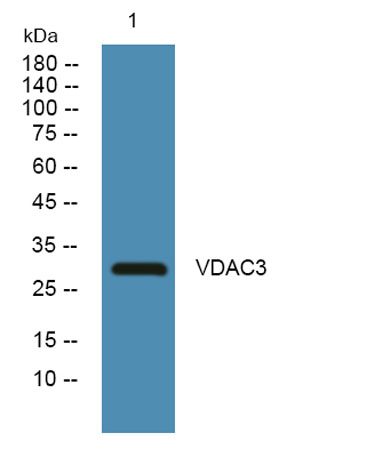
| Observed band (KD) | 31kD |
| Background | This gene encodes a voltage-dependent anion channel (VDAC), and belongs to the mitochondrial porin family. VDACs are small, integral membrane proteins that traverse the outer mitochondrial membrane and conduct ATP and other small metabolites. They are known to bind several kinases of intermediary metabolism, thought to be involved in translocation of adenine nucleotides, and are hypothesized to form part of the mitochondrial permeability transition pore, which results in the release of cytochrome c at the onset of apoptotic cell death. Alternatively transcript variants encoding different isoforms have been described for this gene. [provided by RefSeq, Oct 2011], |
| Function | domain:Consists mainly of a membrane-spanning beta-barrel formed by 19 beta-strands.,function:Forms a channel through the mitochondrial outer membrane that allows diffusion of small hydrophilic molecules.,similarity:Belongs to the eukaryotic mitochondrial porin family.,tissue specificity:Widely expressed. Highest in testis., |
| Subcellular location | Mitochondrion outer membrane . Membrane . May localize to non-mitochondrial membranes. . |
| Expression | Expressed in erythrocytes (at protein level) (PubMed:27641616). Widely expressed. Highest in testis (PubMed:9781040). |

Use collapsible tabs for more detailed information that will help customers make a purchasing decision.
Ex: Shipping and return policies, size guides, and other common questions.