 Français
 English
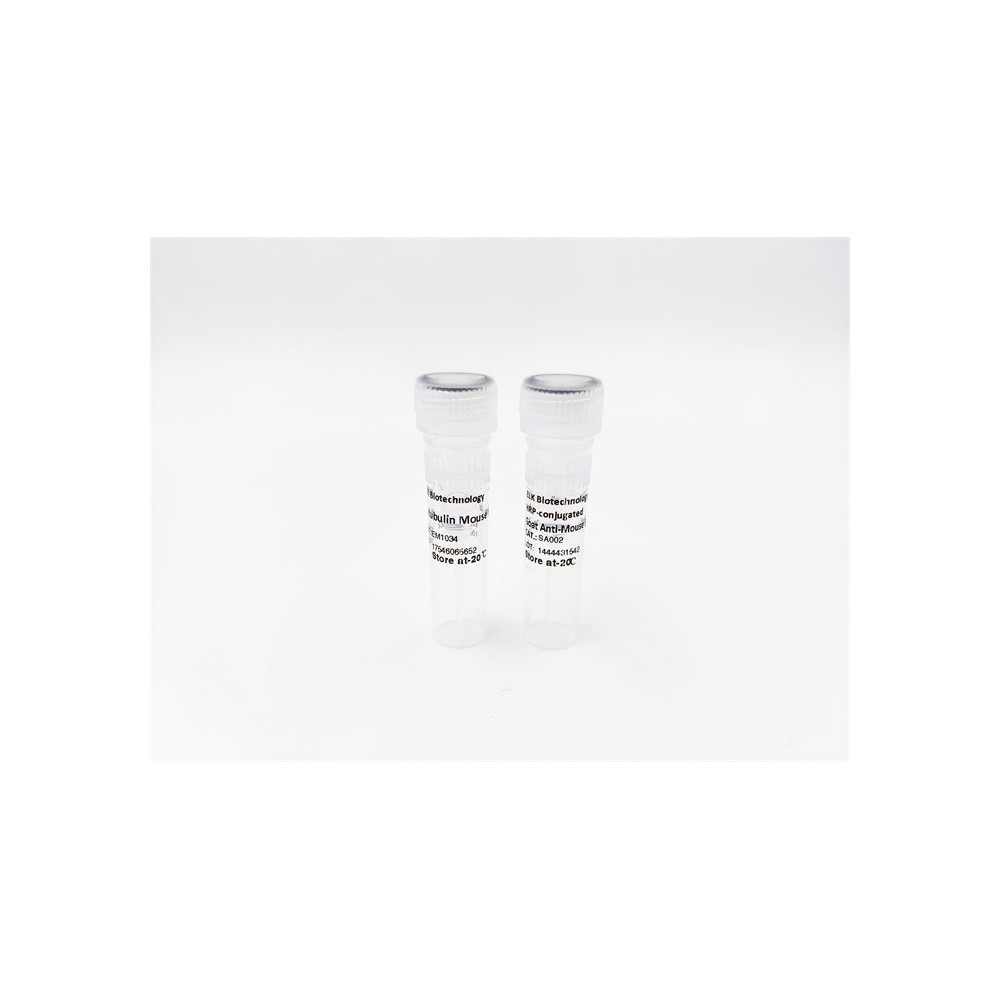

| ELK.No | ES10590 |
| Product name | MRCKG rabbit pAb |
| Reactivity | Human;Rat;Mouse; |
| Applications | WB;ELISA |
| Other name | |
| Size | 100μL |
| Unit price ($) | 248 |
| Human gene ID | 55561 |
| Human Swiss-Prot | Q6DT37 |
| Source | Rabbit |
| Isotype | IgG |
| Target | MRCKG |
| Fields | |
| Gene name | CDC42BPG DMPK2 |
| Protein name | Serine/threonine-protein kinase MRCK gamma (EC 2.7.11.1) (CDC42-binding protein kinase gamma) (DMPK-like gamma) (Myotonic dystrophy kinase-related CDC42-binding kinase gamma) (MRCK gamma) (MRCKG) (Myo |
| Human gene link | |
| Human Swiss link | View Human Swiss-Prot |
| Mouse gene ID | |
| Mouse gene link | |
| Mouse Swiss-Prot | Q80UW5 |
| Mouse Swiss link | View Mouse Swiss-Prot |
| Rat gene ID | |
| Rat gene link | |
| Rat Swiss-Prot | |
| Rat Swiss link | |
| Immunogen | Synthesized peptide derived from human protein . at AA range: 1370-1450 |
| Specificity | MRCKG Polyclonal Antibody detects endogenous levels of protein. |
| Formulation | Liquid in PBS containing 50% glycerol, and 0.02% sodium azide. |
| Clonality | Polyclonal |
| Dilution | WB 1:500-2000 ELISA 1:5000-20000 |
| Purification | The antibody was affinity-purified from rabbit antiserum by affinity-chromatography using epitope-specific immunogen. |
| Concentration | 1 mg/ml |
| Storage stability | -20°C/1 year |
| Molecular Weight (Da) | |
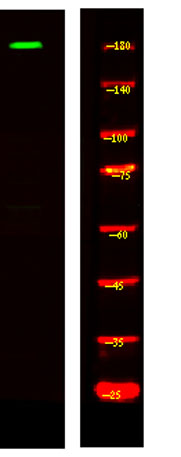
| Observed band (KD) | 170kD |
| Background | catalytic activity:ATP + a protein = ADP + a phosphoprotein.,cofactor:Magnesium.,enzyme regulation:Maintained in an inactive, closed conformation by an interaction between the kinase domain and the negative autoregulatory C-terminal coiled-coil region. Agonist binding to the phorbol ester binding site disrupts this, releasing the kinase domain to allow N-terminus-mediated dimerization and kinase activation by transautophosphorylation.,function:May act as a downstream effector of CDC42 in cytoskeletal reorganization. Contributes to the actomyosin contractility required for cell invasion, through the regulation of MYPT1 and thus MLC2 phosphorylation.,similarity:Belongs to the protein kinase superfamily. AGC Ser/Thr protein kinase family. DMPK subfamily.,similarity:Contains 1 AGC-kinase C-terminal domain.,similarity:Contains 1 CNH domain.,similarity:Contains 1 CRIB domain.,similarity:Contains 1 PH domain.,similarity:Contains 1 phorbol-ester/DAG-type zinc finger.,similarity:Contains 1 protein kinase domain.,subcellular location:Concentrates at the leading edge of cells.,subunit:Homodimer and homotetramer via the coiled coil regions. Interacts tightly with GTP-bound but not GDP-bound CDC42.,tissue specificity:Expressed in heart and skeletal muscle., |
| Function | catalytic activity:ATP + a protein = ADP + a phosphoprotein.,cofactor:Magnesium.,enzyme regulation:Maintained in an inactive, closed conformation by an interaction between the kinase domain and the negative autoregulatory C-terminal coiled-coil region. Agonist binding to the phorbol ester binding site disrupts this, releasing the kinase domain to allow N-terminus-mediated dimerization and kinase activation by transautophosphorylation.,function:May act as a downstream effector of CDC42 in cytoskeletal reorganization. Contributes to the actomyosin contractility required for cell invasion, through the regulation of MYPT1 and thus MLC2 phosphorylation.,similarity:Belongs to the protein kinase superfamily. AGC Ser/Thr protein kinase family. DMPK subfamily.,similarity:Contains 1 AGC-kinase C-terminal domain.,similarity:Contains 1 CNH domain.,similarity:Contains 1 CRIB domain.,similarity:Contai |
| Subcellular location | Cytoplasm . Concentrates at the leading edge of cells. |
| Expression | Expressed in heart and skeletal muscle. |

Use collapsible tabs for more detailed information that will help customers make a purchasing decision.
Ex: Shipping and return policies, size guides, and other common questions.