 Français
 English

| ELK.No | ES10618 |
| Product name | DDB2 rabbit pAb |
| Reactivity | Human;Mouse |
| Applications | WB;ELISA |
| Other name | |
| Size | 100μL |
| Unit price ($) | 248 |
| Human gene ID | 1643 |
| Human Swiss-Prot | Q92466 |
| Source | Rabbit |
| Isotype | IgG |
| Target | DDB2 |
| Fields | >>Nucleotide excision repair;>>p53 signaling pathway;>>Ubiquitin mediated proteolysis;>>Hepatitis B;>>Epstein-Barr virus infection;>>Pathways in cancer;>>Transcriptional misregulation in cancer;>>Colorectal cancer;>>Pancreatic cancer;>>Endometrial cancer;>>Glioma;>>Thyroid cancer;>>Basal cell carcinoma;>>Melanoma;>>Chronic myeloid leukemia;>>Small cell lung cancer;>>Non-small cell lung cancer;>>Breast cancer;>>Hepatocellular carcinoma;>>Gastric cancer |
| Gene name | DDB2 |
| Protein name | DNA damage-binding protein 2 (DDB p48 subunit) (DDBb) (Damage-specific DNA-binding protein 2) (UV-damaged DNA-binding protein 2) (UV-DDB 2) |
| Human gene link | |
| Human Swiss link | View Human Swiss-Prot |
| Mouse gene ID | |
| Mouse gene link | |
| Mouse Swiss-Prot | Q99J79 |
| Mouse Swiss link | View Mouse Swiss-Prot |
| Rat gene ID | |
| Rat gene link | |
| Rat Swiss-Prot | |
| Rat Swiss link | |
| Immunogen | Synthesized peptide derived from human protein . at AA range: 260-340 |
| Specificity | DDB2 Polyclonal Antibody detects endogenous levels of protein. |
| Formulation | Liquid in PBS containing 50% glycerol, and 0.02% sodium azide. |
| Clonality | Polyclonal |
| Dilution | WB 1:500-2000 ELISA 1:5000-20000 |
| Purification | The antibody was affinity-purified from rabbit antiserum by affinity-chromatography using epitope-specific immunogen. |
| Concentration | 1 mg/ml |
| Storage stability | -20°C/1 year |
| Molecular Weight (Da) | |
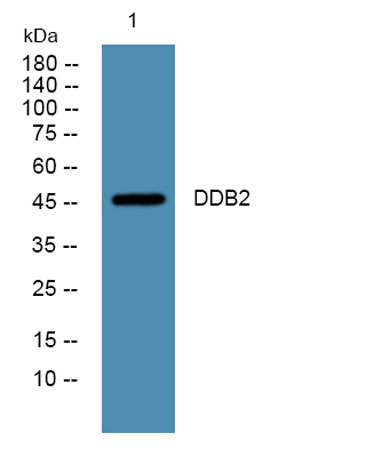
| Observed band (KD) | 46kD |
| Background | This gene encodes a protein that is necessary for the repair of ultraviolet light-damaged DNA. This protein is the smaller subunit of a heterodimeric protein complex that participates in nucleotide excision repair, and this complex mediates the ubiquitylation of histones H3 and H4, which facilitates the cellular response to DNA damage. This subunit appears to be required for DNA binding. Mutations in this gene cause xeroderma pigmentosum complementation group E, a recessive disease that is characterized by an increased sensitivity to UV light and a high predisposition for skin cancer development, in some cases accompanied by neurological abnormalities. Two transcript variants encoding different isoforms have been found for this gene. [provided by RefSeq, Jul 2014], |
| Function | disease:Defects in DDB2 are a cause of xeroderma pigmentosum complementation group E (XP-E) [MIM:278740]; also known as xeroderma pigmentosum V (XP5). XP-E is a rare human autosomal recessive disease characterized by solar sensitivity, high predisposition for developing cancers on areas exposed to sunlight and, in some cases, neurological abnormalities.,domain:The DWD box is required for interaction with DDB1.,function:Required for DNA repair. Binds to DDB1 to form the UV-damaged DNA-binding protein complex (the UV-DDB complex). The UV-DDB complex may recognize UV-induced DNA damage and recruit proteins of the nucleotide excision repair pathway (the NER pathway) to initiate DNA repair. The UV-DDB complex preferentially binds to cyclobutane pyrimidine dimers (CPD), 6-4 photoproducts (6-4 PP), apurinic sites and short mismatches. Also appears to function as the substrate recognition module |
| Subcellular location | Nucleus . Chromosome . Accumulates at sites of DNA damage following UV irradiation. . |
| Expression | Ubiquitously expressed; with highest levels in corneal endothelium and lowest levels in brain. Isoform D1 is highly expressed in brain and heart. Isoform D2, isoform D3 and isoform D4 are weakly expressed. |

Use collapsible tabs for more detailed information that will help customers make a purchasing decision.
Ex: Shipping and return policies, size guides, and other common questions.