 Français
 English

| ELK.No | ES10718 |
| Product name | ITBP1 rabbit pAb |
| Reactivity | Human;Mouse |
| Applications | WB;ELISA |
| Other name | |
| Size | 50μL |
| Unit price ($) | 148 |
| Human gene ID | 9270 |
| Human Swiss-Prot | O14713 |
| Source | Rabbit |
| Isotype | IgG |
| Target | ITBP1 |
| Fields | |
| Gene name | ITGB1BP1 ICAP1 |
| Protein name | Integrin beta-1-binding protein 1 (Integrin cytoplasmic domain-associated protein 1) (ICAP-1) |
| Human gene link | |
| Human Swiss link | View Human Swiss-Prot |
| Mouse gene ID | |
| Mouse gene link | |
| Mouse Swiss-Prot | O35671 |
| Mouse Swiss link | View Mouse Swiss-Prot |
| Rat gene ID | |
| Rat gene link | |
| Rat Swiss-Prot | |
| Rat Swiss link | |
| Immunogen | Synthesized peptide derived from part region of human protein |
| Specificity | ITBP1 Polyclonal Antibody detects endogenous levels of protein. |
| Formulation | Liquid in PBS containing 50% glycerol, and 0.02% sodium azide. |
| Clonality | Polyclonal |
| Dilution | WB 1:500-2000 ELISA 1:5000-20000 |
| Purification | The antibody was affinity-purified from rabbit antiserum by affinity-chromatography using epitope-specific immunogen. |
| Concentration | 1 mg/ml |
| Storage stability | -20°C/1 year |
| Molecular Weight (Da) | |
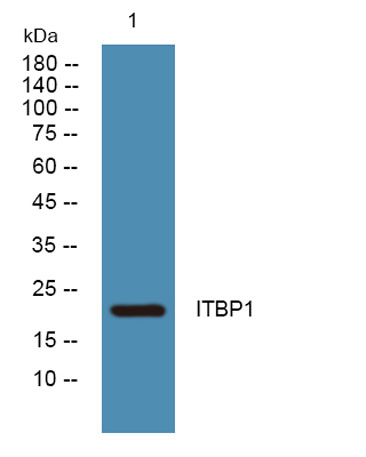
| Observed band (KD) | 22kD |
| Background | The cytoplasmic domains of integrins are essential for cell adhesion. The protein encoded by this gene binds to the beta1 integrin cytoplasmic domain. The interaction between this protein and beta1 integrin is highly specific. Two isoforms of this protein are derived from alternatively spliced transcripts. The shorter form of this protein does not interact with the beta1 integrin cytoplasmic domain. The longer form is a phosphoprotein and the extent of its phosphorylation is regulated by the cell-matrix interaction, suggesting an important role of this protein during integrin-dependent cell adhesion. Several transcript variants, some protein-coding and some non-protein coding, have been found for this gene. [provided by RefSeq, Jan 2016], |
| Function | function:May play a role in the recruitment of beta-1 integrins to the focal contacts during integrin-dependent cell adhesion. Isoform 2 does not bind the integrin cytoplasmic domain-associated protein-1.,PTM:Isoform 1 appears to be phosphorylated. The degree of phosphorylation is regulated by integrin-dependent cell-matrix interaction.,similarity:Contains 1 PID domain.,subunit:Interacts specifically with the beta-1 integrin cytoplasmic domain-associated protein-1.,tissue specificity:Expressed in intestine, colon, testis, ovary, thymus, spleen and prostate., |
| Subcellular location | Nucleus. Cytoplasm. Cytoplasm, cytoskeleton . Cell membrane . Cell projection, lamellipodium. Cell projection, ruffle. Nucleocytoplasmic shuttling protein; shuttles between nucleus and cytoplasm in a integrin-dependent manner; probably sequestered in the cytosol by ITGB1. Its localization is dependent on the stage of cell spreading on fibronectin; cytoplasmic in case of round cells, corresponding to the initial step of cell spreading, or nuclear in case of well spread cells. Colocalizes with ROCK1 and NME2 at beta-1 integrin engagement sites. Together with ITGB1 and NME2 is recruited to beta-1 integrin-rich peripheral ruffles and lamellipodia during initial cell spreading on fibronectin and/or collagen. |
| Expression | Expressed in endothelial cells and fibroblasts (at protein level). Ubiquitously expressed. Expressed in intestine, colon, testis, ovary, thymus, spleen and prostate. |

Use collapsible tabs for more detailed information that will help customers make a purchasing decision.
Ex: Shipping and return policies, size guides, and other common questions.