 Français
 English

| ELK.No | ES10849 |
| Product name | SUMO3 rabbit pAb |
| Reactivity | Human;Mouse;Rat |
| Applications | WB;ELISA |
| Other name | |
| Size | 100μL |
| Unit price ($) | 248 |
| Human gene ID | 6612 |
| Human Swiss-Prot | P55854 |
| Source | Rabbit |
| Isotype | IgG |
| Target | SUMO3 |
| Fields | >>Nucleocytoplasmic transport;>>Fluid shear stress and atherosclerosis |
| Gene name | SUMO3 SMT3B SMT3H1 |
| Protein name | Small ubiquitin-related modifier 3 (SUMO-3) (SMT3 homolog 1) (SUMO-2) (Ubiquitin-like protein SMT3B) (Smt3B) |
| Human gene link | |
| Human Swiss link | View Human Swiss-Prot |
| Mouse gene ID | |
| Mouse gene link | |
| Mouse Swiss-Prot | Q9Z172 |
| Mouse Swiss link | View Mouse Swiss-Prot |
| Rat gene ID | |
| Rat gene link | |
| Rat Swiss-Prot | Q5XIF4 |
| Rat Swiss link | View Rat Swiss-Prot |
| Immunogen | Synthesized peptide derived from part region of human protein AA range: 1-50 |
| Specificity | SUMO3 Polyclonal Antibody detects endogenous levels of protein. |
| Formulation | Liquid in PBS containing 50% glycerol, and 0.02% sodium azide. |
| Clonality | Polyclonal |
| Dilution | WB 1:500-2000 ELISA 1:5000-20000 |
| Purification | The antibody was affinity-purified from rabbit antiserum by affinity-chromatography using epitope-specific immunogen. |
| Concentration | 1 mg/ml |
| Storage stability | -20°C/1 year |
| Molecular Weight (Da) | |
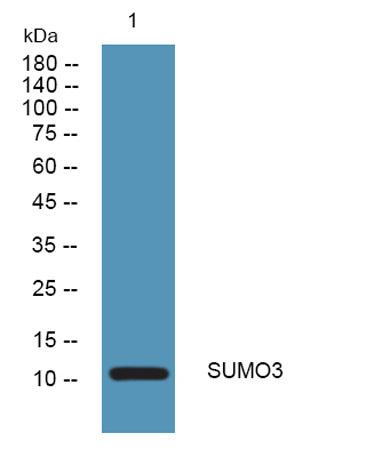
| Observed band (KD) | 11kD |
| Background | This gene encodes a member of the small ubiquitin-related modifier (SUMO) family of eukaryotic proteins. The encoded protein is covalently conjugated to other proteins via a post-translation modification known as sumoylation. Sumoylation may play a role in a wide variety of cellular processes, including nuclear transport, DNA replication and repair, mitosis, transcriptional regulation, and signal transduction. Alternatively spliced transcript variants encoding distinct proteins have been described. [provided by RefSeq, Feb 2014], |
| Function | function:Ubiquitin-like protein which can be covalently attached to target lysines either as a monomer or as a lysine-linked polymer. Does not seem to be involved in protein degradation and may function as an antagonist of ubiquitin in the degradation process. Plays a role in a number of cellular processes such as nuclear transport, DNA replication and repair, mitosis and signal transduction. Covalent attachment to its substrates requires prior activation by the E1 complex SAE1-SAE2 and linkage to the E2 enzyme UBE2I, and can be promoted by an E3 ligase such as PIAS1-4, RANBP2 or CBX4.,online information:SUMO protein entry,PTM:Cleavage of precursor form by SENP1 or SENP2 is necessary for function.,PTM:Cleavage of precursor form by SENP1, SENP2 or SENP5 is necessary for function.,PTM:Polymeric chains can be formed through Lys-11 cross-linking.,similarity:Belongs to the ubiquitin family. S |
| Subcellular location | Cytoplasm. Nucleus. Nucleus, PML body . |
| Expression | Expressed predominantly in liver. |

Use collapsible tabs for more detailed information that will help customers make a purchasing decision.
Ex: Shipping and return policies, size guides, and other common questions.