 Français
 English

| ELK.No | ES10934 |
| Product name | TEFF2 rabbit pAb |
| Reactivity | Human;Mouse |
| Applications | WB;ELISA |
| Other name | |
| Size | 100μL |
| Unit price ($) | 248 |
| Human gene ID | 23671 |
| Human Swiss-Prot | Q9UIK5 |
| Source | Rabbit |
| Isotype | IgG |
| Target | TEFF2 |
| Fields | |
| Gene name | TMEFF2 HPP1 TENB2 TPEF UNQ178/PRO204 |
| Protein name | Tomoregulin-2 (TR-2) (Hyperplastic polyposis protein 1) (Transmembrane protein with EGF-like and two follistatin-like domains) |
| Human gene link | |
| Human Swiss link | View Human Swiss-Prot |
| Mouse gene ID | |
| Mouse gene link | |
| Mouse Swiss-Prot | Q9QYM9 |
| Mouse Swiss link | View Mouse Swiss-Prot |
| Rat gene ID | |
| Rat gene link | |
| Rat Swiss-Prot | |
| Rat Swiss link | |
| Immunogen | Synthesized peptide derived from part region of human protein |
| Specificity | TEFF2 Polyclonal Antibody detects endogenous levels of protein. |
| Formulation | Liquid in PBS containing 50% glycerol, and 0.02% sodium azide. |
| Clonality | Polyclonal |
| Dilution | WB 1:500-2000 ELISA 1:5000-20000 |
| Purification | The antibody was affinity-purified from rabbit antiserum by affinity-chromatography using epitope-specific immunogen. |
| Concentration | 1 mg/ml |
| Storage stability | -20°C/1 year |
| Molecular Weight (Da) | |
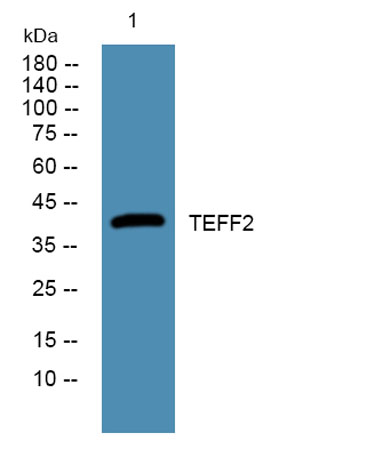
| Observed band (KD) | 41kD |
| Background | This gene encodes a member of the tomoregulin family of transmembrane proteins. This protein has been shown to function as both an oncogene and a tumor suppressor depending on the cellular context and may regulate prostate cancer cell invasion. Multiple soluble forms of this protein have been identified that arise from both an alternative splice variant and ectodomain shedding. Additionally, this gene has been found to be hypermethylated in multiple cancer types. Alternative splicing results in multiple transcript variants. [provided by RefSeq, Feb 2015], |
| Function | function:May be a survival factor for hippocampal and mesencephalic neurons. The shedded form up-regulates cancer cell proliferation, probably by promoting ERK1/2 phosphorylation.,induction:Down-regulated in tumor cell lines in response to a high level of methylation in the 5' region. The CpG island methylation correlates with TMEFF2 silencing in tumor cell lines.,PTM:A soluble form (TMEFF2-ECD) is produced by proteolytic shedding. This shedding can be induced by phorbol ester or proinflammatory cytokines such as TNFalpha, and is mediated by ADAM17.,PTM:N-glycosylated. Contains chondroitin sulfate glycosaminoglycans.,sequence caution:Contaminating sequence. Mitochondrial contamination starting in position 361.,similarity:Belongs to the tomoregulin family.,similarity:Contains 1 EGF-like domain.,similarity:Contains 2 Kazal-like domains.,tissue specificity:Highly expressed in adult and feta |
| Subcellular location | [Isoform 1]: Membrane ; Single-pass type I membrane protein .; [Isoform 2]: Membrane ; Single-pass type I membrane protein .; [Isoform 3]: Secreted. |
| Expression | Highly expressed in adult and fetal brain, spinal cord and prostate. Expressed in all brain regions except the pituitary gland, with highest levels in amygdala and corpus callosum. Expressed in the pericryptal myofibroblasts and other stromal cells of normal colonic mucosa. Expressed in prostate carcinoma. Down-regulated in colorectal cancer. Present in Alzheimer disease plaques (at protein level). Isoform 3 is expressed weakly in testis and at high levels in normal and cancerous prostate. |

Use collapsible tabs for more detailed information that will help customers make a purchasing decision.
Ex: Shipping and return policies, size guides, and other common questions.