 Français
 English

| ELK.No | ES10976 |
| Product name | PAEP rabbit pAb |
| Reactivity | Human;Rat;Mouse; |
| Applications | WB;ELISA |
| Other name | |
| Size | 100μL |
| Unit price ($) | 248 |
| Human gene ID | 5047 |
| Human Swiss-Prot | P09466 |
| Source | Rabbit |
| Isotype | IgG |
| Target | PAEP |
| Fields | |
| Gene name | PAEP |
| Protein name | Glycodelin (GD) (Placental protein 14) (PP14) (Pregnancy-associated endometrial alpha-2 globulin) (PAEG) (PEG) (Progestagen-associated endometrial protein) (Progesterone-associated endometrial protein |
| Human gene link | |
| Human Swiss link | View Human Swiss-Prot |
| Mouse gene ID | |
| Mouse gene link | |
| Mouse Swiss-Prot | |
| Mouse Swiss link | |
| Rat gene ID | |
| Rat gene link | |
| Rat Swiss-Prot | |
| Rat Swiss link | |
| Immunogen | Synthesized peptide derived from part region of human protein |
| Specificity | PAEP Polyclonal Antibody detects endogenous levels of protein. |
| Formulation | Liquid in PBS containing 50% glycerol, and 0.02% sodium azide. |
| Clonality | Polyclonal |
| Dilution | WB 1:500-2000 ELISA 1:5000-20000 |
| Purification | The antibody was affinity-purified from rabbit antiserum by affinity-chromatography using epitope-specific immunogen. |
| Concentration | 1 mg/ml |
| Storage stability | -20°C/1 year |
| Molecular Weight (Da) | |
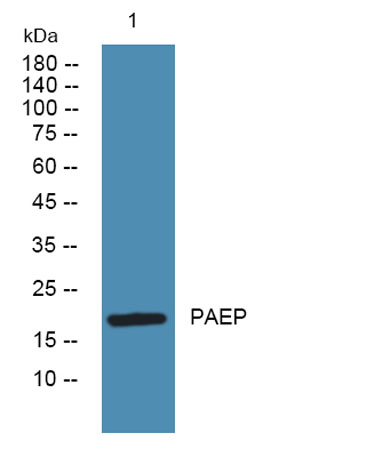
| Observed band (KD) | 19kD |
| Background | This gene is a member of the kernel lipocalin superfamily whose members share relatively low sequence similarity but have highly conserved exon/intron structure and three-dimensional protein folding. Most lipocalins are clustered on the long arm of chromosome 9. The encoded glycoprotein has been previously referred to as pregnancy-associated endometrial alpha-2-globulin, placental protein 14, and glycodelin, but has been officially named progestagen-associated endometrial protein. Three distinct forms, with identical protein backbones but different glycosylation profiles, are found in amniotic fluid, follicular fluid and seminal plasma of the reproductive system. These glycoproteins have distinct and essential roles in regulating a uterine environment suitable for pregnancy and in the timing and occurrence of the appropriate sequence of events in the fertilization process. Al |
| Function | function:This protein is, quantitatively, the main protein synthesized and secreted in the endometrium from mid-luteal phase of the menstrual cycle and during the first semester of pregnancy.,PTM:At least two differentially glycosylated forms are found. Glycodelin-A (GdA) (amniotic fluid) with contraceptive and immunosuppressive activities and glycodelin-S (Gds) (seminal plasma) whose role is not yet known. The gender-specific glycosylation may serve to regulate key process involved in human reproduction.,similarity:Belongs to the calycin superfamily. Lipocalin family.,subunit:Homodimer., |
| Subcellular location | Secreted . |
| Expression | This protein is, the main protein synthesized and secreted in the endometrium from mid-luteal phase of the menstrual cycle and during the first semester of pregnancy (PubMed:3667877). Glycodelin-A is expressed in amniotic fluid, endometrium/decidua and maternal serum (at protein level) (PubMed:3194393). Glycodelin-F is expressed in follicular fluid, luteinized granulosa cells and the oviduct (at protein level) (PubMed:12672671). Glycodelin-S is expressed in seminal plasma and seminal vesicles (at protein level) (PubMed:9239694). Glycodelin-C is detected in cumulus cells (at protein level), but cumulus cells do not synthesize Glycodelin-C but take up and convert glycodelin-A and -F vis glycan remodeling (PubMed:17192260). |

Use collapsible tabs for more detailed information that will help customers make a purchasing decision.
Ex: Shipping and return policies, size guides, and other common questions.