 Français
 English

| ELK.No | ES11052 |
| Product name | TP4A2 rabbit pAb |
| Reactivity | Human;Rat;Mouse |
| Applications | WB;ELISA |
| Other name | |
| Size | 100μL |
| Unit price ($) | 248 |
| Human gene ID | 8073 |
| Human Swiss-Prot | Q12974 |
| Source | Rabbit |
| Isotype | IgG |
| Target | TP4A2 |
| Fields | |
| Gene name | PTP4A2 PRL2 PTPCAAX2 BM-008 |
| Protein name | Protein tyrosine phosphatase type IVA 2 (EC 3.1.3.48) (HU-PP-1) (OV-1) (PTP(CAAXII)) (Protein-tyrosine phosphatase 4a2) (Protein-tyrosine phosphatase of regenerating liver 2) (PRL-2) |
| Human gene link | |
| Human Swiss link | View Human Swiss-Prot |
| Mouse gene ID | |
| Mouse gene link | |
| Mouse Swiss-Prot | O70274 |
| Mouse Swiss link | View Mouse Swiss-Prot |
| Rat gene ID | |
| Rat gene link | |
| Rat Swiss-Prot | Q6P9X4 |
| Rat Swiss link | View Rat Swiss-Prot |
| Immunogen | Synthesized peptide derived from part region of human protein |
| Specificity | TP4A2 Polyclonal Antibody detects endogenous levels of protein. |
| Formulation | Liquid in PBS containing 50% glycerol, and 0.02% sodium azide. |
| Clonality | Polyclonal |
| Dilution | WB 1:500-2000 ELISA 1:5000-20000 |
| Purification | The antibody was affinity-purified from rabbit antiserum by affinity-chromatography using epitope-specific immunogen. |
| Concentration | 1 mg/ml |
| Storage stability | -20°C/1 year |
| Molecular Weight (Da) | |
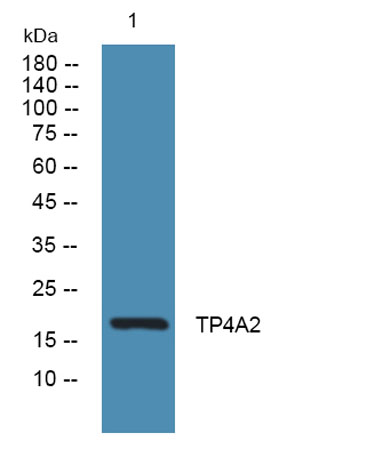
| Observed band (KD) | 18kD |
| Background | protein tyrosine phosphatase type IVA, member 2(PTP4A2) Homo sapiens The protein encoded by this gene belongs to a small class of the protein tyrosine phosphatase (PTP) family. PTPs are cell signaling molecules that play regulatory roles in a variety of cellular processes. PTPs in this class contain a protein tyrosine phosphatase catalytic domain and a characteristic C-terminal prenylation motif. This PTP has been shown to primarily associate with plasmic and endosomal membrane through its C-terminal prenylation. This PTP was found to interact with the beta-subunit of Rab geranylgeranyltransferase II (beta GGT II), and thus may function as a regulator of GGT II activity. Overexpression of this gene in mammalian cells conferred a transformed phenotype, which suggested its role in tumorigenesis. Alternatively spliced transcript variants have been described. Related pseudogenes exist on chromosomes 11, 12 and 17. [provided by RefSeq, Aug 2010], |
| Function | catalytic activity:Protein tyrosine phosphate + H(2)O = protein tyrosine + phosphate.,enzyme regulation:Inhibited by sodium orthovanadate and pentamidine.,function:Protein tyrosine phosphatase which stimulates progression from G1 into S phase during mitosis. Promotes tumors. Inhibits geranylgeranyl transferase type II activity by blocking the association between RABGGTA and RABGGTB.,miscellaneous:A processed pseudogene with 96% sequence identity was found in the BRCA1 (113705) region of 17q21.,PTM:Farnesylated. Farnesylation is required for membrane targeting and for interaction with RABGGTB. Unfarnesylated forms are redirected to the nucleus and cytosol.,similarity:Belongs to the protein-tyrosine phosphatase family.,similarity:Contains 1 tyrosine-protein phosphatase domain.,subunit:In contrast to PTP4A1 and PTP4A3, does not interact with tubulin. Interacts with RABGGTB.,tissue specifici |
| Subcellular location | Cell membrane. Early endosome. Cytoplasm. |
| Expression | Ubiquitously expressed, with highest levels in skeletal muscle, heart and thymus. Overexpressed in prostate tumor tissue. |

Use collapsible tabs for more detailed information that will help customers make a purchasing decision.
Ex: Shipping and return policies, size guides, and other common questions.