 Français
 English
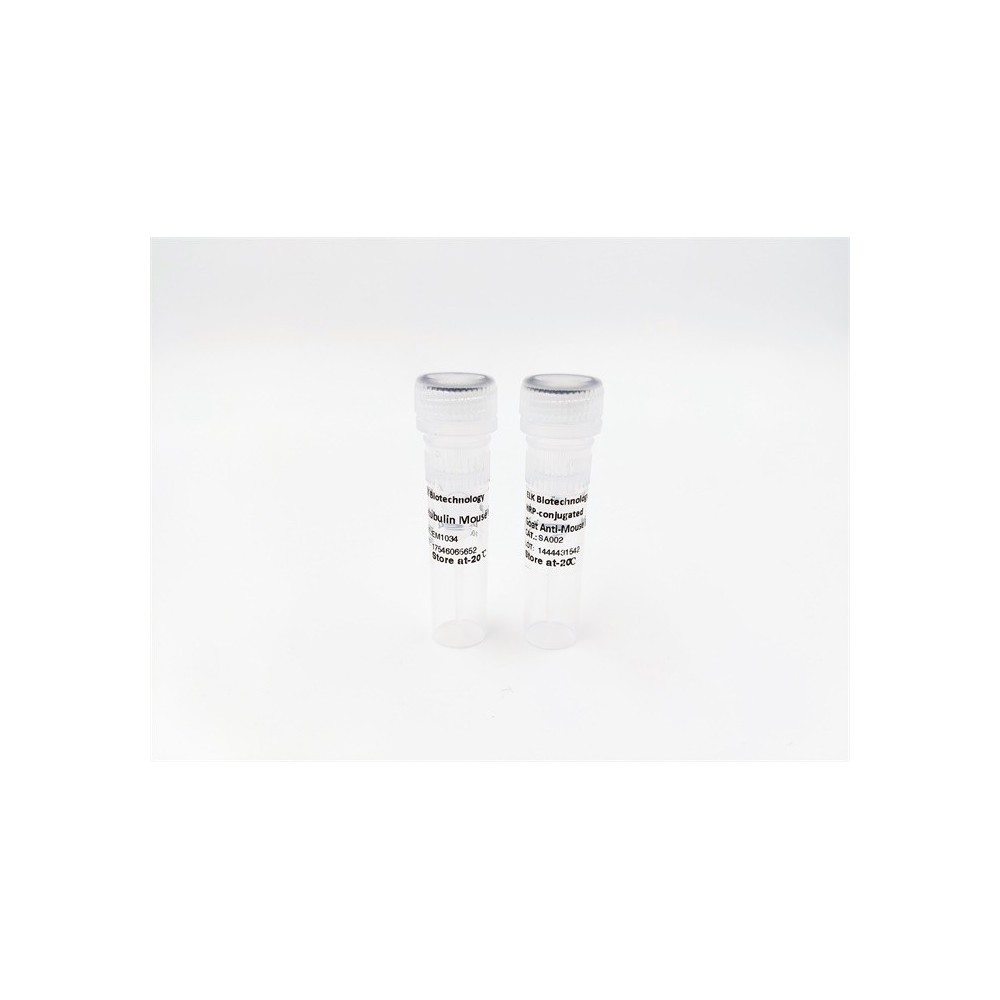

| ELK.No | ES11069 |
| Product name | GBLP rabbit pAb |
| Reactivity | Human;Rat;Mouse |
| Applications | WB;ELISA |
| Other name | |
| Size | 100μL |
| Unit price ($) | 248 |
| Human gene ID | 10399 |
| Human Swiss-Prot | P63244 |
| Source | Rabbit |
| Isotype | IgG |
| Target | GBLP |
| Fields | >>Measles |
| Gene name | GNB2L1 HLC7 PIG21 |
| Protein name | Guanine nucleotide-binding protein subunit beta-2-like 1 (Cell proliferation-inducing gene 21 protein) (Guanine nucleotide-binding protein subunit beta-like protein 12.3) (Human lung cancer oncogene 7 |
| Human gene link | |
| Human Swiss link | View Human Swiss-Prot |
| Mouse gene ID | |
| Mouse gene link | |
| Mouse Swiss-Prot | P68040 |
| Mouse Swiss link | View Mouse Swiss-Prot |
| Rat gene ID | |
| Rat gene link | |
| Rat Swiss-Prot | P63245 |
| Rat Swiss link | View Rat Swiss-Prot |
| Immunogen | Synthesized peptide derived from part region of human protein |
| Specificity | GBLP Polyclonal Antibody detects endogenous levels of protein. |
| Formulation | Liquid in PBS containing 50% glycerol, and 0.02% sodium azide. |
| Clonality | Polyclonal |
| Dilution | WB 1:500-2000 ELISA 1:5000-20000 |
| Purification | The antibody was affinity-purified from rabbit antiserum by affinity-chromatography using epitope-specific immunogen. |
| Concentration | 1 mg/ml |
| Storage stability | -20°C/1 year |
| Molecular Weight (Da) | |
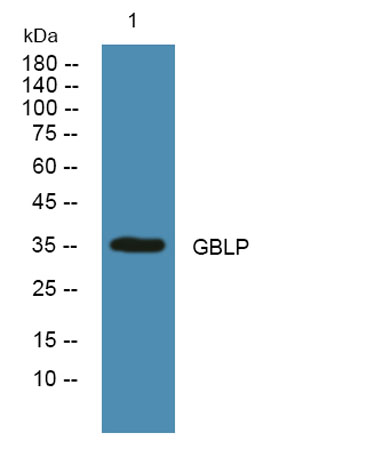
| Observed band (KD) | 34kD |
| Background | domain:The WD repeats domain 5 mediates interaction with TRIM63.,function:Seems to bind protein kinase C acting as an intracellular receptor to anchor the activated PKC to the cytoskeleton. May be involved in up-regulation of the activity of kinases such as PKC via binding to KRT1. Together with KRT1 and ITGB1, serves as a platform for SRC activation or inactivation. May play an important role in the developing brain and neuronal differentiation.,similarity:Belongs to the WD repeat G protein beta family.,similarity:Contains 7 WD repeats.,subcellular location:Located on plasma membrane of neuroblastoma NMB7 cells.,subunit:Binds SLC9A3R1. Forms a ternary complex with TRIM63 and PRKCE. Interacts with HABP4 and KRT1., |
| Function | domain:The WD repeats domain 5 mediates interaction with TRIM63.,function:Seems to bind protein kinase C acting as an intracellular receptor to anchor the activated PKC to the cytoskeleton. May be involved in up-regulation of the activity of kinases such as PKC via binding to KRT1. Together with KRT1 and ITGB1, serves as a platform for SRC activation or inactivation. May play an important role in the developing brain and neuronal differentiation.,similarity:Belongs to the WD repeat G protein beta family.,similarity:Contains 7 WD repeats.,subcellular location:Located on plasma membrane of neuroblastoma NMB7 cells.,subunit:Binds SLC9A3R1. Forms a ternary complex with TRIM63 and PRKCE. Interacts with HABP4 and KRT1., |
| Subcellular location | Cell membrane ; Peripheral membrane protein. Cytoplasm . Cytoplasm, perinuclear region . Nucleus . Perikaryon . Cell projection, dendrite . Cell projection, phagocytic cup . Recruited to the plasma membrane through interaction with KRT1 which binds to membrane-bound ITGB1 (PubMed:17956333). Also associated with the membrane in oncogene-transformed cells (PubMed:11884618). PKC activation induces translocation from the perinuclear region to the cell periphery (PubMed:11279199). In the brain, detected mainly in cell bodies and dendrites with little expression in axonal fibers or nuclei (By similarity). Localized to phagocytic cups following infection by Y.pestis (PubMed:21347310). . |
| Expression | In the liver, expressed at higher levels in activated hepatic stellate cells than in hepatocytes or Kupffer cells. Up-regulated in hepatocellular carcinomas and in the adjacent non-tumor liver tissue. |

Use collapsible tabs for more detailed information that will help customers make a purchasing decision.
Ex: Shipping and return policies, size guides, and other common questions.