 Français
 English

| ELK.No | ES11127 |
| Product name | RAP1A rabbit pAb |
| Reactivity | Human;Rat;Mouse |
| Applications | WB;ELISA |
| Other name | |
| Size | 50μL |
| Unit price ($) | 148 |
| Human gene ID | 5906 |
| Human Swiss-Prot | P62834 |
| Source | Rabbit |
| Isotype | IgG |
| Target | RAP1A |
| Fields | >>MAPK signaling pathway;>>Ras signaling pathway;>>Rap1 signaling pathway;>>cAMP signaling pathway;>>Chemokine signaling pathway;>>Focal adhesion;>>Tight junction;>>Platelet activation;>>Leukocyte transendothelial migration;>>Long-term potentiation;>>Neurotrophin signaling pathway;>>Cushing syndrome;>>Pancreatic secretion;>>Renal cell carcinoma;>>Lipid and atherosclerosis |
| Gene name | RAP1A KREV1 |
| Protein name | Ras-related protein Rap-1A (C21KG) (G-22K) (GTP-binding protein smg p21A) (Ras-related protein Krev-1) |
| Human gene link | |
| Human Swiss link | View Human Swiss-Prot |
| Mouse gene ID | |
| Mouse gene link | |
| Mouse Swiss-Prot | P62835 |
| Mouse Swiss link | View Mouse Swiss-Prot |
| Rat gene ID | |
| Rat gene link | |
| Rat Swiss-Prot | P62836 |
| Rat Swiss link | View Rat Swiss-Prot |
| Immunogen | Synthesized peptide derived from part region of human protein |
| Specificity | RAP1A Polyclonal Antibody detects endogenous levels of protein. |
| Formulation | Liquid in PBS containing 50% glycerol, and 0.02% sodium azide. |
| Clonality | Polyclonal |
| Dilution | WB 1:500-2000 ELISA 1:5000-20000 |
| Purification | The antibody was affinity-purified from rabbit antiserum by affinity-chromatography using epitope-specific immunogen. |
| Concentration | 1 mg/ml |
| Storage stability | -20°C/1 year |
| Molecular Weight (Da) | |
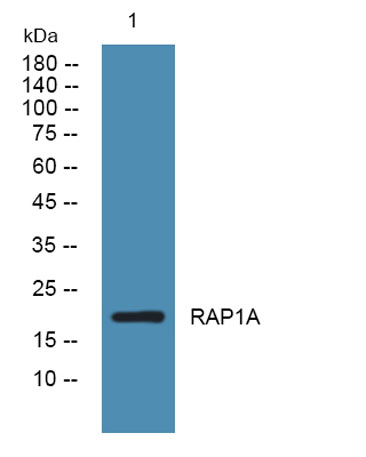
| Observed band (KD) | 20kD |
| Background | This gene encodes a member of the Ras family of small GTPases. The encoded protein undergoes a change in conformational state and activity, depending on whether it is bound to GTP or GDP. This protein is activated by several types of guanine nucleotide exchange factors (GEFs), and inactivated by two groups of GTPase-activating proteins (GAPs). The activation status of the encoded protein is therefore affected by the balance of intracellular levels of GEFs and GAPs. The encoded protein regulates signaling pathways that affect cell proliferation and adhesion, and may play a role in tumor malignancy. Pseudogenes of this gene have been defined on chromosomes 14 and 17. Alternative splicing results in multiple transcript variants. [provided by RefSeq, May 2014], |
| Function | enzyme regulation:Activated by guanine nucleotide-exchange factors (GEF) EPAC and EPAC2 in a cAMP-dependent manner, and GFR.,function:Induces morphological reversion of a cell line transformed by a Ras oncogene. Counteracts the mitogenic function of Ras, at least partly because it can interact with Ras GAPs and RAF in a competitive manner.,similarity:Belongs to the small GTPase superfamily. Ras family.,subunit:In its GTP-bound form interacts with PLCE1 and RADIL. Interacts with SGSM1, SGSM2 and SGSM3., |
| Subcellular location | Cell membrane ; Lipid-anchor . Cytoplasm . Cytoplasm, perinuclear region . Cell junction . Early endosome . Recruited from early endosome to late endosome compartment after nerve growth factor (NGF) stimulation. Localized with RAPGEF2 at cell-cell junctions (By similarity). Colocalized with RAPGEF2 in the perinuclear region. . |
| Expression | Brain,Platelet,Skin,Uterus, |

Use collapsible tabs for more detailed information that will help customers make a purchasing decision.
Ex: Shipping and return policies, size guides, and other common questions.